Monthly Archives: November 2008

The Banat Nura of Ali Pasha Sherif

Copyright © 1995 R.J. Cadranell II
originally published in The CMK Record Spring 1995 XI/2
used by permission

BINT NURA GSB a chestnut foaled about 1885 and bred by Ali Pasha Sherif, is widely influential through her sons KAUKAB, DAOUD and MAHRUSS GSB. This mare’s great elegance still is reflected in her modern descendants. (NBGS)

“Zeyd… offered 100 and 150, whereupon Ali Pasha exclaimed, ‘Ho, ho, ho! one hoof of the bint Nura is worth 100 pounds.'” — Lady Anne Blunt, Journals and Correspondence

Horses from the family of NURA consistently attracted Lady Anne Blunt’s attention, from her earliest visit to the Cairo stables of Ali Pasha Sherif. As Mr. Wilfrid and Lady Anne Blunt began to acquire more and more of Ali Pasha Sherif’s horses for their own studs at Crabbet and Sheykh Obeyd, the NURA line was frequently in the pedigrees.

Lady Anne Blunt first saw the Ali Pasha Sherif horses in 1880. Among them were two “banat Nura” (daughters of NURA in the usage that daughters, granddaughters, and great-granddaughters are all “daughters” of an original mare):

…we saw 2 bay Doheymeh Nejib mares difficult to choose between. The more interesting at first is a 5 year old, bright full bay (like Kars) with 2 white hind feet and small star. Her crest, wither and shoulder exaggerated like the portraits of the Godolphin Arabian. She is a picture and at a little distance very like Kars. The other mare was darker bay and altogether I think the best. Legs stouter and more muscle. She is 6 or 7 – a daughter of a celebrated D.N. mare called Nurah who died of the disease when this mare was 2 yrs. old [i.e. in about 1875-6]. The first bay is a grand-daughter of Nurah. Both of these are daughters of Vizir [Wazir]. The younger one has a head like Jasmine [Dajania] and Kars. 25 Nov: 1880.

On the occasion of another visit, she commented on three banat Nura:

The three daughters of Nura the Doheymeh Najib, have two of them got foals within the last fortnight. The beautiful bay I admire more than ever. [If this mare is the bay with the Godolphin crest – and the markings described, the comparison to Kars, and “I admire more than ever” comment indicate that she is – Lady Anne was apparently incorrect in 1880 when she recorded her as a granddaughter of Nura.] Her colt foal is 8 days old, a bay with no white by Shueyman. She has a narrow white mark on the forehead and two white hind feet to above fetlock and the finest head I ever saw. Her sire Vizir [Wizir]. The brown mare her half sister (daughter to Shueyman) [ if this is the same “darker bay” Nura mare described in 1880, Lady Anne was apparently incorrect when she recorded her as a daughter of Wazir] has a colt by the Dahman horse [ Aziz}…. there is a third daughter of Nura, a white mare, but I did not care for her so much as the other two. If we could ever get the bay it would be the glory of the stud. She is exactly the color of Kars (though less black points). 3 Dec: 1881.

Just a few months later, Lady Anne wanted to know whether Ali Pasha Sherif would sell either of the bay NURA mares. She sent an emissary to inquire surreptitiously.

Zeyd…went to Ali Pasha Sherif to inquire, as we supposed, privately, whether his Excellency would be disposed to sell one or both of the bay daughters of Nura (Doheymeh Nejib). But Zeyd was no match for the Pasha, let the cat out of the bag at the first question and then offered 100 and 150, whereupon Ali Pasha exclaimed “Ho, ho, ho! one hoof of the bint Nura is worth 100 pounds.” … I told Zeyd he had no business to tell Ali Pasha who had asked him to enquire about the mares, it would be time for that if the Pasha wished to sell. 15 Feb:1882.

During this trip to Egypt the Blunts apparently made their last visit to Ali Pasha’s stables before they were barred from entering Egypt in 1883. In 1887 they were able to return to Egypt, but do not appear to have visited Ali Pasha’s stables. In December of 1888 the Blunts were again in Egypt, and saw the Ali Pasha Sherif horses for the first time in about seven years. The NURA family had grown:

There was a bay black points – if white on feet very little, can’t remember, something like Kars but rather small hocks….He had a star. They said he was five years old. I suppose 6 next spring which would make it fit with his being the foal of the bay Doheymeh Nejib saw in 1882….we found he was by Aziz. I thought hocks small but no defect. Head very fine, carriage of tail also, remarkably good feet. Then No. 2 a brother of the above, also bay – 2 years I think. Perfect head better than proceeding. Legs look as if they would be stouter.

…a grey Dahman with very beautiful head and good legs, back, not quite so strong in back….really lovely little horse [Probably IBN NURA, who would have been about 12 and whose head Lady Anne consistently admired.]

a brown…with star, I forget if any other white. Her last year’s foal same color also star – very rough coat – foal by…Aziz….The mare I understood to be the daughter of the brown Dahmeh (or Doheymeh) Nejib we saw in 1882 – her dam I was told is dead.

…the bay Doheymeh..with a last year’s foal a chestnut of course the Dahman’s. This mare I think called Nura. She is a wreck of her former self, the crest like the Godolphin Arabian has gone, nothing but the immensely high wither remains – light of bone, nevertheless I should not mind having her!

This Doheymeh Nejib must be about 12 years old….a lovely chestnut mare also Doheymeh Nejib, daughter of the white D.N. we saw (now dead). She is very fine. 19 Dec: 1888.

IBN NURA, shown here as an old horse with the young Judith Blunt, was a sire for Ali Pasha Sherif and for the Blunts at Sheykh Obeyd. His most influential offspring was FEYSUL. (NBGS)

The Blunts were to acquire the blood of the NURA family through a mare they registered in Weatherby’s General Stud Book as “BINT NURA” and a stallion they entered in Sheykh Obeyd records as “IBN NURA.” In addition to BINT NURA and IBN NURA themselves, the Blunts also purchased two sons of BINT NURA, four daughters and a son of IBN NURA, and a grandson of both.

From published sources, the pedigree connections are not entirely clear between the IBN NURA and BINT NURA owned by the Blunts and the mares Lady Anne enthusiastically described on her early visits to Ali Pasha’s stud. A photograph of a Blunt herdbook entry[1] describes IBN NURA as “a fleabitten White Dahman Nejib his dam Bint Nura a bay Dahmeh Nejiba by [illegible in reproduction] out of Nura a grey Dahmeh Nejiba….” Lady Anne consistently dated the bright bay mare with the Godolphin crest to approximately 1875 or 1876 – too young to have been the dam of her IBN NURA, whom she also dated to about 1876. Ali Pasha’s “darker bay” BINT NURA mare (apparently by Shueyman) would have been old enough to have produced IBN NURA as her first foal – especially if she was 7 and not 6 in 1880, and if IBN NURA was foaled closer to 1877 than 1876. But pedigree information Upton took from Blunt notes [DH p. 48) describes the dam of IBN NURA as BINT NURA, a bay mare by ZOBEYNI and out of NURA. A mare of this description does not seem to have been recorded in the Journals — although it is possible she had been sold or died before Lady Anne first visited Ali Pasha.

Upton (DH p. 108), working from Blunt records, gives the dam of BINT NURA (GSB) as a bay mare by ZOBEYNI and out of NURA. The tables in Arabian Horse Families of Egypt (p. xxxi), also compiled from Blunt notes, list IBN NURA and BINT NURA (GSB) as both out of the same bay BINT NURA, by ZOBEYNI x NURA.

MAHRUSS GSB (Mahruss x Bint Nura GSB), sire of the influential RIJM and the American *IBN MAHRUSS 22 from his very few opportunities at stud (NBGS)

Listed in order of acquisition, the NURA descendants the Blunts purchased were:

  1. MAHRUSS, purchased from Ali Pasha Sherif on January 7, 1896. He was a son of the BINT NURA Lady Anne was to acquire in 1897. MAHRUSS arrived in England in May of 1897. His breeding opportunity, as seen in GSB, was limited. In 1898 MAHRUSS covered four mares. All were barren except BADIA, whose 1899 colt broke a leg and was destroyed as a foal. MAHRUSS does not appear to have been used at all in 1899. In 1900 he covered five mares and was then sold from Crabbet. Three of these last five mares were barren, one was sent to the United States carrying a colt (registered as *IBN MAHRUSS 22, and an influence in American pedigrees), and one produced a 1901 colt named RIJM. “It would be well to have more of Mahruss’s stock,” Lady Anne commented, but RIJM was to be his sole representative at Crabbet. RIJM was a favorite of all the Blunts, and started his breeding career in 1905. His get include the sires *NASIK and *Nureddin II, and the broodmares NESSIMA, *RIJMA, FEJR, JAWI-JAWI, and BELKA. In Australia his son FAKREDDIN has pedigree influence.

    FULANA and her daughters produced at Crabbet but in the long run she has remained in pedigrees only via her very handsome MESAOUD son FARAOUN, brother to the filly shown. He sired important mares in Australia. (NBGS)

  2. FULANA (Bint Bint Fereyha el Saghira) and
  3. ABU KHASHEB were purchased from Ali Pasha Sherif on December 14, 1896. ABU KHASHEB, full brother to MAHRUSS, was imported to England in 1898, but does not appear to have been used at stud prior to his sale to India in 1901. FULANA was a daughter of IBN NURA, and imported to England in 1897. Her family bred at Crabbet until 1911, but the only modern pedigree connection is through her son FARAOUN (by MESAOUD), a widespread influence in Australia.
  4. IBN NURA was purchased at auction January 15, 1897 when he was about 21 years of age. “Magnificent horse, head splendid and splendidly set on; neck shoulder and style perfection.” IBN NURA was apparently the only sire used at Sheykh Obeyd (except on his own daughters and BINT NURA) during the 1897, 98, and 99 breeding seasons, whether a mare was on her way to England or to remain in Egypt.
    Of the 11 or more foals that could have been expected, there were but two born: MAKBULA foaled a grey IBN NURA colt at Newbuildings (in 1899 according to GSB) in what must have been one of those ordeals every breeder fears: “Foal dead, mare nearly dead,” Lady Anne recorded in herdbook records. The other IBN NURA foal was born at Sheykh Obeyd: an 1898 grey filly named WUJRA, out of BINT FEREYHA, and thus a full sister to FULANA. WUJRA was dam of a colt that died at ten months, and then on February 1st of 1904 a stillborn filly. A week later WUJRA herself was dead, apparently of complications related to foaling. It was a “great loss. She is the youngest daughter of Ibn Nura, she was also perfect to ride…And her temper was of the best.”
    During the 1900 breeding season at Sheykh Obeyd IBN NURA covered only one mare, WUJRA’s dam, but once again it was a barren breeding. The other three mares bred in 1900 all went to FEYSUL. Thereafter IBN NURA was a pensioner at Sheykh Obeyd, where he died in the spring of 1903.
  5. BINT NURA (Bint Bint Nura es Shakra) and
  6. GHAZIEH (Bint Bint Horra) were purchased at auction March 26, 1897. BINT NURA was sent to England in May that year. For Ali Pasha Sherif she had produced MAHRUSS and ABU KHASHEB, as well as one of two colts by IBN SHERARA (one of these, an 1890 grey, was bred to JOHARAH). At Crabbet BINT NURA promptly produced three more colts. DEM-DEM (1900) and DURRAJ (1902) were sold, but DAOUD (1899) was a favorite of Lady Anne’s and a sire for her. In 1903 BINT NURA, along with NEFISA and ROSE OF SHARON, became one of Crabbet’s three oldest mares; BOZRA had died and JOHARA and BADIA were given away in 1903. Like some older mares, BINT NURA became a problem breeder. She produced just one more foal — a 1906 filly by HARB, which died. Among her barren breedings was one to her grandson RIJM. She was put down in 1912. DAOUD and RIJM were BINT NURA’s only breeding ties to later Crabbet pedigrees. DAOUD’s get included NASRA, SOMRA, NADIMA (exported to Argentina), MARHABA, SARAMA (dam of *SIMAWA), RUDEYNA and *RASIMA.
    GHAZIEH, an IBN NURA daughter bred by Ali Pasha Sherif, remained at Sheykh Obeyd where she became a broodmare. Her son GHAREB was used for breeding there, was were her daughters GHAZWA and FEYDA. After Lady Anne Blunt died, FEYDA found her way to the stud of Prince Kamel el Dine. He bred her son IBN FAYDA (by IBN RABDAN), a sire at the Inshass Stud. Through IBN FAYDA, GHAZIEH has a presence in “New Egyptian” pedigrees.

    JELLABIEH, daughter of IBN NURA, was closely related to FEYSUL – some references would have them full brother and sister. She produced in England but the line did not persist. This photo carries its own story. It was published in Lady Wentworth’s Thoroughbred Racing Stock, specifically as an individual bred by Ali Pasha Sherif and of the Jellabieh strain. The background is English. The Blunts imported only two grey Jellabiehs. The other MAKBULA, was always referred to as “white” and clearly appears so in her one photo, taken two years after importation. This mare still showing grey on her legs would by process of elimination, be JELLABIEH. (This also appears to be the photo on which Peter Upton modeled his painting of that mare.)

  7. JELLABIEH, an IBN NURA daughter bred by Ali Pasha Sherif, was purchased December 10, 1897 from Ayub Bey. She was imported to Crabbet in 1898. JELLABIEH produced four foals at Crabbet from 1899 to 1902 (none of which carriedc her family into another generation), and then spent some time in the ownership of Lady Anne’s brother Ralph, Lord Lovelace. When Lord Lovelace died in 1906, JELLABIEH returned to Crabbet. She produced *BERK fillies in 1908 and 1910 for Lady Anne and was sold to Musgrave Clark in 1912 carrying a third *BERK filly, JERAWA (1908) produced at least one foal (which died) before she was exported. JASK (1910) was sold by Lady Anne Blunt and repurchased by her daughter, Lady Wentworth, in 1918 or 1919, carrying JELLAL, by RIYAL. Lady Wentworth sold both JASK and her son JELLAL abroad. According to Colin Pearson, JASK may have left a line in South American pedigrees.

    FEYSUL sired such important individuals as GHADIA at Sheykh Obeyd and RASIM at Crabbet. (NBGS; thanks to Betty Finke for custom print work.)

  8. FEYSUL, an IBN NURA son bred by Ali Pasha Sherif, was acquired December 7, 1898. By 1900 it was becoming clear that old IBN NURA had a chronic fertility problem, and FEYSUL was promoted to head sire at Sheykh Obeyd, a position he held until he was sent to Crabbet in 1904 with his son IBN YASHMAK. FEYSUL’s sons FERID, GHADIR, and GHAREB were all, used for breeding at Sheykh Obeyd (although just briefly), as were his daughters GHAZWA and GHADIA, and GHADIA’s daughter ZARIFA. Lady Anne presented GHADIA to the Royal Agricultural Society in 1917, where she was listed as RADIA, and influenced Egyptian pedigrees enormously through her daughter BINT RADIA (dam of SHAHLOUL, ZAMZAM, SAMIRA and HAMDAN). ZARIFA was another who went to Prince Kemal el Dine after Lady Anne died. The Prince bred a daughter of hers who went to the Inshass Stud and founded a large family there.
    At Crabbet FEYSUL and IBN YASHMAK were both used for breeding. Among FEYSUL’s get in England were RASIM (a sire at Crabbet) and AAJMAN (a sire in South America). IBN YASHMAK was part of the Newbuildings Half, where breeding opportunity was more limited than in the Crabbet Half. His get included AMIDA, AJJAM, *NAFIA, *FELESTIN, *RIZVAN and RAZIEH (BINT RISSALA in Egypt).
  9. AZZ was an IBN NURA daughter bred by Ali Pasha Sherif. Lady Anne Blunt purchased her in May of 1906 from Ali Pasha’s son, Osman Bey Sherif, but it was not until November, 1909 that she found out “Osman Bey swindled us as he knew that the mare had been hurt at last foaling.” Lady Anne sent AZZ to Crabbet in 1910, but she never produced another foal and was put down in 1916.
  10. SAHAB was a son of KAUKAB and AZZ bred by Osman Bey Sherif and foaled in 1903. Lady Anne Blunt bought him from Timur Bey in November, 1909, at about the same time she learned of the foaling accident of his dam. SAHAB was out of a daughter of IBN NURA and by a son of BINT NURA — apparently the BINT NURA owned by Lady Anne. When she saw KAUKAB she noted in her journal for February 20, 1914: “what style, the quarter splendid (I wish Sahab had inherited that)…Kaukab is son of B.Nura, and there is in him much to recall her – a perfect head.” SAHAB was used as a sire at Sheykh Obeyd from shortly after his arrival until Lady Anne’s death in 1917. He has Egyptian descent through his daughter ZARIFA (out of FEYSUL’s daughter GHADIA, thus with three NURA lines), his daughter SERRA (out of JEMLA, and dam of *BINT SERRA I and RASALA), and his daughter JAZIA (out of JAUZA and dam of GHANDOUR).
  1. [1]Desert Heritage: An Artist’s Collection of Blunt’s Original Arab Horses, p. 8

The South American Arabian Pedigree FAQ

by Robert J. Cadranell with Michael Bowling

Originally published in Arabian Visions, January-February 1997
Revised January 2005

Horses in South America were part of the deadlock between the Arabian Horse Registry of America (AHRA) and the World Arabian Horse Association (WAHO). This article answers some frequently asked questions about the South American horses.

The AHRA mentioned thousands of horses in South America with bloodlines it would not recognize as purebred Arabian. Which South American foundation horses are in question?

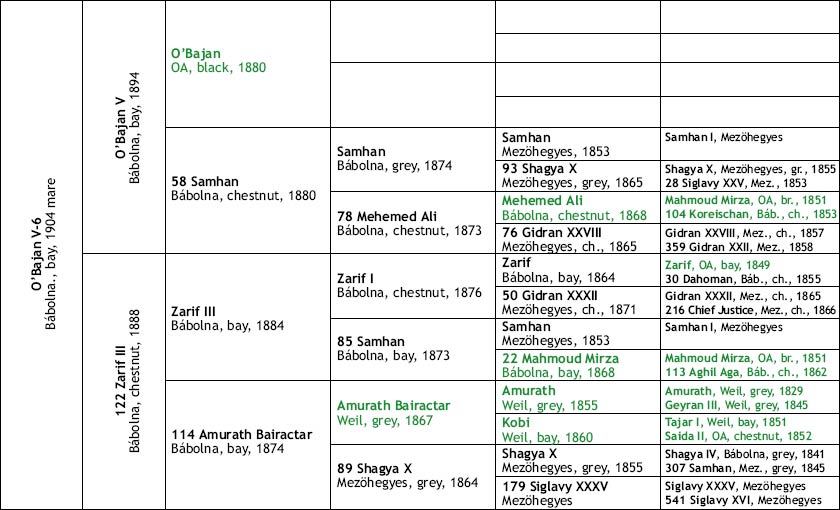
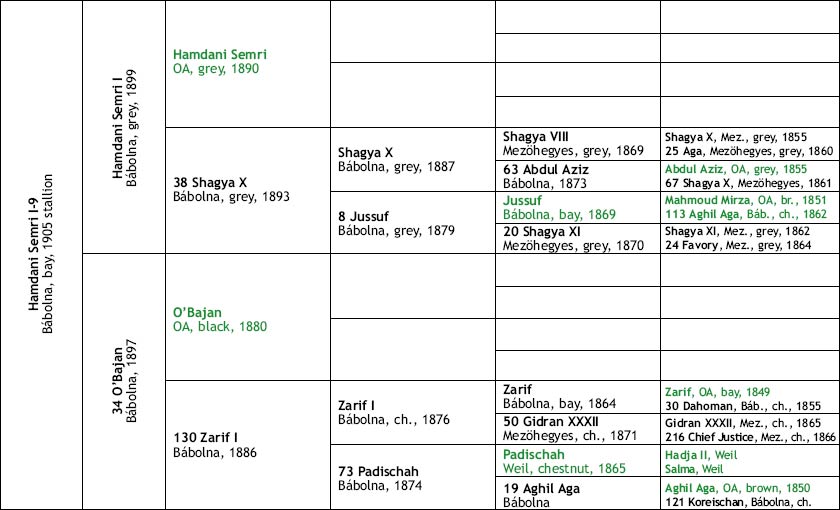
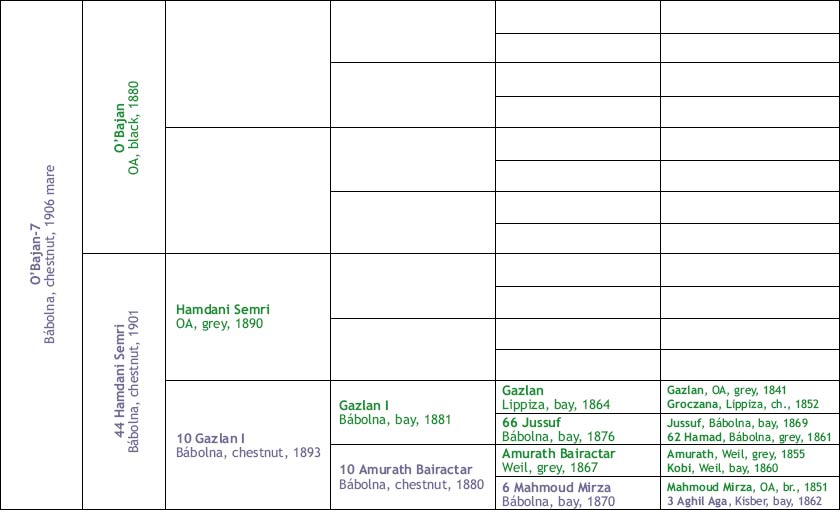
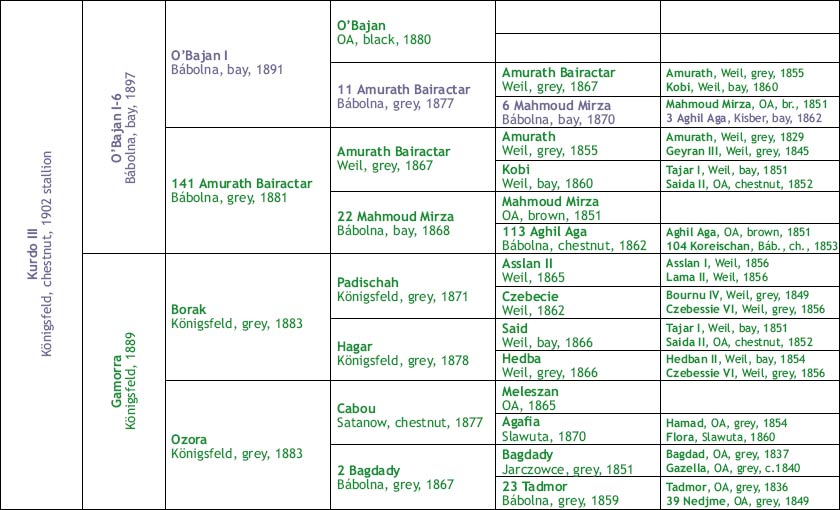
The foundation horses are O’Bajan V-6, Hamdani Semri I-9, O’Bajan-7, and Kurdo III. The first three were bred at the Babolna state stud in Hungary. Kurdo III was the son of a horse from Babolna. These four horses were imported to South America in the years just prior to World War I.

Babolna breeding is in the pedigrees of many Arabians in the U.S., including *Bask, Bey Shah, and Khemosabi. What makes these Babolna bloodlines in South America different?

In 1789, the Austro-Hungarian government established at Babolna a branch of its military horse breeding. In 1816, two desert bred Arabians arrived at Babolna: the stallion Siglavy Gidran and the mare 74 Tifle. Among the horses fostered at Babolna since then is a herd of purebred Arabians, which are designated in Hungarian Arab teliver horses (the German language equivalent is Arab vollblut, literally “Arab fullblood”).

Babolna’s Arabian purebreds were always outnumbered by its Arabian partbreds, known in Hungarian as Arab fajta horses. The Germans call them Araber rasse. In earlier years, Americans used the term “Grade Arab” to describe these horses. The words Grade Arab are used, for example, in a 1946 U.S. Army Remount catalogue to describe *275 Shagya XXV and *52 Gazal II, among others.

The nomenclature used at Babolna was also in place at other Austro-Hungarian state studs, like Radautz and Mezoehegyes. The handwritten pedigrees reproduced in Hans Brabanetz’s book about Radautz illustrate usage in German. Among partbreds, the male line determines the rasse of the foal. Partbreds descending in tail male line from a purebred Arabian stallion are “arab. Rasse.” Partbreds from the male line of the Norman import Nonius are “norm. Rasse,” just as partbreds by a Kladruber stallion are “Kladr. Rasse.”

Today, a number of distinct breeds have crystallized from the Hungarian partbred stocks. Among these are the Shagya and the Gidran, each named after an imported desert bred Arabian stallion who founded a prominent sire line. Both breeds aim to combine the intelligence, endurance, and hardiness of the Arabian with more bone, size, substance, and a larger frame. The Austro-Hungarian pedigrees carefully note the breed and origin of the early foundation stock. Behind Shagya X (1855), for example, are Arabian, Spanish, and Nonius ancestors. The pedigree of Gidran XXVIII (1857) includes Arabian, Lippizzaner, Nonius, Spanish, and English Thoroughbred ancestry.

Laszlo Monostory, former commanding officer of the Hungarian state stud Alsozsuk, mentions another category of horses recognized in Hungary, which he calls in English “Anglo-Arab purebreds.” These combine Arabian and Thoroughbred blood only. According to Monostory, in the records of the Hungarian state studs such horses were recorded in purple ink, while purebred Arabians were recorded in green ink, English Thoroughbreds in red ink, and partbreds in black ink. In his book on Babolna, Dr. Hecker mentions that a slightly different color coding system was used during the 19th century.

To return to the South American horses, O’Bajan V-6 and Hamdani Semri I-9 were Arab fajta horses. Kurdo III and O’Bajan-7 each have one line to an English Thoroughbred mare named 30 Maria.

How does the Babolna naming system work?

Foundation horses imported to Hungary were given their own names. For example, the black stallion O’Bajan, bred by the Sebaa tribe, was imported from the desert in 1885.

Babolna foals are given the name of their sire followed by a foal number indicating order of birth during a given year. Thus O’Bajan foals born during 1906 were named O’Bajan-1, O’Bajan-2, O’Bajan-3, O’Bajan-4, etc.

When mares enter the broodmare band, they are given broodmare numbers in front of their name, and the foal numbers are usually dropped. The many broodmare daughters of O’Bajan included 22 O’Bajan and 124 O’Bajan. If a mare dies or is sold from Babolna, her broodmare number is reassigned to a young mare entering the broodmare band.

When stallions are promoted to chief sires at Babolna, the foal number is replaced by a Roman numeral indicating order of coming into service. Several sons of O’Bajan stood at Babolna: O’Bajan I started in 1895, O’Bajan II in 1897, O’Bajan III in 1902, O’Bajan IV in 1903, and then O’Bajan V. The next sire of this line, O’Bajan VI, was a son of O’Bajan V. Recently Babolna has used O’Bajan XXIV, foaled in 1997.

Just as with the original O’Bajan, foals of these later horses are named after their sire, e.g. O’Bajan V-1, O’Bajan V-2, etc. Babolna stallions can also be assigned to state-owned stallion depots and given a number in front of the name. The 1954 colt O’Bajan X-5 became 4604 O’Bajan X-5.

Sometimes exceptions were made. The breeding sons of Mahmoud Mirza included Jussuf, Mehemed Ali, and Kara Mirza. The desert bred O’Bajan had a breeding son named Dzsingiskhan. Also, if a sire line disappeared from Babolna for several generations and was later reintroduced from another Hungarian government farm, the new horse might be unnumbered, e.g. Gidran or Samhan. Note also that Shagya X at Mezoehegyes, Shagya X at Babolna, and Shagya X at Radautz were three different horses. To further complicate things, if a stallion was moved from one farm to another, he was usually renumbered. Thus Shagya XVII at Mezoehegyes was known as Shagya VIII after transfer to Babolna.

Who was 30 Maria?

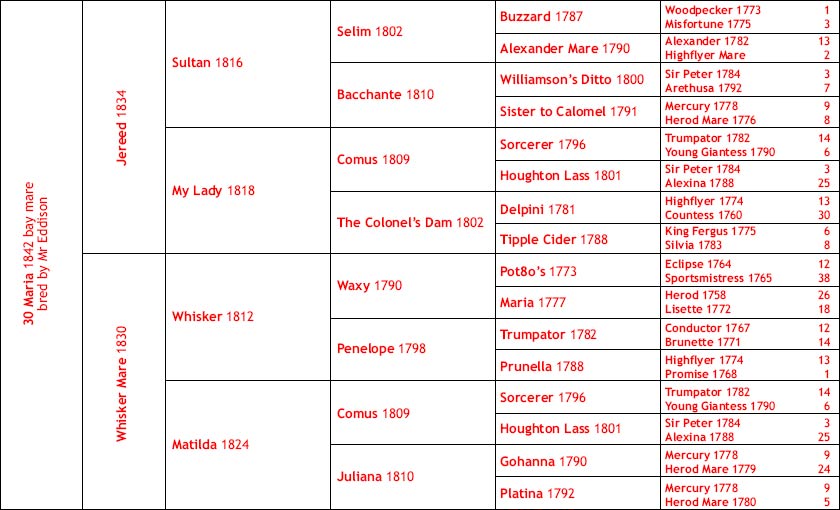
According to the 1972 Babolna stud book, the first edition of volume I of the Polish Arabian Stud Book, and Dr. Walter Hecker’s history of Babolna, the Austro-Hungarian broodmare 30 Maria was an English Thoroughbred foaled in 1842. Maria’s registration as a Thoroughbred and her foals born in England appear in Weatherby’s General Stud Book, which states, “Sold to the Austrian Government in 1852, before foaling” (see volume VII, page 230). The pedigree for 30 Maria appears here.

She was left in England to foal and then brought to the Austrian stud of Piber later in 1852. The Austro-Hungarian government established the stud farm of Kisber in 1853 for breeding Thoroughbreds and Thoroughbred crosses, and Maria was sold to Kisber in 1854. On May 3, 1861, she was bred to the imported desert bred stallion Aghil Aga, producing a bay filly on April 7, 1862. The filly was designated 3 Aghil Aga when she entered the broodmare band at Babolna, and the 30 Maria line descends through her.

30 Maria herself was transferred from Kisber to Mezoehegyes in October of 1862. Her last owner was Baron Bela Wenckheim; 30 Maria died in 1865.

The broodmare daughters of 3 Aghil Aga included 6 Mahmoud Mirza (1870), 35 Mahmoud Mirza (1871), and 90 Mehemed Ali (1878), but it was through 6 Mahmoud Mirza that Babolna developed a long line of horses with Arabian blood plus 30 Maria. A more recent example of such breeding is 30 Maria‘s tail-female descendant 125 Ghalion, born in 1975. After 12 generations of crossing to Arabian stallions, 125 Ghalion has just 0.024% of 30 Maria‘s blood.

The 30 Maria line appears in WAHO pedigrees through Babolna bloodlines that went to South America and Babolna lines that went to Romania. One of 30 Maria‘s first descendants to stand at Babolna as a chief sire was O’Bajan I. A son of his was sold to Germany where he sired Kurdo III.

Who owned Kurdo III?

Arabian breeding in South America began with the horses of Sr. Hernan Ayerza. He imported his earliest foundation stock to Argentina in 1894 and was for decades one of the world’s largest private breeders of Arabian horses. When he died in 1940, he owned 221 head. Hernan Ayerza’s foundation stock came from several sources, including France, Crabbet Stud in England, and his own importations of desert bred animals. Hernan Ayerza also had a stallion named Kurdo III. According to volume VII of the Stud Book Argentino (SBA), Kurdo III was imported in 1910 and was in service at Hernan Ayerza’s stud beginning 1912. He became a heavily used sire for Hernan Ayerza.

Kurdo III was bred at the Koenigsfeld stud in Saxony, Germany, but he was sold to Argentina through the Circus Hagenbeck. European circuses have a long tradition of acquiring Arabian stallions to train as performers. The Tierpark Hagenbeck in Hamburg, Germany, is still a popular tourist attraction. Kurdo III‘s dam, Gamorra, traced to horses bred at Weil in Germany, horses bred by Poland’s Sanguszko family, and in tail-female to horses from Babolna. See Kurdo III‘s pedigree for details.

Why is he called Kurdo III? Who were the other two horses named Kurdo?

According to SBA, Kurdo II was a 1909 colt by Racid and out of Kariban. The original Kurdo was an 1899 colt by Richam and out of Kariban. Both of these colts were bred by Hernan Ayerza.

Nebal by Rukham ex Mottaka, an O’Bajan V-6 daughter by Hamdani Semri I-9

Did Hernan Ayerza own O’Bajan V-6, Hamdani Semri I-9, and O’Bajan-7?

No. Hernan Ayerza had a brother named Alfonso Ayerza who also bred Arabians, although on a smaller scale. Alfonso Ayerza started his program with the stallion Hamdani Semri I-9 and mare O’Bajan V-6, both stated in SBA to have been imported in 1909. His pedigree appears here and hers is here, but it would be necessary to extend them for many more generations to calculate the exact amount of non-Arabian blood. Hamdani Semri I-9 and O’Bajan V-6 had a 1911 daughter named Mottaka. Alfonso Ayerza bred Mottaka to the Crabbet stallion Rukham to produce a colt named Nebal. In 1978, Colin Pearson described Nebal’s male line as the primary sire line of Argentine breeding.

According to the SBA, more imports soon joined Alfonso Ayerza’s program. Two more Babolna mares, Hadban I-4 and O’Bajan-7, were imported in 1911. Djellah was imported from France in 1912. In August of 1913, Alfonso Ayerza purchased the stallion Rukham and the mare Nadima from Lady Anne Blunt of the Crabbet Stud in England. Alfonso Ayerza also incorporated, starting 1911, a desert bred horse named Seglaani al Abdi.

Alfonso Ayerza’s herd developed separately from Hernan’s, at least through 1923. During this time the only use Alfonso made of his brother’s horses was to breed two mares to Racid, but both mares were returned barren in SBA.

Of the Babolna mares imported in 1911, Hadban I-4‘s pedigree was Arab teliver. O’Bajan-7‘s pedigree, however, traced in tail-female to 30 Maria. In summarizing the influence of Rukham, Colin Pearson mentions the 1924 colt Setuhan (Rukham x O’Bajan-7).

Although the two Ayerza brothers developed their programs separately, their bloodstock was the major foundation for the following generations of South American breeders.

I’ve heard that there could already be Kurdo III blood in Arabian horses in the United States. How is that possible?

In 1926, Hernan Ayerza sold ten mares to the Duque de Veragua as foundation stock for his newly established stud in Spain. Ayerza also gave the Duque a colt, Kumit, but Kumit and a colt imported in utero were both gelded and do not seem to have been used for breeding. The ten mares are listed below:

Holail II 1922 (Haurram II x Alima, by Ajman)

Radjef 1922 (Risfan x Kamil, by Kurdo III)

Roala III 1922 (Risfan x Aziyade, by Ajman)

Hayadjan 1923 (Haurram II x Kadidjah, by Kurdo III)

Heknat 1923 (Haurram II x Adda, by Ajman)

Razayel II 1923 (Risfan x Riyala, by Racid)

Kate 1924 (Kurdo III x Habaya, by Haurram II)

Khotbat 1924 (Kurdo III x Halama, by Haleb)

Rabih 1924 (Rustnar x Kefta II, by Kurdo III)

Rafa 1924 (Risfan x Kaaba, by Kurdo III)

As of Spanish Stud Book (SSB) volume XXII, six out of the Duque’s 29 broodmares had Kurdo III blood. The Duque bred Arabians for only about ten years. He and his stud manager were killed in 1936 during the Spanish Civil War. With the Duque and his stud manager gone, many of the Duque’s younger mares and fillies could not be identified positively. Nonetheless they were retained in the SSB as “Veragua horses” without further pedigree. It cannot be known if any of these Veragua horses descend from Kurdo III. Veragua blood is found in some Spanish Arabians imported to and registered in the United States.

In 1978, Michael Bowling discussed the fate of the Duque de Veragua and his stud with the Duque’s niece. See his article “Spain” in Arabian Horse World, October 1978, in particular pp. 155-7, in which he recounts the family version of the story as told to him in Spain.

Kurdo III does have traceable descendants in Portugal through Aksoum (Razada x Radjef), bred by the Duque and sold to Portugal in 1933.

Isn’t it also true that a few Arabians already imported to and registered in the U.S. trace to some of the same Hungarian partbred Arab ancestors as Hamdani Semri I-9 and O’Bajan V-6?

In 1891, Babolna traded chief stallion Zarif I for Ibn Achmet of the Antoniny Stud in Poland. Zarif I is the great-grandsire of both O’Bajan V-6 and Hamdani Semri I-9. According to Britta Fahlgren’s The Arabian Horse Families of Poland, this Babolna stallion was the sire at Antoniny of Tybet, whose grandson Ornis was exported to Spain in 1912. From there the Ornis blood has found its way to the United States. An alternate reading exists for the pedigree of Ornis, since his export document from the Antoniny Stud describes Tybet as imported, not bred in Poland. However, reported translations of material from the earliest Arabian stud book of Russian Poland do not support this version.

Another Babolna stallion with Gidran breeding, Jussuf (1885), also stood in Poland. At the Slawuta Stud, he sired the mares Otawa and Porta. These mares are in the pedigree of 40 Lenkoran II, a stallion bred at Sarajevo. 40 Lenkoran II is the grandsire of a mare imported to the U.S. in 1946 and later registered in the U.S. Arabian stud book, where she has descendants.

Sources and Selected Bibliography

Books

Rosemary Archer, Colin Pearson, Cecil Covey: The Crabbet Arabian Stud, Its History & Influence (Alexander Heriot, 1978).

Hans Brabanetz: Das k.k. Staatsgestuet Radautz und Seine Pferde (ISG Verlag, 1987).

Monique Dossenbach, Hans Dossenbach, Hans Joachim Koehler: Great Stud-Farms of the World (William Morrow & Co., Inc., 1978).

Britta Fahlgren: The Arabian Horse Families of Poland (Alexander Heriot, 1991)

Walter Hecker: Babolna und seine Araber (ISG Verlag, 1994)

Wojciech Kwiatkowski: The Complete Pedigrees of Arabian Horses from Babolna (Kawalkada, 1994)

Joanna Maxwell: Spanish Arabian Horse Families 1898-1978 (Alexander Heriot, 1983)

Otto Mayr: Allgemeines oesterreichisches und ungarisches Gestuetbuch (1867).

Erika Schiele: The Arab Horse in Europe (Borden Publishing, 1970)

C.G. Wrangel: Ungarns Pferdezucht in Wort und Bild (Schickhardt & Ebner, 1893-95).

Personal Communication

Wojciech Kwiatkowski for pedigree and other historical data

Veronica Lencinas for pedigree data

Tamas Rombauer and Andrea Toth of Babolna for checking the Babolna archives in response to specific questions

Carol M. Schulz for pedigree data

Gudrun Waiditschka for pedigree and other historical data

Periodical literature

Marta Cossio, “The Arabian Horse in Argentina,” Arabian Horse World, December 1979, p. 451.

Jill Erisman, “South America,” Arabian Visions, March-April 1995, p. 45.

Laszlo Monostory, “The Hungarian Naming System,” Arabian Horse World, May 1966, p. 50.

Carol Schulz, “Spain,” Arabian Visions, March-April 1995, p. 45.

Stud Books

as mentioned, plus the German Shagya Stud Book and Arabian Horse DataSource

A Wrinkle in the Stud Book: Rosa Rugosa 166

Copyright 1991 by R.J.CADRANELL
from Arabian Visions Jan 1991
Used by permission of RJCadranell

One of the most puzzling registrations in the first edition (1944) of Volume V of our Arabian Stud Book is 166. This is the number assigned to a bay mare foaled March 27, 1907, and entered in the Stud Book as “*Rosa Rugosa.” Her sire was *Imamzada, and her dam was *Rose of Sharon. The Stud Book states that Rosa Rugosa was bred by the Crabbet Stud in England, and imported in 1911 by American foundation breeder Spencer Borden, of Fall River, Massachusetts. The same Stud Book states that Borden imported both *Imamzada and *Rose of Sharon from England in 1905. There’s the rub, or in this case, the wrinkle. With both her parents owned in America, how was it that this animal was bred in England and imported to America as a four-year-old? Or could there be an error in the Stud book?

Unlike some problematic early registrations, there is enough evidence to iron out Rosa Rugosa’s wrinkle. The 1986 publication, Lady Anne Blunt, Journals and Correspondence, contains much of it. From correspondence published in this book, we know that Borden made what was apparently his first visit to Crabbet, on September 6, 1905. After his visit, he wrote to Lady Anne Blunt,

“I find the family that pleases me most is that of Rose of Sharon. As I should have to pay duty on the old mare, I would much prefer having Ridaa her daughter or Risala her granddaughter, unless the price of the old mare is quite a short one. Ridaa, I understand you will not sell, and I fear the price on Risala would be too high…” (1) (page 433)

*Rose of Sharon was then twenty years old, and had already assumed the position of one of the most valuable and distinguished broodmares the Blunts ever bred at their Crabbet Stud. She had produced her eleventh foal in 1904, and was in foal for 1906. Lady Anne Blunt replied,

“…I could take 100gs for Rose of Sharon. I am, however, not keen to sell the mare as she is in foal to Harb, and also at her age the change she is making to a new climate and surroundings might be trying…”(1) (page 433)

Despite the initial reservations on both sides, Borden and Lady Anne eventually struck a deal. *Rose of Sharon’s English Stud Book Certificate, recording her sale to Borden (now at the Arabian Horse Trust) is dated September 28, 1905. According to Michael Bowling, (2) the Crabbet herdbook records that, *Rose of Sharon was shipped from Liverpool on October 6. The section of Borden’s book detailing importations to America, states,

“In October 1905 there came… the famous old mare Rose of Sharon…”(3)(page 93)

Borden had added his prize, a mare he felt was just about the best the Crabbet Stud could offer him, to his own small herd in America.

A letter from Borden to “Harry” (perhaps Major Henry Leonard) dated November 3, 1919 (now on file at the Arabian Horse Trust) continues the story:

“When I visited Crabbett Park [sic] in 1905, I thought Ridaa the best mare…No price would buy her. As I wanted some of the blood, I had to buy her dam, the Rose of Sharon, then 20 years old.
“In January 1906, she foaled Rodan. I bred her to Imanzada [sic] and in 1907 she had Rosa Rugosa. I sold her to Ames as a yearling.”

*Rodan was the Harb colt *Rose of Sharon had been carrying when she left Crabbet. *Imamzada was a bay or brown stallion of non-Crabbet lines, foaled in 1891. Borden had bought *Imamzada from the Hon. Miss Etheldred Dillon during his September 1905 trip to England. This was “before he went down to Crabbet.” (1) (page 420)

Arabians of H.H. and W.R.Brown Registered in 1916:

  • (N.B. *157 was a Hingham Stock Farm foal registered 2-10-16)
  • 160 *Shibine
  • 161 Nazlet, mare of H.J.Brown’s from Borden
  • 162 *Antika, imported by Borden, owned by W.R.Brown
  • 163 (Alladin, colt bred by Albert Harris)
  • 164 *Narda
  • 165 *Risalda, imported by Borden, owned by Brown
  • 166 Rosa Rugosa
  • 167 *Noam
  • 168 Matina, 1913 foal bred by H.J.Brown
  • 169 Hajar, 1915 foal bred by W.R.Brown
  • 170 Jafa, 1915 Brown foal
  • 171 Mahmet, 1915 Borden foal owned by Brown
  • 172 Reza, 1915 Rosa Rugosa foal bred by H.J.Brown
  • 173 Abeleyd, 1913 *Shibine foal bred by H.J.Brown
  • 174 (Yemen, 1915 Hingham foal)
  • 175 Abyssam, 1916 Brown foal
  • 176 Gemar, 1916 Brown foal
  • 177 Kahlaga, 1916 Brown foal
  • 178 Suleiman, 1916 Brown foal
  • 179 Yaquida, 1916 Brown foal
  • 180 Djemeli, 1916 Brown foal
  • 181 Mariam, 1915 Brown foal
  • (N.B.*184 was a Hingham foal registered 12-4-16)

*Rose of Sharon did not live many years in America. This was not because she was sent back to England, as some people have hypothesized to explain the confusing Rosa Rugosa registration. Borden wrote to Lady Anne Blunt on July 29, 1907. “You will be sorry to hear that Rose of Sharon died last week. A severe attack of what seemed like cholera, perhaps brought on by the dreadfully hot weather, carried her off. She left me a fine filly, by Imamzada, which I have named Rosa Rugosa.” (1) (page 438)

Rosa rugosa is the botanical name of a species of rose having rough leaves with furrowed veins (from the Latin rugosus wrinkled). In naming the filly Rosa Rugosa, Borden was following the Crabbet Stud practice of connecting the names of foals to the names of their dams. *Rose of Sharon was the daughter of Crabbet foundation mare, Rodania. The Blunts named Rodania’s other daughters Rose of Jericho and Rosemary. Among Rodania’s granddaughters were *Rosetta, Rose of Dawn and Rose Diamond, the dam of Rose of Hind.

As we already know, Borden sold Rosa Rugosa to Frederick Lothrop Ames when she was a yearling. Ames was a descendant of the founder of the “Ames Shovel and Tool Company.” The family seat was in North Easton, Massachusetts. Beginning in 1909, Ames bought some Arabians of his own from Crabbet. On the occasion of Ames’ (July, 1909) visit. Lady Anne Blunt noted in her journal that, “[h]e possesses the R. of Sharon filly by Imamzada, very fine he says which he bought from Borden.” (1) (page 338)

In 1909, Ames bought a number of horses from Wilfrid Blunt, including the mares, *Shibine and *Narda. The mares were imported in 1910, and *Narda produced a filly named *Noam, in 1911.

The imported Arabians mentioned thus far, as well as Rosa Rugosa, were registered in the Arabian section of the Jockey Club’s American Stud Book, well before they were entered in our Arabian Stud Book. As of the Jockey Club’s 1914 Stud Book, the Ames’ mares, *Narda and *Shibine, were owned by Herbert J. Brown, brother of W.R.Brown of the famous Maynesboro Stud. H. J. Brown seems to have acquired the bulk of the Ames’ Arabians. As of 1914, H. J. owned Rosa Rugosa as well as *Narda and *Shibine; he is credited as the breeder of Rosa Rugosa’s first foal, Kheyra, registered in the Arabian Stud Book as born in 1913.

In 1916, the Brown brothers burst into the Arabian Stud Book with a nearly solid block of 20 registrations, as shown in the accompanying box. The first published Stud Book in which these registrations appeared was Volume II, dated 1918. At that time Rosa Rugosa was listed as dead, and the misinformation about her having been bred at Crabbet and imported by Borden in 1911, first saw print. Where it came from is difficult to judge; perhaps it was a clerical error, since the mare registered immediately before Rosa Rugosa, *Risalda 165, really was bred at Crabbet and really was imported by Borden in 1911. The one Jockey Club Stud Book naming Rosa Rugosa’s breeder, is Volume XII. It says that she was bred by Spencer Borden.

Arabian Stud Book Volumes II, III, IV, and V, all list Rosa Rugosa as bred at Crabbet and imported by Borden in 1911. The third edition of Volume V (1973) corrects the name of her breeder to Spencer Borden. The 1986 edition of the Registry’s Stud Book on microfiche, however, has returned to the erroneous information with the curious addition of a specious importation date of 3-28-07.

Though three of her four registered foals, Rosa Rugosa’s line is active in Arabian breeding today. Her daughter, Kheyra (by *Astraled) is the dam of Rawada. Rosa Rugosa’s most widespread line is through her son, Sidi (by Khaled), sire of Babyat, Raad and Rehal.

References

    Lady Anne Blunt, Journals and Correspondence
    CMK Record, Vol. IV, No. 3, (writing in )
    The Arab Horse, Spencer Borden

Lady Anne Blunt in the London Times

Lady Anne Blunt in the London Times

Copyright 1992 by R.J.CADRANELL

from Arabian Visions December 1992

Used by permission of RJCadranell

Readers are probably familiar with the name of Lady Anne Blunt, who founded England’s Crabbet Arabian Stud with her husband Wilfrid Blunt in 1878. Most articles written about Crabbet focus on the horses with little more than a glimpse of the woman behind them.

Lady Anne Blunt died in Egypt on December 15, 1917. Two weeks later, on December 29, her obituary ran in the London Times. It offers a summary of her life and accomplishments outside of her horse breeding interests:

Byron’s Granddaughter

The Late Baroness Wentworth

A correspondent writes:–

A distinguished and well-beloved personality has just passed away in the person of Baroness Wentworth — better known as Lady Anne Blunt. It is now half a century since she and her brother Lord Wentworth (afterwards second Earl of Lovelace), attracted much interest in London society as grandchildren of the poet Byron. A few still remember her charm as a girl. Her face, with its exquisitely delicate features, dark brown eyes, and expression of high intelligence and warmth of heart, was attractive at all ages. Her figure was small but beautifully made, and though simple and unassuming as a child, she had a gentle, old-fashioned dignity of manner which was all her own. An additional charm was the softness of her voice in speaking. It will be remembered that this attraction is recorded of her famous grandfather.

She learnt drawing from Ruskin. Her gift for sketching was unequaled, especially as regards horses, and the rapidity of her pen-and-ink drawings could never have been guessed from their minute perfection. An architectural drawing done by her at the age of 12 was hung in the Royal Academy. The beautiful house at Crabbet Park was designed by her. That her artistic and literary gifts are not better known to the world at large is due to her retiring nature and love of self-effacement; she always preferred to enjoy the triumphs of her friends. She was a first-class chess player, mathematician, and linguist, being a most distinguished Arabic scholar. She had much knowledge of music, and had been a friend of Joachim. She was a remarkable long-distance runner until she dislocated her knee on one of her desert journeys. Medical help not being at hand, she continued to ride for weeks with her swollen and useless leg supported by the foot in a rope tied to her waist. At the age of 77, she could still vault on to a horse unassisted, and while in the prime of her strength habitually rode a buck-jumper, which afterwards “put down” the crack Australian roughrider of that day. Perhaps this was her proudest achievement.

To her stoical endurance of pain and hardship, her asceticism and self-sacrifice, she joined a light-hearted gaiety, a delightful humour and lavish generosity and loyalty of nature, together with fathomless sympathy for the sufferings and weakness of others.

In 1869 she married Mr. Wilfred Blunt [sic], of Crabbet Park, Sussex, who survives her (then in the diplomatic service and not yet known as a poet), and for years moved in the best literary and general society of her day, always holding her own and distinguished among the best of company. But her heart was not in drawing-rooms. She worshipped the sun and the wind and the hills and the freedom of outdoor life, happiest always in the saddle, or caring for the welfare of her numerous family of Arab horses, so well-known to all her visitors both at Crabbet and at her Egyptian home at Sheykh Obeyd, near Cairo. Her perfect horsemanship, her absolute fearlessness, and the extremely abstemious habits which she inherited from a very remarkable father (the first Earl of Lovelace) made her singularly well fitted for the adventurous journeys which she undertook in the seventies and eighties of the last century. She rode (the only woman in the cavalcade) with her husband through the wildest parts of the Mesopotamian and Arabian deserts, penetrating to jealously guarded fastnesses and often in no slight peril. She crossed the Tigris, Euphrates, and Kherkha rivers, either on a goatskin raft or clinging to a swimming horse. Knowing the formidable nature of these rivers, she foretold the military difficulties in those regions. To the end of her life the romance and delight of these wild journeys were never far from her memory.

Her last years were mainly lived in Egypt, whence since 1915 she had been unable to return at all. She spent her time dispensing kindness to all about her, and especially to the soldiers, wounded and unwounded, who now surrounded her. It was within a few weeks of her 80th birthday that she simultaneously finished a book (her History of the Arabian Horse), which it is believed is likely to become a classic, and inherited the ancient barony that had descended to her through her grandmother, Lady Byron. About a month later she fell ill, and the strength that had up till then seemed extraordinary for her age at last failed her. For those whom she has left here it is a tragedy. For herself, no. She lies for ever under the Eastern sun, in the land of her heart, and her memory will not soon fade. To the end of her life she had the heart of a child, the brain of a scholar, and the soul of a saint.

***

Who was the correspondent who wrote to the Times about the passing of Lady Anne Blunt? It was someone familiar with her entire life, from her ancestry to her debut in London society to her marriage and desert journeys. The writer knew Lady Anne had designed the house at Crabbet and about her knee injury. Wilfrid Blunt’s name was spelled incorrectly, but that could have been done in typesetting at the Times.

It is probably safe to guess that the writer was Lady Anne’s daughter, Lady Wentworth. Mention is made of Lady Anne’s completion of a book on the Arabian horse. This manuscript she willed to her daughter. The tone and phrasing of the piece are strikingly similar to Lady Wentworth’s discussions of her mother in her own book, The Authentic Arabian Horse. The “my mother was a saint” theme runs throughout Lady Wentworth’s written commentary on her mother’s life. Whoever the writer was, he or she has left a moving portrait of a foundation Arabian breeder.

  Web cmkarabians.com

Davenport Arabians

Davenport Arabians

Arabian Visions Jul/Aug ’96

Copyright © 1996

Used by permission of Arabian Visions

The Davenport bloodline is one of the original bloodlines of American Arabian breeding. In 1906, before there was even an Arabian Horse Registry, Homer Davenport realized his boyhood dream of traveling to Arabia and buying Arabians directly from the Bedouin horse breeding tribes.

Davenport was not the first English speaking importer of foundation Arabian bloodstock. Starting just over 30 years before Davenport’s trip, in the 1870s, a few people from England traveled the same desert regions and bought Arabian horses from the same tribes. These people–notably Roger Upton and the Blunts–put their travel experiences and Arabian horse lore down in books. Upton and the Blunts had apparently learned much from James Skene, British Consul in Aleppo since the 1850s. Davenport made use of the Blunt and Upton books in planning and executing his own trip. He learned the names of the principal horse breeding tribes, the various family or strain names of Arabian horses, and to insist on a sworn attestation of purity and breeding–known in Arabic as a hujja–for each horse purchased.

Davenport left the United States in July. By what has been described as a series of fortunate blunders, he was able to ship to the United States a group of 27 horses. Most of these were stud colts, an item easily and inexpensively procured from any horse breeder. Also included, however, was a real prize: eight purebred Arabian mares, along with two 1906 fillies.

Davenport was a political cartoonist, and it was thought that one of his cartoons was key to Theodore Roosevelt’s election in 1904. Thus President Roosevelt, a fellow horseman and interested in Arabians for cavalry breeding, was happy to lend diplomatic support to the expedition. Davenport’s partner in Arabian horse breeding was Boston industrialist Peter B. Bradley, who provided the financial backing. Inquiry through the Ottoman ambassador in Washington resulted in the Sultan’s issuing a permit (called an irade) for Davenport to export mares–an item illegal to export without special permission.

Anxious to be on their way, Davenport and his two traveling companions left as soon as possible after the irade was issued. This meant they would be in the desert during the summer, when the migrating horse breeding tribes were in their northern pastures. And for some reason, in 1906 the tribes had swung a little farther north than usual.

When Davenport arrived in Aleppo, he was not sure what to do next. But in a bazaar, he met two members of the Fidaan tribe, who told him their tribe was encamped just a few hour’s ride from Aleppo. One of them offered to conduct Davenport to the house of Akmet Haffez, a rich and powerful intermediary between the Ottoman government and the region’s Bedouin tribes. Being a man of action, Davenport went immediately to see Haffez.

This was a violation of protocol. Davenport was carrying an Imperial irade and traveling under the aegis of President Roosevelt. Propriety dictated he first call on the region’s Ottoman governor, Nazim Pasha. Haffez was so honored by Davenport’s visit that he presented two horses to the Davenport party and personally took charge of the expedition, accompanying Davenport out to the tribes, and assisting in negotiations. Davenport and Haffez became fast friends, and before the trip was out went through a blood brother ceremony which bound them together as family.

Davenport died not even six years after his importation. By then, however, most of the Davenport horses were located with Peter Bradley, who continued to breed them together until the 1920s.

Any bloodline this old should have long since been outcrossed out of existence. Yet enough people have recognized the importance of maintaining the Davenport bloodline, and bred enough foals along the way, that these horses have survived 90 years in the hands of American breeders–the majority of whom are bent on topcrossing to the latest imported outcross bloodline. The Davenports offer the intellectual fascination of owning something unique in Arabian horses animals tracing wholly to one of the breed’s foundation breeding groups. Their documented Bedouin origin is also unusual. Few other Arabian horses can show in every line uninterrupted descent from authenticated Bedouin stock.

This heritage and background would be of lesser note if the Davenport horses themselves were not so eminently appealing. They meld complex, almost human brains with the conformation of a using horse and the lithe, graceful beauty inherent to all desert creatures. Naturally there is some variation within the Davenport herd: like snowflakes no two are exactly alike, yet all are recognizable as examples of Davenport breeding, and all look like Arabians.

Among the most typical physical characteristics of Davenport horses are fine skin and coat, balanced conformation, flat bone, well let-down knees and hocks, and wideset, prominent eyes. Under saddle they are sensitive and smooth with a light and airy tread–as though riding on “wings and springs,” as one author put it. Their mental traits include intelligence and an interest in communicating not just with people but most any animal species they happen to meet. They are keenly aware of humans as fellow beings, not just another item in the catalog of their environment. The case for docility can be overstated, however. Although among the most manageable of Arabians, they are still horses, not overgrown puppy dogs, and need to be handled with sensible and responsible horsemanship.

Most Davenport horses have been bred by people interested in a friendly, companionable riding horse with traditional Arabian type. These values attracted the owners to the Davenport bloodline in the first place, along with an awareness of their history. Thus they were more likely to select matings with an eye to perpetuating rather than changing, the characteristics of Davenport horses. All Davenports are not equal, but the most glorious of them have never been surpassed as examples of the traditional Arabian horse.

  Web cmkarabians.com

The Ever Expanding Crabbet Universe

The Ever Expanding Crabbet Universe

Copyright 1991 by R.J.CADRANELL

from Arabian Visions March 1991

Used by permission of RJ Cadranell


Words are defined in one of two ways: the first is by long-standing and widely accepted dictionary definitions. The second is according to how a word is actually used in the living language. As a word’s new meaning gains wider and wider acceptance in first the spoken and finally the written language, dictionary writers must acknowledge at last what is happening in the real world, and amend their volumes. The meaning of many words has changed over time, reflecting changes in society at large.

For example, the word “access” has traditionally been a noun. We speak of the access to a highway or building, or of gaining access to information. The advent of computers has changed this word into a verb: “Will you hold please while I try to access that for you?” is something one hears over the phone these days, when calling to make inquiries. An “access” is no longer just something we can see or acquire; accessing is now a thing we can do.

There’s nothing new about words changing their meanings. The Old English word “dysig,” meant foolish or ignorant. Its modern descendant, “dizzy,” means unsteady or light-headed. To call a person “dizzy” and mean “scatterbrained” is a slang expression, ironically close to the word’s original meaning.

If there were a dictionary of words used in conjunction with Arabian horse breeding and showing, adding a new definition to the word “Crabbet” is something its writers would have to consider seriously. The way the word is used today in conversation, advertisements, and magazine articles tells us that its meaning has changed dramatically.

In the middle of the eighteenth century, Crabbet was the name of an English estate in Sussex. When Sarah Gale married Samuel Blunt in 1750, the Blunt family acquired from her several estates, including Crabbet Park. Samuel Blunt’s son, William, was the father of Francis Blunt, who was the father of two boys. The elder brother died in 1872, at which time the younger brother, Wilfrid Scawen Blunt, became the owner of the Crabbet estate. Wilfrid Blunt was then age 31. Nearly three years before he had married Lady Anne Isabella Noel King-Noel. In November of 1877, Wilfrid and Lady Anne Blunt set out for Syria to buy a horse of the same blood from which the Darley Arabian had come. Before the year was out, they had hatched a plan to transplant specimens of the Arab breed to England and breed them there.

The first Arabians arrived at Crabbet Park in July of 1878. The spring of 1879 saw the first breeding season, and the first foal crop arrived in 1880. The official name of the horse breeding venture was “The Crabbet Arabian Stud.” In less formal parlance, the Blunts spoke of “the Crabbet Stud,” and among themselves of “the Stud.” Over the years they bred hundreds of Arabians at Crabbet, adding new bloodlines until approximately 1904.

Although for years catalogs had been issued with the name of the Crabbet Arabian Stud on the cover, it wasn’t until 1909 that the General Stud Book (GSB), the registration authority in England which handled the Blunt stock, published a stud book crediting foals to the “Crabbet Stud” as breeder. Prior to that time, they had been attributed either to “Mr. W.S. Blunt” or “Lady Anne Blunt.”

Lady Anne Blunt’s death in 1917 touched off a legal battle over the horses, fought between her husband and daughter, Lady Wentworth. In 1920, Lady Wentworth gained possession of the horses. She added new bloodlines, most notably the stallion Skowronek, and continued the operation of the stud until her death in 1957.

In 1924, Lady Wentworth issued a catalog under the name “Crabbet Arabian Stud.” Later she preferred to call her operation the “Crabbet Park Stud.” Breeder credits in the GSB reflect this change. Beginning with the 1949 edition, the credits read somewhat grandiosely, “The Wentworth, Crabbet Park and Burton Studs.” (Burton Park was the name of a Thoroughbred stud Lady Wentworth had bought during World War II.)

After Lady Wentworth’s death the horses passed to her stud manager, Cecil Covey. The horses he bred are credited in the GSB to the “Crabbet Arabian Stud.” He didn’t stable them at Crabbet itself, but rather at nearby Caxtons and Frogshole Farm. More than 1600 acres of the Crabbet estate, including Frogshole, was sold at auction in 1916. Lady Wentworth bought back Frogshole about 1929, and it was left to Mr. Covey, along with the horses. He also inherited Caxtons, a property “on the southern side of Crabbet Park, about half a mile from the house,” to quote Mrs. Archer in The Crabbet Arabian Stud, Its History and Influence. Mr. Covey’s breeding program was far smaller than that of the Blunts or Lady Wentworth. Highway construction forced the final dispersal of the stud in 1971.

Today, hardly a horse is now alive that was bred by the Crabbet Stud. If a “Crabbet Arabian” is one that was bred by the Crabbet Stud, there can be at best only a handful still living.

But Crabbet means much more than an Arabian horse bred by the Blunts, Lady Wentworth, or Cecil Covey. The name “Crabbet” has come to apply to an entire bloodline within the Arabian breed. Today some people specialize in breeding Arabians of ancestry tracing in every line back to the horses of the Crabbet Stud. A few people have horses bred only from the stock of the Blunts. Others choose to breed equally Crabbet horses making use of one or more of Lady Wentworth’s additions of foundation stock to the herd: Skowronek, Dafina, and/or *Mirage. Some expand their pool of Crabbet blood to include the descendants of Dargee, a horse with a pedigree showing only part of the Crabbet herd.

Horses from Crabbet were known as “Crabbet Arabians,” both to give credit to their breeder (and to acquire some of Crabbet’s luster), and to distinguish their bloodlines from those of other Arabians. The gene pool the Blunts assembled was unique. It is impossible to prove relationships between Blunt desert bred horses and anyone else’s desert bred horses. The Blunt stock is a distinct and self-contained part of the foundation of modern Arabian breeding. The horses the Blunts acquired in Egypt might have close pedigree ties to the horses of the various princes, but again exact relationships are for the most part impossible to prove. In this way, “Crabbet” is used as a handy term to identify a distinct group of bloodlines. (Skowronek’s pedigree does show that he was related to other Polish lines. Admirers of Crabbet and Poland will probably never resolve the question of to whom he really belongs.)

Miss Dillon and the Rev. F.F. Vidal were among the first Arabian breeders to make use of Arabians from Crabbet, for crossing with Arabians obtained from other sources. The horses from these crosses continued to be interbred with horses from Crabbet Park, sometimes for ten or more generations. This raises a sticky question: when, if ever, should a horse resulting from such crossing earn the title of “Crabbet Arabian”?

Many people have answered this question for themselves, by referring to any and every horse from the English Arabian breeding tradition as a “Crabbet horse.” British studs founded largely but not entirely on Crabbet blood (like Hanstead and Courthouse) produced an Arabian closely allied to those bred at Crabbet, but yet not exactly the same. For many, there is no reason not to blur the distinction.

North America has and always has had a particularly rich and diverse Arabian gene pool. Almost from the beginning, horses bred at Crabbet have been a part of it. *Raffles, *Raseyn, *Serafix, and *Rissletta are among the most famous of the many to have made significant contributions to American Arabian breeding. The Crabbet imports (and part-Crabbet imports) were combined with virtually everything else in our stud book. At one time the distinction between what had come from Crabbet and what had not was fairly easy to make. But time passed and these horses receded into the back lines of pedigrees, and finally dropped off entirely. What seems a subtle distinction is made less and less frequently. “Crabbet” has started to become a generic term to describe all of the older American breeding, much of which actually derives from the Crabbet Stud.

However, many of the older American lines of Arabian breeding have little or nothing to do with the Crabbet Stud. The Davenport and Hamidie imports, Huntington’s breeding, the lines to Mameluke, El Emir, Ishtar, and/or Kesia II behind some of the Borden imports and *Nuri Pasha, Maynesboro’s French mares, the Rihani horses, and individual animals like *Nejdran, *Lisa, and *Malouma are among the older American pedigree elements. When examined on a case by case basis, all of these are emphatically non-Crabbet. But when eight, ten or twelve generations back in a pedigree filled with significant Crabbet horses, it is temptingly convenient to blanket the whole thing with the label “Crabbet.” And in practice, many people do.

There is a further complication. Horses tracing back in all lines to Crabbet Park are today relatively scarce. In contrast, there is an abundance of predominantly Crabbet horses exhibiting many of the most admired traits traditionally associated with Crabbet stock. The World Symposium on Crabbet Breeding, held several years ago in Denver, issued a reference book containing pictures and pedigrees of some 180 horses owned by interested parties. Of these, fewer than 25 had pedigrees going back to Crabbet Park in all lines. Nevertheless, all 180 merit the label “Crabbet bred,” as the Symposium applied it to them.

“Crabbet,” as a term to describe the bloodlines from the Crabbet Stud, is not falling into disuse. Instead, the word is taking on an added meaning.

  Web cmkarabians.com

The Crabbet Lawsuit (part II)

This entry is part 2 of 2 in the series The Crabbet Lawsuit

221b Baker Street: The Crabbet Lawsuit (part II)

As reported in The London Times

ANNOTATED BY R.J.CADRANELL

Copyright 1991 by R.J.CADRANELL

from Arabian Visions July 1991

Used by permission of RJCadranell


Last month this column presented the first three articles the London Times printed about the Crabbet Stud lawsuit. Those anxious to read the rest of the articles are invited to skip ahead and begin. Readers who missed last month’s “Baker Street” column might need some background information. Mr. Wilfrid and Lady Anne Blunt founded the Crabbet Stud in 1878 with horses they imported to England that year. In 1906, due to personal differences, the Blunts divided the 126 Crabbet horses into two herds and wrote a formal partition agreement. The agreement stated that on the death of one of the parties the survivor was to inherit all of the horses. Lady Anne Blunt died in 1917. Her will left her Arabian horses in trust for her teenage granddaughters. Blunt claimed all the horses as his on the basis of the partition agreement. Lady Wentworth, the daughter of the Blunts, claimed about fifteen horses for herself on the basis of exchange, purchase, and gift from her mother.

On February 14:

The Sale of Arab Horses.

Lady Wentworth’s Claim.

Mr. Pollock, the Official Referee, continued the hearing of the claims by Lady Wentworth and the Public Trustee to the ownership of a part of the Crabbet Park Arab Stud. The defendant is Mr. Wilfred Secawen[sic] Blunt, who carried on the stud for many years with his wife, Lady Anne Blunt.

Lady Wentworth, resuming her evidence, said that she was largely basing her claim to the “greys” on her mother’s entry in the catalogues: “To go to Judith on my death.”

Mr. Hughes, K.C. — Have you the slightest doubt that in the face of that Lady Anne Blunt intended to keep them herself during her lifetime?

The witness said that she had, but she would prefer the Official Referee to decide.

Are you sure that your father told you that he had transferred the management of the stud, and not the ownership?–Quite sure. You have it in my diary.

There is a letter from Mr. Blunt to your mother in which he said: “I have no desire other than to hand over to you the entire ownership and management of the stud, retiring altogether myself.” Are you clear that he used the word ownership to you?–Quite clear.

Lady Wentworth said the sale by her of portions of the Crabbet Estate was due to the burden of the mortgage of 15,000 on it when it was settled on her by her father. She sold the land very reluctantly, and she told her father at the time that it was his fault for burdening the estate.

As to the “assault” incident, Lady Wentworth said that she did not wish it to be thought she had been indifferent to the injury suffered by Holman, the stud groom, on the occasion of the encounter at the stables. She was sorry to hear that he had been hurt, and when he resisted the attempt to removed the horses she told him, no doubt, it was his duty to Mr. Blunt to protest, but she did “not think he need have been so violent about it.”

Mr. Hughes, opening the case for Mr. Blunt, said that it seemed to be clear that the object of the deed of 1906 was to maintain that there was really one stud in two halves, and if either party died his or her half was to go to the survivor. There were negotiations in 1915 for the preparation of a new agreement in accordance with the proposals made between Lady Anne Blunt and Mr. Blunt, but the agreement was never executed. Lady Anne Blunt wrote from Egypt that she was much amused at the squire’s having detected a flaw in it, and she added: “Meanwhile I suppose the old agreement holds and would save trouble in case of my death.”

In one of Lady Anne Blunt’s letters, which was quoted by Counsel, she spoke of “my exaggeratedly great age.” Lady Anne Blunt, said Counsel, was getting on for 80, and he had been told that she played polo until the age of 75. A letter of Mr. Blunt’s to his wife referred to “the latest of Judith’s mad letters,” and contained the remark: “It would be fatal to leave the stud to Judith.”

The hearing was again adjourned.


And on February 20:

The Crabbet Stud Dispute.

Lady Wentworth’s Claim.

Mr. Pollock, the Official Referee, continued the hearing of the claims by Lady Wentworth and the Public Trustee to certain horses in the Crabbet Park Stud.

Mr. Arthur C. Caffyn [sic], who was stud manager for Lady Anne Blunt, when she was in England, said she was practically her own stud manager.

Mr. Storry Deans (who appears for Lady Wentworth).–Lady Anne was a very estimable lady, wasn’t she?–Quite. If she had a fault it was that she was inclined to be too generous.

Was she the sort of person who was likely to conspire to defraud anyone of his property?–I should not have thought so.

Counsel read a letter from Lady Anne Blunt to Lady Wentworth, written in August, 1917, from Egypt. It said:–

My mind is so exhausted that I cannot say more to-day, though there are hundreds of things to be said which come into my head whenever I am able to put them down. One, however, which is a great relief to me is that I have succeeded in making the last preparations for death. About this I have been very anxious. It seems so near, always almost within my grasp, and you can imagine the joy of feeling ready. Please pray for me. …By the way, I have been reading again the book on miracles which I had lent to others and have only just got back.–Ever your devoted mother.

The witness said that Mr. Blunt never suggested to him that he would like to get rid of his half of the stud, and he was not surprised when Mr. Blunt’s horses came over to be kept by Lady Anne Blunt, because it had been talked of for months before they came over.

Counsel.–Wasn’t it a fact that after 1916 they were always spoken of as her ladyship’s horses?–They were always spoken of as “the stud.” There was no mention of a name.

James Holman, Mr. Blunt’s stud groom, said that he had been in the service of Mr. Blunt and Lady Anne Blunt for 40 years, and after the partition of the stud in 1906 he attended to the Crabbet half.

Counsel quoted a statement by Lady Wentworth, and he asked whether the witness had been bewildered when she spoke to him.

The witness.–No, I wasn’t any more bewildered than I am now. I was never much frightened at Lady Wentworth.

The witness then described the incident of April 4, 1918, when Lady Wentworth and her party went to the “Squire’s” stables and removed a mare [Riyala] and her foal.

Lady Wentworth, said counsel, called that a very humorous incident.

The witness.–Yes, I know about that. I was urged to take it to Court, but I did not like to. I had known them [referring to Lady Wentworth’s three children, and possibly Lady Wentworth herself] from babies and loved them.

The hearing was adjourned.


And on February 21:

The Arab Stud Dispute.

Mr. Pollock, Official Referee, continued the hearing yesterday of the claims by Lady Wentworth and the Public Trustee to a part of the Crabbet Park Arab Stud, which Mr. W. Blunt and his wife, the late Lady Anne Blunt, founded many years ago. The plaintiffs allege that Mr. Blunt transferred his share to Lady Anne Blunt in 1916, and that from that time the whole stud became her property.

James Holman, the stud groom, again went into the witness-box, and was cross-examined by Mr. Storry Deans, who appears for Lady Wentworth.

Mr. Deans.–Yours was rather a good job?–I can’t say that I disliked it, Sir. I always tried to do my duty.

I want to ask you about the horse Rasim. Rasim was tested to stand noise, wasn’t he?–Yes.

Rasim was subjected to the test of the Crawley Town Band?–Yes.

So he would not have minded the noise of cannon? (Laughter.)–I don’t know about that, Sir.

How was it that Rasim came to be removed by you from Lady Wentworth’s stables at 6 o’clock on a morning in January?–I was merely obeying orders.

Hadn’t Lady Wentworth given you direct orders not to move any horses from her stables?–She might have done. I carried out my orders, and that is all you will get from me.

Whom were the orders from?–I do not know.

Holman, continuing his evidence, adhered to his statement that Lady Wentworth held him by the throat when he resisted her attempts to remove the horse Riyala.

Counsel.–I suggest that you made a mistake about that in the scuffle that took place?–No, Sir: there was no mistake about it. They came up there on purpose for the business. They had all got their orders from their mother.

You really say that Lady Wentworth took you by the throat?–So she did, the second time. She held me when I was finished and I was very nearly dead.

The hearing was adjourned.


And on February 24:

The Crabbet Park Stud.

Mr. Pollock, the Official Referee, resumed the hearing of the claims by Lady Wentworth and the Public Trustee to a number of horses in the Crabbet Park Stud from Mr. Wilfrid Scawen Blunt, who, with his wife, the late Lady Anne Blunt, founded the stud.

Mr. Storry Deans, for Lady Wentworth, said that she did not intend to sell the horses if she established her claim to them, nor did she intend to let them go to America. Her object was to keep up the stud and so preserve the life work of her mother.

Mr. Grant, K.C., for the Public Trustee, who represents Lady Wentworth’s two daughters, said that he claimed damages against Mr. Blunt for conversion of certain horses which he had destroyed or had sold to America. Mr. Blunt had given evasive evidence. Where the versions of Lady Anne Blunt and of Mr. Blunt disagreed, the evidence of Lady Anne Blunt should be accepted.

Judgment was reserved.


The Arab Stud Case.

Judgment in the dispute about the ownership of the Crabbet Park Arab Stud which was claimed by Lady Wentworth and the Public Trustee, who sued Mr. Wilfrid Scawen Blunt, was given by Mr. Pollock, the Official Referee, in the High Court yesterday.

The Official Referee said that it was clear that after the deed of 1906 Mr. Blunt became very anxious to get rid of the responsibilities of his half of the stud. Over and over again, according to Lady Wentworth, who had kept a record of the conversations in her diary, he spoke of his desire to be rid of his animals, as the expense was too great for him and worried him very much. In 1916 Mr. Blunt wrote to his wife a letter in which he said he had no wish but to retire altogether from the stud. That letter showed that he desired to make over not only the management but the ownership as well. Both the conduct of Lady Anne Blunt and the letters of Mr. Blunt showed that Lady Anne Blunt regarded the stud as entirely hers, and Mr. Blunt’s attitude was that of a person who merely gives advice on it, not of one who had a controlling interest. He (the Official Referee) therefore found that Lady Anne Blunt quite rightly held the stud to be wholly hers, and therefore the action of the Public Trustee, who was the trustee under her will, must succeed.

Lady Wentworth claimed the greys as a gift from her mother, but he found that they were never made over to her, and as her claim to them fell to the ground. There remained the question of damages.

Mr. Storry Deans (for Lady Wentworth), said that he did not want damages for trespass if she got the horses.

The Official Referee.–Do you want an injunction?

Mr. Deans.–I do, to prevent Mr. Blunt from interfering with these horses. If he were an ordinary litigant I should not ask for it, but he is not.

The Official Referee.–Very well.

It was agreed that the question of damages for horses which had been destroyed should be mentioned to the Court at a later date.

(So ended one of the livelier accounts of the Crabbet lawsuit. The horses Mr. Blunt had brought to his property, Newbuildings, were returned to Crabbet. Lady Wentworth bought the horses from the trustees and, with a few carefully selected outcrosses, built a world famous breeding program which she maintained until her death in 1957 at the age of 84.)

The Crabbet Lawsuit (part I)

This entry is part 1 of 2 in the series The Crabbet Lawsuit

221b Baker Street: The Crabbet Lawsuit

As reported in The London Times

ANNOTATED BY R.J.CADRANELL

Copyright 1991 by R.J.CADRANELL

from Arabian Visions June 1991

Used by permission of RJCadranell


Most books and articles about the Crabbet Stud mention the famous lawsuit fought over the horses after Lady Anne Blunt died. Her husband and daughter each had claims to the horses. The material written in recent decades has the benefit of hindsight in assessing the situation.

The London Times covered the Crabbet lawsuit as events were taking place. Although newspapers are rarely the best source of information about long ago happenings, and although one suspects the paper of choosing for publication the most sensational aspects of the case, the account has an immediacy lacking in more staid historical works.

The first article appeared in the issue of February 11, 1920, on page 4:

The Ownership of Arab Horses

The case in which Lady Wentworth and the Public Trustee are claiming horses of the Crabbet Arab Stud from Mr. Wilfred [sic] Scawen Blunt, the breeder of Arab horses, came before Mr. Pollock, the Official Referee, in the High Court yesterday.

The stud was started many years ago as the outcome of the travels in Egypt[1] of Mr. Blunt and his wife. In 1906, by a deed of partition between Lady Anne Blunt and her husband, each took a half share in the stud, and this arrangement was continued down to 1916, when the Public Trustee, who represents beneficiaries[2] under Lady Anne Blunt’s will, alleged that Mr. Blunt transferred his half to his wife.

Mr. Storry Deans said that Mr. Blunt wrote to his wife in September, 1915, “I have no wish other than to make over to you the whole of the ownership and management of the stud, retiring altogether from it.” In 1916 Lady Anne Blunt appeared likely to be leaving Crabbet Park.[3] and he (counsel) suggested that if all that Lady Anne Blunt took over in 1915 was the management of the defendant’s half of the stud, it was incredible that Lady Anne Blunt should write to Mr. Blunt proposing to rent stabling from him in which to keep horses which she was only managing for him. After she had gone to Egypt she wrote to Holman, the stud groom, proposing to get rid of a considerable number not only of her own horses, but of those which Mr. Blunt now said belonged to him. Lady Wentworth’s case did not depend upon that of the Public Trustee at all, and assuming that the deed of partition between Mr. Blunt and Lady Anne Blunt in 1906 were held to be still in existence at the time of Lady Anne Blunt’s death, Lady Wentworth’s case rested upon the three heads of purchase, exchange, and gift.

Lady Wentworth, in the witness-box, said that she succeeded to the title[4] on the death of her mother, Lady Anne Blunt. Her mother used to find the money for the stud, and when her father paid anything he got it back again from her mother.

Lady Wentworth said: –Since this case has begun I have received an anonymous letter saying that if I mentioned a certain name some very startling revelations would come out. I want to say they can come out with their startling revelations. The person who wrote that anonymous letter can come on. I don’t mind.

Mr. Hughes, K.C. (for Mr. Blunt). –As far as I can see the letter has about as much to do with the case as the binomial theorem.

The hearing was adjourned.


The next installment appeared on February 12:

The Ownership of Arab Horses.

Lady Wentworth’s Claim

The hearing was continued before Mr. Pollock, the Official Referee, yesterday of the claims by Lady Wentworth and by the Public Trustee to Arab horses which were bred by Mr. Wilfrid Scawen Blunt at the Crabbet Park Stud.

Lady Wentworth was again in the witness-box. She produced a diary kept by her, and read the following extract from an entry which was made after a visit to her father in December, 1915:–“The mares are looking rather wretched now. H.F. (her father)[5] told me he had resigned the stud to M. (Lady Anne Blunt) and that the silly partition is finally scrapped. R.I.P. Good riddance of bad rubbish.”

Mr. Hughes, K.C. (for the defendant).–I don’t know whether the lady means that as a reference to Mr. Blunt, or whether it is merely a general comment.

Mr. Storry Deans (for Lady Wentworth). –We will take it as a general comment.

Counsel mentioned a letter written to Mr. Blunt by Lady Wentworth on April 28, 1916, and said that owing to the nature of its contents he proposed to hand it in without reading it aloud.

Lady Wentworth. –I have no objection if you want to read it.

Mr. Houghes. –What this lady wrote to her father, offensive as it was, does not seem to have any importance in the case. It is a very offensive letter for a lady to write to her father.

Mr. Deans.–I think that it has some bearing on the case. There is an expression which I propose to read. What she said was never contradicted.

Mr. Grant, K.C. (for the Public Trustee). –This is an unfortunate family quarrel and the less said about it the better.

Mr. Hughes formally objected to the reading of the letter, and the Official Referee upheld the objection.

Lady Wentworth then said that her father had declared that the quarrel between Lady Anne Blunt and himself was entirely about the estate, whereas the letter would show that that was not the case. In 1916 [?] she heard a rumor that her father intended to [original damaged] the horses, and she therefore instructed Holman, the stud groom, not to let them go. Holman replied that he daren’t disobey “the Squire.” She found afterwards that all the horses had been removed from her stables. Some were taken at night, and they were always removed when she was not on the spot. First of all they were shifted about, and when she asked where a particular horse was she was told that it was in another box. Holman explained that it was “the Squire’s orders.” When she found where the horses had been sent, she went with her son, Anthony, to get them back. The groom seized her by the neck to prevent her, and her son “went for” the groom. She did not think that the groom was much the worse, and she regarded it as merely a “comic encounter.” Her father had sold some of the stud horses at absurdly low prices. He told her that he would rather shoot them than let her have them.

A number of letters written by Lady Wentworth about the stud were read by Mr. Deans. In February, 1914, Lady Wentworth was in a liner approaching New York, and she wrote that she had been too wretched on board to talk about stud affairs. In another letter there was a passage about Philadelphia, which, in the present state of public feeling, he (counsel) would forbear to read.

Mr. Deans said the horses comprising the stud were catalogued, and against some of the names there appeared an asterisk, and at the bottom the words in Lady Anne Blunt’s handwriting, “To go to Judith (Lady Wentworth) at my death.”

One of the catalogues was handed to the witness, who identified the writing as her mother’s.

The witness said that among the greys which she was claiming was one of five which Mr. Blunt, in 1913, threatened to shoot if her mother did not take them. She explained that the partition deed provided that an animal before being destroyed by either of the parties should be offered to the other.

In reply to Mr. Grant, K.C., Lady Wentworth denied the suggestion which counsel said Mr. Blunt had made that she and her mother had been given of conspiracy in withholding information on stud matters from him.

The hearing was adjourned.


The next installment appeared on February 13:

The Sale of Arab horses.

Mr. Pollack, Official Referee, resumed yesterday the hearing of the actions by Lady Wentworth and the Public Trustee.

Lady Wentworth and the Public Trustee, the latter representing beneficiaries under the will of Lady Anne Blunt, are claiming from Mr. Wilfrid Scawen Blunt a number of horses from the Crabbet Park Arab Stud.

Lady Wentworth was cross-examined by Mr. Hughes, K.C.

Learned counsel asked her what her attitude had been towards Mr. Caffin, who held a responsible position at the stud, and she denied that she had tried to get her mother to discharge him.

A letter written to Mr. Caffin by Lady Anne Blunt, in May, 1917, ran:–

“Don’t let yourself be interviewed or accosted as it were by accident which I am inclined to think might be attempted with the intention of drawing you to reply so that what you say might be twisted as something supposed to be an insult to those by whom eight pages of invective have been sent.”

Mr. Hughes.–Were those eight pages of invective a letter of yours?–Certainly not.

Perhaps you quarrel with the word invective. Did you write a long letter to your mother about Mr. Caffin?–If it was invective I should think that it was from him.

Mr. Hughes read a further letter written by Lady Anne Blunt to Mr. Caffin November, 1915. She referred to an agreement which she promised to read “with the greatest care and in quieter surroundings than I did the old agreement, which, I suppose, holds meanwhile.”

Mr. Hughes. — That is the old partition agreement?–I suppose so.

Mr. Hughes.– Were there differences of opinion between yourself and Lady Anne Blunt over the stud at one time? You treated it rather as a hobby, and she regarded it as a national duty?

Lady Wentworth agreed that that was her mother’s view of the stud, at any rate.

Counsel read the following letter by Mr. Blunt to his wife in Egypt shortly before her death–

“Now that there seems so little chance of the war being over this year and of your being able to return to England, I feel something ought to be done about the future of the stud. Though yours is probably the better life than mine, in spite of my advantage of two years, it might be that I should have to take over the stud as your survivor, and as things are I should be very much at a loss how to find a suitable way of continuing it.”

The letter, Counsel added, mentioned the necessity that something should be done then instead of the stud’s being left “for heirs to quarrel about.”

Lady Wentworth. — Rather prophetic, wasn’t it? It shows how he was trying to prevent her from leaving the stud to me.

Counsel.–I should not be surprised if he was.

Mr. Hughes then asked whether Lady Wentworth really adhered to her statement that her father removed the horses by night.

Lady Wentworth.–I said some of them. I am not in the habit of telling lies.

Counsel read a letter written by Mr. Blunt’s solicitors complaining of an alleged assault by Lady Wentworth and her party on Holman, the stud groom, when Lady Wentworth removed some of the animals from his custody.

Lady Wentworth.–I did not assault Holman. He assaulted me.

The hearing was again adjourned.

To be Continued in July…

  1. [1]James H. Skene, H.B.M. Consul in Aleppo, was responsible for giving the Blunts the idea for the Crabbet Stud, and the first horses acquired were either bought through Skene or were the outcome of the Blunts’ travels in the desert regions near Aleppo. More than a decade after the arrival at Crabbet of the initial stock, the Blunts began to import horses representing the breeding program of Ali Pasha Sherif of Egypt. This perhaps accounts for the newspaper writer’s confusion.
  2. [2]2. The beneficiaries mentioned were Lady Anne Blunt’s granddaughters, Anne and Winifrid Lytton, ages 18 and 15. Lady Anne Blunt’s will had left most of her estate, including her Arabian horses, in trust for her granddaughters. Lady Wentworth, daughter of the Blunts and the mother of Anne and Winifrid, claimed for herself about fifteen horses. Some she said were gifts from her mother. Others she claimed to have purchased from her. The Trustees recognized Lady Wentworth’s claim, but claimed all the rest of the horses for the beneficiaries. Mr. Blunt maintained that he had never transferred his horses, known as “the Newbuildings Half” of the stud, to his wife. Blunt claimed not only the Newbuildings half but also Lady Anne’s “Crabbet Half” since he alleged the 1906 partition agreement was still in effect. This agreement had stated that on the death of one of the Blunts, the deceased party’s horses were to become the property of the survivor.
  3. [3]Lady Anne Blunt habitually spent her winters in Egypt, at her property near Cairo known as Sheykh Obeyd Garden. She left England for the last time in October of 1915, not 1916. Unable to return due to wartime activity, she spent the rest of her life in Egypt and died December 15, 1917.
  4. [4]Six months before she died, Lady Anne Blunt had inherited the title of Baroness Wentworth, becoming the 15th holder since the barony was granted in 1529. At her death the title passed to her daughter, Judith. Blunt commented that this would make Judith “more arrogant than ever.”
  5. [5]Wilfrid Blunt was known as H.F., “Head of the Family”.

Thoughts on the Evaluation of Historical Material

by R.J. Cadranell

copyright 1995 from “Scholar’s Corner” in CMK Record, XI/3: page 8 & 24

(Preface: This paper [originally written to be read at the 1995 Annual Meeting of the Arabian Horse Historians Association] is confined to commentary on Western writers, since this author is not familiar enough with Eastern writers to include them.)

One problem facing writers interested in Arabian horse history — and I seldom hear it mentioned — is how to evaluate a source. Much of the time a source is simply taken at face value, but historical writers nearly all had motives of one kind or another, and not all of them were benevolent motives. There might even have been a few crackpots at the turn of the century.

Nearly all of the writers whose work we read had Arabian horses for sale, and if they didn’t, their friends did. When someone sent a letter to the editor of the Rider and Driver criticising the Arabian horse, and Spencer Borden and Homer Davenport rushed to the breed’s defense, it was partly because their feelings were hurt and the Arabian was being treated unfairly. How fortunate that their own horses — among others — could provide examples of the virtue of Arabians. To use Borden and Davenport again as examples, when Davenport produced a detailed catalogue of his stock, and Spencer Borden wrote a couple of books, it was only partly to record photographs and information for posterity. Lady Wentworth in her Authentic Arabian Horse dismisses Davenport’s book [My Quest of the Arabian Horse] as an “advertising stunt.” Undoubtedly that was one reason for the book, but My Quest was far more than just that, as you all know. And let us not forget that Authentic Arabians includes a whole chapter on the Crabbet Stud as it existed at publication time, with a long list of champions bred.

Both Borden and Davenport had a flair for publicity. Two very different flairs, to be sure, but they each had one, and I am glad they did. We would know far less about these men and their horses if they, like Peter Bradley of Hingham Stock Farm, had been the type to stay out of the public eye. We must keep in mind that the books, newspaper and magazine items, catalogues and letters were not written entirely for our benefit and enjoyment. Multiple motives were involved, and the items were aimed at multiple audiences. Entertaining a group of horse history buffs 90 years later was probably not the primary motive. This use of their material is often simply a byproduct of the intended use — a byproduct of which the writers may have been aware, but a byproduct all the same.

Other categories of writers provide their own set of problems. When a writer claims to know all about someone else’s horse, how much credibility is he or she to be given? Perhaps none. Perhaps full credibility. Or somewhere in between? Then there are the writers who left pages of invective. Dismissing it as the ravings of lunatics may be extreme, but personalities and motives must be taken into account in evaluating any of this material. If taken at face value, there is potential for it to do great harm.

Although it becomes less true as more examples of diaries, herd books and correspondence of early breeders become available, frequently what we are left to evaluate is only what was designed for public presentation. Slick catalogues, carefully written books, ads in periodicals and letters to the editor put a veneer on a historical person or program. All that material has its place — without it we might be hard put to understand how the breeders wanted their horses or themselves to be perceived. But it frequently leaves us scratching our heads and wondering what was happening on the inside.

Using published stud books is essential, but I have to credit Charles Craver for saying that to understand a breeding program fully, one must know what was attempted and failed as well as what succeeded. And knowing what happened to every foal is important. Was an animal sold as a youngster, or kicked at three months and subsequently put down? It makes a difference.

I will take a few examples from the breeding program of Alice Payne at the Asil Arabian Ranch. AFARA was an Asil Ranch foundation mare and dam of the important broodmares CELESTE, TRITY, DESTYNEE and ASIL LYRA. AFARA’s last three registered foals were all by RAFFERTY, in 1958, ’59 and ’61. Yet she was still at the Asil Ranch when Alice Payne died in 1969. Was she retired from breeding, did her foals die, or did she become a problem breeder as an older mare? If she was bred, did she go to RAFFERTY or to another stallion? Asil Ranch records show that AFARA aborted a colt in 1962 and was treated for infection off and on over the next several years, during which she was bred not to RAFFERTY but to his sons SYZYGY and ASIL ECLIPTIC.

Another question. From 1962 to 1969, were there any stallions used who have no foals registered to them, or does the stud book record accurately reflect the full extent of the Asil stallion battery? The answer is yes, it does, with the exception that ASIL HARB did cover one mare before he left for Connecticut.

Another crucial perspective is the context of when something was written and what was happening at the time. If Lady Wentworth or Musgrave Clark writes a letter to the editor regarding the height of Arabian horses, particularly in the show ring, perhaps a divine muse suddenly inspired them to expound on the subject, and we have an opportunity to learn from their selflessly expressed knowledge and opinions. Or maybe the letter dates from the period when a violent debate on the subject was taking place within the Arab Horse Society. Clark may have felt that his drive to limit the height of Arabian horses in the show ring served some lofty purpose — but might it also bar from the ring many successful show horses owned by his competition, even some owned by Lady Wentworth? Undoubtedly.

Aiding in the evaluation of a writer is intimate knowledge of the biography and personality. I will go out on a limb and say that to understand the motives behind, and properly evaluate, any written material, one cannot know too much about the writer. This knowledge is gained by reading — and re-reading — everything he or she ever wrote, reading everything written about them by people who knew them, by a study of what they did, and by reading scholarly biographies if available. Newspaper and magazine accounts also help. If the person in question was also a breeder of Arabian horses, much can be learned from published stud books.

Take nothing at face value, and evaluate it only in the context of everything else known about the person.

Basilisk Defended

by R.J. Cadranell II
from The CMK Record Spring 1992 X/I, Copyright 1992


Photos courtesy AHOF and the late Lady Anne Lytton [BEREYDA]; captions by the editor.

Ever since the beginning of modern Arabian horse breeding in the English speaking world, it has been customary to question the origins of other people’s stock. Among the foundation horses of the Blunts, probably the one attracting the most attention over the last thirty or forty years is a fine-boned little mare named BASILISK.

BASILISK was a grey mare, foaled in 1876 according to Crabbet records, although the GSB states 1875. H.B.M. Consul at Aleppo, James Skene, purchased her for the Blunts at Deyr in February of 1878. He bought her from Abd el Jadir, a resident of that town, for £75. BASILISK’s history prior to this has been the subject of much commentary over the years. The story is told in brief in her entry in the General Stud Book, and with a little more detail in the reference pedigree section of the second volume of the stud book of the Arab Horse Society. The Crabbet herdbook, which has a more complete account than either published stud book, says that her dam was a white mare

“stolen by Faris Assaat from the desert. Neddi ibn ed Derri had sold the mare on shares to an Abadat (Sebaa Anazeh) and it was from him that she was stolen. Sire said to be a bay Seglawi of same strain. Faris Assaat sold the dam to Abd el Jadir of Deyr on the Euphrates in whose possession Basilisk was foaled.”

Since neither published stud book mentioned her sire, and since BASILISK was born in a town rather than with the Bedouin, for years BASILISK’s provenance lacked enough information that some people in America connected to “purist” breeding movements regarded her with suspicion. Animals acceptable for “purist” breeding often traced to foundation animals with backgrounds more murky than BASILISK’s. Some dismissed these with the explanation that the lines had passed through the hands of breeders known (or believed) to have insisted on verifiable stock.

That the Blunts also fell into this category escaped them. Ever since the appearance of Borden’s The Arab Horse in 1906, American breeders have known that Lady Anne Blunt wrote that it was

“a fundamental principle at the Crabbet Arabian Stud that no stallion, however individually excellent, [was] eligible for service if there [was] any doubt or lack of information as to a true Arabian descent…”

Lady Anne Blunt’s use of *BERK as a sire should have been enough to validate the BASILISK line.

The year 1978 saw the publication of Archer, Pearson, and Covey’s The Crabbet Arabian Stud, Its History and Influence. Lady Anne Blunt was quoted on the subject,

In one instance, that of Basilisk whose dam had been stolen from Ibn ed Derri by one of the Abadat tribe [sic], authentication was not obtained for three years not until we visited Ibn ed Derri in the desert—if we had not succeeded her descendants would not have counted as pure-bred, and no stallion of her or of her posterity could have been used as a sire.

Excerpts from Lady Anne Blunt’s journals were published in 1986. According to the journals, the visit to Neddi ibn ed Derri was in April of 1881:

We have enquired about Basilisk. Neddi says that eight years ago a white mare, of his Seglawyehs, was stolen by people from Aleppo, from a Sebaa one of the Abadat to whom Neddi had sold her in shares, and there seems no doubt that Basilisk is her daughter.

The exact date of BASILISK’s arrival in England is difficult to fix. Crabbet herdbook records quoted by Archer, Pearson and Covey, and by Peter Upton in Desert Heritage, give 1878. This seems to be incorrect. The first Arabians arrived at Crabbet in two batches during the summer of 1878. Archer et al. list the animals included in both batches. BASILISK was not one.

In December of 1878 the Blunts sent for a number of horses Skene was keeping for them in Aleppo. In explanation, footnote 24 in the published version of Lady Anne’s journals reads,

“The previous April, the Blunts had left with Skene the mares Pharaoh and Queen of Sheba as well.”

In October Skene had purchased PHARAOH for the Blunts. He notified the Blunts “late in the autumn” that he had acquired QUEEN OF SHEBA on their behalf. Lady Anne Blunt wrote in Crabbet records that since QUEEN OF SHEBA “could not be safely left in Aleppo we had her sent (with Pharaoh, Francolin and Basilisk) to Egypt for the winter.” According to the GSB, FRANCOLIN’s 1879 colt FARIS (by Kars) was foaled in Egypt. GSB volume XIV lists PHAROAH, QUEEN OF SHEBA, BASILISK and FRANCOLIN as imported in 1879. When the 1879 imports arrived at Crabbet, the Blunts were on the trip which included their pilgrimage to Nejd and “nightmare journey,” as well as a visit to India. In August of 1879 they saw the horses at Crabbet again.

As of August, the three or four year old BASILISK was already under saddle. One day that month, six year old Judith Blunt was put on her back. This was likely the first Arabian she ever rode. By the time Judith was eleven, the mare was such a favorite of hers that Judith could “bring tears into her eyes for Basilisk at any moment.”

PHAROAH, QUEEN OF SHEBA, FRANCOLIN, and BASILISK apparently arrived late enough in 1879 that they all missed the breeding season, Crabbet’s first. BASILISK’s first foal at Crabbet was the 1881 filly BOZRA. BOZRA has the distinction of being Crabbet’s earliest foal to have influence in the long term breeding program.

BASILISK’s complete production record at Crabbet, extracted from GSB, is as follows:

  • 1881 gr f BOZRA, by Pharoah
  • 1882 no produce
  • 1883 gr f BALSAM, by Kars
  • 1884 gr f BUSTARD, by Kars

In August of 1884 the Blunts sold BASILISK to the Duke of Westminster. She left Crabbet Park on the first of September, after her foal was weaned. Her subsequent production follows:

  • 1885 c by Kars
  • 1886 ch f by Bend Or (TB)
  • 1887 b c by Newton (TB)
  • 1888 ch f by Golden Cross (h.-b.)
  • 1889 barren
  • 1890 gr f by Downpatrick (TB)
  • 1891 barren and shot

Crabbet records as published in Desert Heritage state that BASILISK died of liver disease.

The writer does not know whether BASILISK blood is found in modern Thoroughbreds. Lady Wentworth wrote in Thoroughbred Racing Stock that BASILISK’s 1886 filly was the dam of ALFRAGAN, and that “Alfragan in 1894 won the Dee Stakes and also the Drayton Handicap at Goodwood by six lengths” (2nd ed. p. 303).

Although BUSTARD did produce two foals at Crabbet, BOZRA became BASILISK’s link to modern Arabian breeding. This was through BOZRA’S three daughters to live to maturity. The first of these, *BUSHRA (by Azrek), is important to American breeding through her son *IBN MAHRUSS and daughter SIRA. At Crabbet the line was to develop through *BUSHRA’s younger three-quarter sisters, BUKRA and BEREYDA (both by Azrek’s son Ahmar).

Wilfrid Blunt’s famous 1897 memorandum ranked the breeding influence of the foundation mares imported from the desert. It treated the BASILISK line well:

“the strains which have hithero proved themselves the best are 1. Rodania’s 2. Dajania’s through Nefisa 3. and 4. Meshura’s and Basilisk’s…”

The Blunts seem to have regarded MESHURA and BASILISK as of the same line, since they were both of the Seglawieh Jedranieh strain of Ibn ed Derri.

The 1917 Crabbet catalogue, prepared about a year before Lady Anne Blunt’s death, lists the mares BUKRA and BEREYDA with their daughters *BATTLA and *BARAZA as representing the BASILISK family. At that time BUKRA’s son *BERK was one of Lady Anne Blunt’s senior sires, and the 1917 catalog lists eleven of his get, including *RAMIM, SAFARJAL and RYTHMA. Among the 1917 foals was to be RISSLA, the most famous of all the *BERK daughters.

BASILISK was a small mare, standing 14.1 hands. Lady Anne Blunt described her as having “wiry legs… not large below the knee”and a “good head and small muzzle.” Lady Anne Blunt commented that BASILISK had “something of the compact wiriness of a wild animal.” BASILISK was likely fine-skinned; through her coat were visible some patches of pink skin. Grey horses with fine skin frequently exhibit some loss of pigment. Small as she was, Michael Bowling has noted that BASILISK “seems to have bred still smaller, since BOZRA and BUSHRA were both noted as standing 14 hands even” (see CMK Record V/3). In its early generations, the BASILISK family seems to have produced an abundance of pretty, delicate-looking “deserty” little grey mares which very often turned flea-bitten as they aged. According to notes on the back of a Maynesboro photo of *BATTLA (Razaz x Bukra), published in the October 1972 Arabian Horse News, at the age of five years she stood 14.2 and weighed only 850 lbs.

Two people, both of whom have attracted not insignificant followings, have presented alternate views of BASILISK. Carl Raswan printed a photo of BASILISK on p. 80 of his book, The Arab and his Horse. He describes BASILISK as a coarse mare with an ugly head, and states that she had Syrian blood. He seems to have based his description on the photograph alone. A far clearer reproduction of the same photograph appears between pages 104 and 105 of Archer et al. In the photograph, BASILISK exhibits the fine bone and small muzzle Lady Anne Blunt described.

The entry in the Raswan Index for BAHRAM, a horse with two crosses to BASILISK (one in tail-female), touts him as “[one of] the last true and outstanding CLASSIC TYPE Arabians of the old Lady Anne Blunt, ‘ALI PASHA SHARIF and DESERT ARABIAN breeding.” However, BASILISK’s own entry in the Index says that she, like TAMARISK and PURPLE STOCK, was “another one of the early SYRIAN BLUNT importations (which were improved in later years with the incomparable ‘ALI PASHA SHARIF blood).” Among these Ali Pasha horses was WAZIR, sire of MAKBULA GSB, MERZUK, *SHAHWAN, and SOBHA. WAZIR’s head, wrote Lady Anne Blunt, “in shape reminded me of… Basilisk.”

Jane Ott has written that BASILISK possessed and handed on “extra bone and substance,” that “Basilisk type” horses are “robust” and “larger, bigger boned, and more substantial” than some other lines of Arabian breeding. No one can deny that Crabbet bloodlines have on occasion produced animals matching Miss Ott’s description. That someone should trace the origin of these characteristics to the fine boned 14 and 14.1 hand BASILISK mares is rather startling. Crabbet’s “enormous Rijm” topped 15.3 hands and would have towered over “little Bozra” and her compact, wiry dam. The NEFISA family bred a series of horses in excess of 15 hands. Hanstead’s RIFFAL (Naufal x Razina), of pure Blunt breeding, grew to stand over 16 hands without a drop of BASILISK blood.

Miss Ott states that *BERK “in spite of his too-slender legs and body… transmitted [the] extra bone and substance of his third dam as faithfully as any of her other progeny.” A Maynesboro photo of *BERK’s daughter *RAMIM (published with that of *BATTLA) had notes on the back stating *RAMIM’s height at age five years to be 14.1 hands and her weight 825 lbs, not a large horse by anyone’s standards. Mr. Covey writing in Archer et al. described *BERK’s daughter RISSLA as having “a lovely head and refined body,” and in his booklet Crabbet Arabians:

“Beautiful head with fine muzzle…a rather delicate mare and had to be brought in earlier than the other mares in the autumn.”

Photographs of RISSLA show a fine boned mare with the appearance of fine skin as well. If some lines of Blunt breeding are capable of producing “larger, bigger boned, and more substantial” Arabians it is far more likely due to the influence of horses like RIJM and NEFISA than BASILISK and BOZRA.