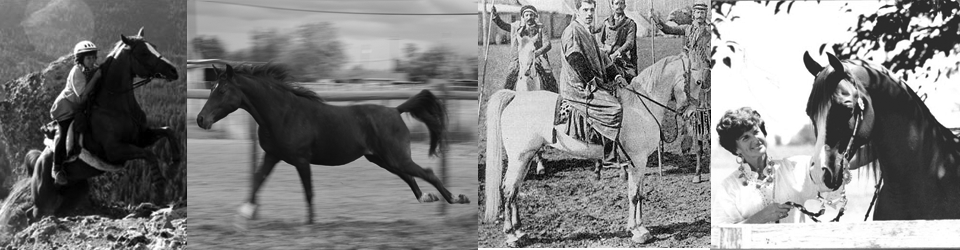
by Michael Bowling © 1989; used by permission
from The CMK Record VIII/3 1989

*MIRAGE at Crabbet in 1923 or ’24. Photo courtesy Rosemary Archer.
From the 1924 Crabbet Stud Catalogue:
“Mirage. Lady Wentworth has also at Crabbet a very fine white stallion imported by King Faisal of Irak from the Denednasha tribe, to whom he paid £500 for the horse through General Haddad Pasha, who identified the horse and his history in 1922. He is a Kehilan Ajuz of the Denednasha nejd strain, but will not be incorporated in the Crabbet Stud until King Faisal’s signature has been obtained.”
From The Crabbet Arabian Stud: its history and influence by Archer, Pearson and Covey: p. 108
“Mirage. A Seglawi Jedran Dalia. White stallion bred by the Anazeh tribe. Exact date of birth unknown….The Crabbet records indicate it was about 1916. Brought by King Faisal of Irak to France and presented to the Italian Ambassador Signor de Martino and brought by him to England. Bought at Tattersalls 1923. Sire: a Seglawi Jedran. Dam: a Seglawieh Dalia. Sold to the USA 1930.”
p. 182 “[Roger Selby’s] main purchase in 1930 was Mirage, an imported grey stallion of the Seglawi Jedran Dalia strain. Lady Wentworth described him as ‘a very showy good horse. Excellent legs, splendid quarters and fine front. Very good in saddle but too bouncing for English taste as he gets English riders off.’ But this was not the reason Mirage was sold. Weatherbys had by now closed their Stud Book to new imports and although Lady Wentworth tried to persuade them to accept Mirage, she was unsuccessful and therefore had no option but to sell him.”
p. 220 “Another stallion I [Cecil Covey] remember was Mirage, a very quiet horse to handle but as soon as you mounted him he became a different animal, full of fire and verve. When we were visited by King Fuad of Egypt, I was detailed to meet his convoy of cars at the gate of Crabbet Park and to escort them down the drive mounted on Mirage. We must have put on a spectacular display as Mirage hated combustion engines and gave me a most awkward ride. When ridden he carried his head and tail high and had a very short gait which took a while to get used to. But once mastered he was exhilarating.”
From Al Khamsa Arabians: p. 76
“Mirage. 1919 grey stallion, sire a Kuhaylan-Ajuz of the Anazah, dam a Saklawiyah-Jidraniyah of the Dal’al family, bred by the Saba, imported in 1921 to Iraq for King Faisal.” “*Mirage’s date of birth is given as 1909 in Vol IV of the Arabian Horse Registry stud books, but this is corrected in Vol V. … The Arabic document in *Mirage’s case is from the Royal Stables at Bagdad, sealed by El Mahasshami, Director. It confirms his strain, the strain of his sire, and his breeder.”
*MIRAGE could scarcely have been more highly esteemed in his day, and he played a central role in Selby breeding, perhaps the most influential single program in the breed’s post-World War II development in North America. *MIRAGE and his sons achieved the very highest regard as sires of mares for the all-conquering *Raffles horses. When styles changed and the Selby stock came to appear more often in the female lines of outcross pedigrees, *MIRAGE was increasingly diluted, although his name still appears with surprising frequency as an ancestor, whether of CMK Arabians or those of mixed sources. In recent years the *MIRAGE influence has entered a new phase and become increasingly prominent in tail male; his must now be the most internationally successful of all the pre-1960 North American sire lines–and one of very few of that vintage not only to hold its own against more recent imports but rapidly to increase its standing. Few sire lines in the breed can ever have equalled the explosive expansion experienced by that of *MIRAGE since 1980.
The beautifully produced 1936 Catalogue of the Selby Stud described *MIRAGE as a pure white 14:2-hand, 1000 pound “Seglawi Jedran of Dalia, the most prized of the Seglawi strains,” foaled in 1909, and indicated he was “three gaited, sound, most gentle and lovable.” According to this source *MIRAGE was champion at the 1926 Richmond Royal Show in England, and also champion at the 1934 National Arabian Show at Nashville, Tennessee. The Selby management clearly believed the 1909 foaling date to be correct, for much was made of the vigor of *MIRAGE, that “he shows none of the characteristics of advanced age” and that his 1934 championship “at the age of 25, [was] a most unique honor for a horse of such remarkable age.” Similar comments on *MIRAGE’s vigor for his age were made by Margaret Lindsley Warden in The Horse, Sept-Oct 1934, and reprinted in The Journal of the Arab Horse Society for 1935. Warden also called *MIRAGE “wonderful” and said he was
“now rated by many experts as the most perfect specimen of the ancient êlite or classic type in America…He stands a scant 14:2, a sturdy model with the characteristic refinements of the best of his breed. His head is a glory and his great eyes express high but gentle spirit and gracious personality.”
General Dickenson of Traveler’s Rest, contributing a review of US Arab horse activities to the 1936 number of the same British annual, wrote that
“Selby Stud has continued to breed very intensely from the imported foundation stock, using MIRAGE as a sire the past season, not only because of his fine type, but because he is past twenty-five years of age and at best they cannot hope to have him many more years.”
The Selby catalogue records that *MIRAGE was chosen from his desert breeder as “a young colt” for King Faisal of Iraq by a General Haddad, and that Chefik Bey Haddad, son of the General, visited the Stud to spend
“many hours in the corral with the Stallion, and Mirage seemed to recognize him, even though some time had elapsed since he had last seen him. The Bey stated that he had frequently visited the horse while in England, after he passed out of King Faisal’s possession.”
This seemingly direct connection with *MIRAGE’s early years make it somewhat difficult to understand how an error of ten years in the horse’s foaling date could have persisted. On the other hand, one could picture that while comment might be made to Chefik Bey Haddad that *MIRAGE “looks well for his age,” the question of precisely what that age was might not come up in so many words.
*MIRAGE was not registered in England; the General Stud Book was closed to new imports and Lady Wentworth at that period refused to recognize the authority of the Arab Horse Society. The Iraqi certificate of *MIRAGE’s origin, reproduced in the Selby catalogue, is dated 1927. It is interesting to note that at the time he won his 1926 Richmond Royal championship *MIRAGE apparently was not only unregistered but quite undocumented.
Either Chefik Bey Haddad or Carl Raswan might have provided that “most prized” designation for the unfamiliar Seglawi substrain of Dalia. It is well to remember that particular strains and substrains passed in and out of fashion according to the exploits of individual war mares, and that a “most prized” substrain in one tribe or region might be of no special note, or nonexistent, in another. Lady Wentworth, in that monumental tome Thoroughbred Racing Stock and its Ancestors, provides another reference to Seglawi Dalia. She records that
“Lady Anne Blunt made careful enquiries over a number of years [as to the origins of the Darley Arabian and that] Sheykh Mijuel … said mares had gone from Central Arabia at one time, and others later, and stallions from his own tribe. He had heard talk of a Managhieh mare and some colts of that strain, a grey and a bay, purchased by an Englishman at Aleppo. One colt, which was left apparently some time after purchase with the tribe, went by the name of the Managhi Daali (Darley’s Managhi)…before leaving the tribe the colt sired a well-known filly which was known as the ‘Daalieh’ or ‘Daralieh.’ Possibly the modern strain Dalia, still existing, may have some connection with this. There is a strain of Seglawi Dalia with the the Anazeh which may be descended from the Seglawieh mare with ‘Darley’ attached, according to custom.”
Since we are not told that the “Daalieh” was not a Seglawieh, it seems at least plausible that she herself may have founded the Dalia substrain of Seglawi Jedran; it is therefore within the realm of speculation that the Darley Arabian, renowned as a Thoroughbred foundation sire, might still have Arabian descent through *MIRAGE. Had Lady Wentworth been able to register the horse in GSB or chosen to use him at Crabbet as a single-registered sire she might herself have made more of this possibility, but at the time of this writing *MIRAGE was already in Ohio.
There is no record of British foals by *MIRAGE though it seems strange that he should have been seven years at Crabbet, presumably with the idea of providing a potential outcross to the existing lines of the Stud, without so much as being tried on a pony mare. [Note added in 2005: it is now clear that the breedings credited in GSB to “Miraze” actually reflect the use of *Mirage]. In the early years of the Selby Stud crossbred matings appear for some reason to have been done more often with the Arab mares than with the sires; at any rate despite those recorded efforts to make full use of *MIRAGE while he still was available, he got just 26 registered Arab foals from 1932 through 1940. He leaves descent through all but four of them, a remarkably high success rate for any sire, again indicating the regard in which he was held by breeders of his day. Three of the four nonstarters died young; according to Arlene Magid’s *MIRAGE feature in The Crabbet Influence (Nov-Dec ’89), one of them drowned and two were struck by lightning. The only *MIRAGE gelding was his 1935 son BATU and ever since learning that the original of that name was an heir of the rampageous Mongol leader Genghis Khan I’ve wondered what the young BATU’s disposition might have been like.
The 1932 *MIRAGE crop consisted of one grey filly PERAGA, out of the “old American” mare SLIPPER (Yima x Sabot) and bred by Selby. PERAGA produced in Tennessee, California and Missouri and has descent through six of her ten foals; her daughters TABITHA, KATINKA and MARAGA all founded substantial branches of the BASILISK family. PERAGA’s sister of 1933, PERA, produced 6 foals and has descent through 4 of them.
The other 1933 *MIRAGE foal of record proved the most important of them all, for he was the dynamic little dark chestnut IMAGE out of *RIFALA (Skowronek x Rissla), destined to succeed his sire at the head of the Selby Stud. IMAGE had his first foals in 1939 while he was still competing for mares with *MIRAGE; he might have stopped with those and still have left an important legacy, for they grew to be the elegant and dynastic chestnut matrons IMAGIDA, dam of RAFFI and IMARAFF and foundress of a superior mare line; and DEVA, the most influential mare at Never Die Farm in Maryland. In fact IMAGE was credited with 70 more foals over 20 seasons and 54 of them left descent. The word “credited” is used advisedly, because there were four grey foals registered to the chestnut IMAGE from non-grey mares. One of these, the 1940 colt NISIM, is not counted among the 72 for his sire of record was changed to *Raffles, but the other three remain recorded impossibly as grey products of matings without a grey parent. (One is certainly grey in her photos; both the others sired grey foals from chestnut mares.)

ARABI KABIR 2379 (Image x *Kareyma) photo courtesy Linda Paich
PENNE, KHYMAE, IMNA, TALEH, NABIMA, MAATIGA, NIMA, SEBBA, IMCHA, SANGE, PAMELA, EL HACENE, ALIMA, and IMABIMA are perhaps the most noted of the younger IMAGE daughters in pedigrees; the IMAGE influence through mares has been incalculable. As show horses and sires PHANTOM, SARAB AL SAHRA, SELMAGE, DEVACHON, ARABI KABIR, RAFLAGE, MIRAZ, DESMOIN, IMAGIN, SHARRAK, EL MOTELA, IMAGINATION, RAMINAGE, GEYIMAGE, GAGE and ZELIMAGE were among the IMAGE stallions to achieve note. *RIFALA’s inbred son PHANTOM was a sire of distinctive style whose elegant curve of neck still can be recognized in his descendants but there is no question that the most prominent branch of the direct *MIRAGE male line today springs from ARABI KABIR. That showy chestnut son of the China doll *KAREYMA (Naseem x Julnar by *Abu Zeyd) got 52 foals, stationed first in California but gaining renown in the Northwest when promoted to head sire of the Silva program. ARABI KABIR’s sons ERRABI and RABAAR sired the national champion stallion and mare BAY-ABI and RAHBANA, and his daughters including notably INEZ, ZABIRA, IRAYIS, ABARAYIS, WANDA and LADIRAH were champion producers or founded important families. BAY-ABI became the leading sire of the *MIRAGE line; the record of BAY-EL-BEY has latterly far surpassed that of the other BAY-ABI sons and he himself has been replaced in turn by his sons, most prominently BEY SHAH, BARBARY, and HUCKLEBERRY BAY (triple *MIRAGE and double *KAREYMA).
1934 brought *MIRAGE two lesser but worthy sons and a prominent daughter in the persons of NAMIR, INDRAGE and RAGALA, all out of imported Crabbet mares. Dr. Septimus Thompson took to Ontario the Selby imports *JERAMA and *NAMILLA, both of the rare MAKBULA family in which the Selby Stud had achieved a near-monopoly by importing the KIBLA descendants *NAMILLA (*Nureddin II x Nejmia), *KAREYMA, *KIYAMA (Rafeef x Julnar) and the latter mare’s filly *JERAMA by JERUAN. *NAMILLA went to Canada with her grey son NAMIR at side; NAMIR got 18 foals and bred on through half of them. The only Canadian descent from NAMIR was via his son NARAMA, from *JERAMA, sire of five foals. Later in Nebraska NAMIR did better for himself, getting the familiar matrons MIRZALNA, KOMIR (that beautiful chestnut *SULEJMAN stallion KOMSUL heads up her line), MIREEBAH and CYNKIR and the lightly-used sires NAJA and NARAH among his 15 foals from 1950-54.

INDRAGE 1088 (*Mirage x Indaia) photo courtesy Craver Farms
The RASEEM/NISREEN mare *INDAIA’s handsome bay son INDRAGE was to get 55 foals, mostly during his tenure as head sire for C.A.West in Pennsylvania. INDRAGE was another noted sire of mares, with the likes of WASEIDA, WAZVAND, WAFADI, KOREEN, WANDRA, REISINDE, MIRABA, RASEEMA, and KATAWBA (his last foaled when he was 21, though he lived to be 34) on his list. One INDRAGE son does not much stand out from another in terms of influence but WARAJE, the improbably named EL PASHA OF HIGHVIEW and KENTHELMARG’S SHEIK, RAHAGE, IFRIT ABYAD, and the reserve East Coast Champion MIRLINDRAFF are among those seen in pedigrees. INDRAGE get, including many of those above plus such as INDKERAGE and SKOWROMIR, made notable riding horses.
The first of the great *MIRAGE mares was IMAGE’s grey 1934 sister RAGALA, dam of 16 foals with descent through 11 of them. Hers was predominantly a mare-line influence; three of her sons were used for breeding but only one of those sources persisted. The 10 RAGALA daughters produced up to 18 foals apiece, averaging 11.4 even though one of them managed only three. *RIFALA’s only daughter amply furnished her branch of the RISSLA family. RAGALA was much the most important foundation mare for the famed Bear Claw Ranch program of Mrs. Jeannette Cox Morill in Wyoming; those RAGALA daughters, without extending the lines further, included such noted matrons as RAZIKA, MISTY MOON, BOIS DU ROSE, ARIANA, ADASTRA, NEFERTITI, BINT RAGALA, LAKSHMI and LALLA KADIJA.
SLIPPER’s gelding son BATU was the best *MIRAGE could do in 1935 but the ’36 crop brought five foals, again all from Crabbet mares; besides RAGIN, the ill-fated brother to INDRAGE, there were ROMIRA, RIFAGE, AGWE and RAGEYMA. The *ROSE OF FRANCE (*Raswan x Jalila) daughter ROMIRA produced four fillies, all “straight Selby” by pedigree though none were bred there, and all represented in pedigrees today. The *Raffles daughter RAFFIRA with 8 foals was the most prolific; her sister MIRAFF produced only one but that was the classy show horse NARZAD who also got a few foals, with successful individuals among them.

RIFAGE 1286 (*Mirage x *Rifala) photo courtesy Nyla Eshelman
The third of the *MIRAGE/*RIFALA siblings, the grey RIFAGE, went to Colorado as a youngster and lived into his 30s as the head sire of the Van Vleet program. RIFAGE left 102 registered foals including a wealth of daughters headed by the national champion mare ROMINNA and a particularly lovely early top ten winner SHIHADA. The most prominent RIFAGE son in pedigrees must be the Gainey sire GAYSAR who got the mare sire GALIMAR and the versatile show horses SKORAGE, double-*MIRAGE full brothers out of RAGEYMA. AGWE, the *MIRAGE son from the scopey arched-necked bay *HILWE (Najib x Hafra), sired just seven registered foals in his South Carolina career through age 16; five of the seven were from the Brown Egyptian import *RODA, and four of those still represent AGWE in pedigrees. The handsome eldest brother APOLLO got 36 foals and the imposing junior partner JASPRE sired 64, while their sister WEDA numbered such good mares as AZEDA by AZRAFF and RAFFWE by RAFFEY among her eight offspring. The success of these family members is only prologue to the story of RODETTA who was exported to Cuba but not before she had produced the Field and Al-Marah foundation mares CASSANDRA and ROSE MARIE, two of the most renowned and impressive of the *Raffles daughters.
The first *MIRAGE chestnut and the second of his great daughters was foaled by *KAREYMA: RAGEYMA, dam of 11 foals with descent through 10. She began with the grey colt GEYM; as the only *Raffles son out of a *MIRAGE daughter to reach maturity, GEYM was inevitably a head sire at the Selby Stud and then in the successor program of Friendship Farms in Illinois. GEYM lived into his 30s and sired 138 foals. At Selby’s as the IMAGE daughters came to maturity they went to the court of GEYM, and while IMAGE lived his grandaughers from this generation were crossed back to him. At Friendship GEYM encountered a somewhat wider set of mares and his daughters made the acquaintance of *NIZZAM. GEYM’s sister GAJALA was a key foundress in the Gainey program; their half-brothers GALIMAR and SKORAGE have been mentioned, and those two had a prolific full sister in GAGEYMA. FA-EL-GEMAR by *FADL, GARAK by AZRAK, GALLANT by PHANTOM, GAYFERRA by FERZON and VIA by GARAFF rounded out the RAGEYMA breeding roster.

RIFALA’S LAMI 8391 (Geym x Maatiga by Image) photo from the Cummings collection
RASAGE, RAGIA, GEYAMA and (in Canada) MIRILLA were the 1937 *MIRAGE offspring, once again all from Selby Crabbet mares. The chestnut RASAGE from *RASMINA (Shareer x Jalila) was another sold first to California but even more than ARABI KABIR found his niche in the Northwest, where he left such daughters as NIRAGE, AMORET, FILLAREE, RONDI, RASYL, RASAGE’S QUEEN OF SHEBA and RASAGE’S GARDEN OF EDEN. RASAGE was back in California to leave a last crop in 1961. His son DALLAL ABU RASAGE had a colorful career; shipped to Hawaii en utero he made an all-around performance horse, and DALLAL too returned to California to sire a few foals as an older stallion. RAGIA, the grey sister to INDRAGE, was one of the mares Roger Selby donated to the US Remount; she produced two fillies by KATAR and both have bred on, with her granddaughter AL-MARAH BINT AIGRETTE perhaps the most successful for the line. GEYAMA, a three-quarters sister to RAGEYMA out of *KIYAMA (Rafeef x Julnar), produced eight foals, most of them for Comar Arabians in Iowa. She bred on through her daughters AMULET, MIRAGETTE, MIRAGEY, all by IBN MIRAGE, and AL-MARAH GENNA by INDRAFF. AMULET and MIRAGEY produced by AL-MARAH IBN INDRAFF the blood-sisters ROSE OF MIRAGE and VEISHEA, dams by AZRAFF of the blood-brother show horses and sires COMAR BAY BEAU and CAMIRAFF.
Dr. Thompson’s (and *NAMILLA’s) second *MIRAGE foal, the filly MIRILLA, was to produce eight foals in Canada and Washington. One of her sons by the Maynesboro stallion GHASIK had two breeding daughters while her three daughters by ROYAL FEZ and one by ABU BAHA gave her 20 grandchildren. The least prolific of the ROYAL FEZ sisters, bred to ABU BAHA in her turn, produced FEZABBI to whose family belongs the glamourous show horse and sire SHABAOUD.
*KAREYMA and *KIYAMA produced again to *MIRAGE in 1938. *KAREYMA’s filly was one of those struck by lightning, but the *KIYAMA colt YAMAGE went to Florida where he sired five foals through 1949 and bred on through three of them. *MIRAGE had his biggest crop of seven foals in 1939, five of them from outside mares. W.C.Shuey sent the double *BERK granddaughter CURFA (Ribal x Nardina) and RIHANI (*Saoud x *Muha) from North Carolina to produce the grey colt ADONIS and bay filly JOHARAH. ADONIS was sold to Montana where he got 24 foals including such producing mares as NEJD BANOU, UR ARABAH, ABA-EL-RIEL, UM EL SURAB, BINT SABA, NEJD KAMIL, UR OKAI, NEJD KUSOF, NEJD BENAYA and NAMIRADA, and RAKKA who sired the important mare KHAMMA of Hillcrest Stud. ADONIS mares were producers for the early Kale and Lasma programs.

A very young JOHARAH (*Mirage x Rihani)
JOHARAH produced 11 foals, all but two of them for the Shueys at Sunny Acres, and is in pedigrees through six. JOHARAH’s first three were all by *Raffles; the colt SHUEYMAN died young and his sister MY GYPSY ROSE left no descent though she had three registered foals. This nick still is accounted one of the most successful in history, for the eldest sister was the elegant if oddly-named chestnut MY BONNIE NYLON, already mentioned under the IBN HANAD heading in the HANAD story (Record VII/4) and one of the key mares in the success of the Sunny Acres program. JOHARAH never produced another MY BONNIE NYLON (few mares manage one in that class) but she had good breeding offspring by GEYM, TUT ANKH AMEN and IBN HANAD at Sunny Acres, and also has descent through her last foal MALIK EL HAWA from her days in the less equable clime of Massachusetts.
The sires of CURFA and RIHANI each had an Ohio-owned daughter producing by *MIRAGE in 1939. ADONIS’s three-quarters sister was the grey KAE out of KETURAH (Ribal x Aatika), bred by L.N.Brutus; KAE produced first for R.J.Geimer of California and Texas and then became an early Al-Marah matron, giving six INDRAFF foals beginning with the great cutting mare AL-MARAH ZAIBAQ, dam of 11 foals including OVERLOOK FARWA by Abu Farwa. The next sister FAE died foaling in 1960, leaving six registered foals, but these included IBN JULEP, FAESAN and LA FAESANA. AL-MARAH KETIR also produced 11 foals including the lovely if hiccup-like about the name HHIK. SHIRIK was a noted show horse who rather surprisingly got only 30 foals but numbers good producing mares among them; AL-MARAH KAIDAR was less lucky as he sired two foals but neither of them bred. The youngest sister TRAKILA produced 10 foals. KAE ended her career in South Carolina and left two breeding double-*MIRAGE offspring by AGWE’s son APOLLO.

RASMIR 3071 (*Mirage x Rasasah) in old age photo courtesy Linda Paich
RASMIR was a grey three-quarters brother to JOHARAH, out of L.P.Bailey’s RASASAH (*Saoud x Aatika) who was to cross so successfully with *Raffles. RASMIR was not registered until he was five years old; he became a working stock horse in Texas, owned at the end of his life by the Kuhlmans of Rancho Llano Grande. RASMIR sired three colts; his first son, the bay KARAGE, made a great using gelding after he sired two fillies from the beautiful ANTEZ granddaughter TEZEYNA. One of the KARAGE daughters produced 15 foals and carried on the RASMIR influence. Her name was KAREYN and she numbered among her produce some of the top show horses of the ’70s including MINDY KAR by IZKAR and a string of notables by KIMFA. The KAREYN family includes halter show horses, top performers and breeding animals but unquestionably is headed by the sheerly beautiful KIMFA daughter KIMEYN, a great show mare of her day and now an international pedigree influence. The fifth outside mare to produce by *MIRAGE in 1939 was C.J.Brukner’s Davenport plus Domow chestnut CHARMAIN (Abu-Selim x Aatika) who produced the grey filly KYMIR, dam of one foal. This was the bay double *MIRAGE grandson MERJAN by IMAGE, sire of 14 Arab foals but probably more noted as a sire of partbreds. (Another AATIKA daughter played a major role in developing the *MIRAGE legacy: AL-MAATIKA by *AL-MASHOOR produced the important IMAGE mares MAATIGA and ALIMA.)
Two Selby Crabbet mares produced grey *MIRAGE colts in 1939. IDOL out of *SELMNAB got 40 foals through 1965, of which the striking chestnut action champion LIDOL must be the most noted. IDOL’s sons FAYZ and SHAHZADOL also are encountered in pedigrees. IBN MIRAGE, full brother to RAGEYMA, replaced RAGIN at Comar Arabians in Iowa and got 54 foals, playing a central role in linebreeding *MIRAGE and the JULNAR influence and then providing mares to cross with AZRAFF. IBN MIRAGE and his double *KAREYMA son MIRFEY are still recognizable sources of the KAREYMA stamp in modern Arabians, and an earlier son HIMALAYA is a widespread influence.
*MIRAGE died in 1939, leaving *KAREYMA in foal once again for 1940. She produced the grey filly KARAGA who with her older sister KAREYGA was struck by lightning and killed in 1941. Given the success of their full siblings RAGEYMA and IBN MIRAGE, that lightning bolt might have halved this story.
Descent table *MIRAGE 790: registered offspring
| name |
reg# |
color |
sex |
year foaled |
(dam) |
breeder |
state |
(number of foals/number with offspring) [“//” – no offspring] |
| Peraga |
910 |
gr |
f |
32 |
(Slipper 442) |
Selby |
OH |
(10/6) |
| Pera |
1107 |
gr |
f |
33 |
(Slipper) |
same |
|
(6/4) |
| Image |
1008 |
ch |
c |
33 |
(*Rifala 815) |
same |
|
(72/54) |
| Namir |
1056 |
gr |
c |
34 |
(*Namilla 855) |
same |
|
(18/9) |
| Indrage |
1088 |
b |
c |
34 |
(*Indaia 813) |
same |
|
(55) |
| Ragala |
1091 |
gr |
f |
34 |
(*Rifala) |
same |
|
(16/11) |
| Batu |
1116 |
b/gr |
g |
35 |
(Slipper) |
same |
|
// |
| Ragin |
1284 |
gr |
c |
36 |
(*Indaia) |
same |
|
// |
| Romira |
1285 |
gr |
f |
36 |
(*Rose of France 857) |
same |
|
(4/4) |
| Rifage |
1286 |
gr |
c |
36 |
(*Rifala) |
same |
|
(102) |
| Agwe |
1287 |
ch/gr |
c |
36 |
(*Hilwe 810) |
same |
|
(7/4) |
| Rageyma |
1289 |
ch |
f |
36 |
(*Kareyma 811) |
same |
|
(11/10) |
| Rasage |
1374 |
ch |
c |
37 |
(*Rasmina 856) |
same |
|
(40/26) |
| Ragia |
1375 |
gr |
f |
37 |
(*Indaia) |
same |
|
(2/2) |
| Geyama |
1376 |
ch |
f |
37 |
(*Kiyama 809) |
same |
|
(8/4) |
| Mirilla |
1437 |
gr |
f |
37 |
(*Namilla) |
Thompson |
Ontario |
(8/5) |
| Kareyga |
1579 |
gr |
f |
38 |
(*Kareyma) |
Selby |
OH |
// |
| Yamage |
1581 |
gr |
c |
38 |
(*Kiyama) |
same |
|
(5/3) |
| Adonis |
1619 |
ch/gr |
c |
39 |
(Curfa 1019) |
Shuey |
NC |
(24) |
| Joharah |
1620 |
b/gr |
f |
39 |
(Rihani 1015) |
Shuey |
NC |
(11/6) |
| Kae |
1748 |
gr/rn |
f |
39 |
(Keturah 945) |
Brutus |
OH |
(10/7) |
| Idol |
1762 |
gr |
c |
39 |
(*Selmnab 812) |
Selby |
OH |
(40) |
| Ibn Mirage |
1763 |
gr |
c |
39 |
(*Kareyma) |
same |
|
(54) |
| Kymir |
2455 |
gr |
f |
39 |
(Charmain 860) |
Brukner |
OH |
(1/1) |
| Rasmir |
3071 |
gr |
c |
39 |
(Rasasah 1141) |
Bailey |
OH |
(3/1) |
| Karaga |
1943 |
gr/w |
f |
40 |
(*Kareyma) |
Selby |
OH |
// |