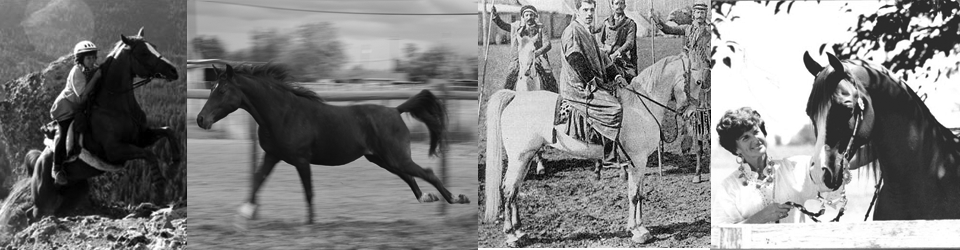
by Michael Bowling © Copyright 1997


CMK stands for “Crabbet-Maynesboro-Kellogg” and recognizes three programs which transmitted much of the central stock of what became North America’s historical Arab-breeding tradition. “CMK” is a registered US trademark; rather than discouraging others from using it, we urge them to do so, as long as such use is in keeping with the CMK definition. The CMK Record newsletter grew out of the general interest in these horses in 1981, without attempting to define specific pedigree limits for CMK but emphasizing North America’s historical using Arabian tradition. Rick Synowski, announcing the first CMK Heritage Catalogue in 1982, sent out a call for listing stallions which could trace
“in at least 75% of their pedigree to foundation stock of Crabbet Stud [including its Egyptian branch, the Sheykh Obeyd Stud], the Hamidie Society, Spencer Borden, Randolph Huntington, Homer Davenport, W.R. Brown and Kellogg.”
The definition was first modified during the preparation of that Catalogue to recognize the importance of the Selby and Hearst programs. The current definition, acknowledging a threat of genetic bottleneck in the trend to breed Arabians almost exclusively for narrowly focused show-ring applications, added a further qualification. A CMK Arabian must still carry a minimum 75% by pedigree of CMK founder ancestry as above. It must also trace in tail male to a CMK sire line, as summarized in the third CMK Heritage Catalogue of 1992, and in tail female to a family established in North America by 1950. A previously unstated assumption is now made explicit: CMK breeders will tend over time to increase the average founder percentage in their programs above the minimum 75%.
Note that the CMK movement exists to bring together the supporters of traditional Arabian breeding. Specialized aspects within the tradition, such as straight Crabbet, GSB, or Jockey Club, or programs based on preserving the influence of individual breeders or sires such as Never Die Farm or Gulastra, all fit under the CMK umbrella. Note too that we are committed, if the overall CMK pedigree definition should change in the future, that it can only go in a more inclusive direction.
The CMK Heritage is a working preservationist movement emphasizing the beautiful using and companion horses that earned the breed its reputation for versatility, adaptability and soundness. The vision which informs our activities traces originally to the travel writings and the imported horses of the Blunts and Homer Davenport–CMK Arabians are distinctive for their Blunt and Davenport character. Very strong elements descend from the two over-arching cooperator breeder circles of the 1950s and 1960s, founded by H.H. Reese (Old California breeding) and James P. Dean (the Midwest circle). At the same time we value, and seek to preserve, other CMK ancestral elements, including old sire lines from Maynesboro and other sources which were not well represented among the Reese and Dean programs, and consequently have become rare. One healthy undertone to the CMK approach is a respect for the regional flavor of traditional breeding; we emphasize working through local action groups to preserve genetic diversity, and oppose national and international trends toward genetic homogenization.
The Crabbet Arabian Stud was founded in1878 by Wilfrid and Lady Anne Blunt after their desert journeys. Foundation horses from the Bedouin tribes were blended with those descending from the legendary collection of Abbas Pasha I through that of Ali Pasha Sherif–the Egyptian “Pasha” breeding may be seen as an early influential cooperator circle. Although the Crabbet Stud no longer exists as a physical entity the Crabbet heritage prospers in the hands of dedicated breeders throughout the world. The influence exerted by the Blunts and their daughter Lady Wentworth through their writings is a further international unifying theme. Crabbet breeding was continued by Lady Wentworth, who added the Polish outcross Skowronek; and after her death from 1957 to 1971 by C.G. Covey. North America possesses a rich and diversified sampling of both the Blunt and Wentworth aspects of Crabbet breeding. Thanks are due to the early importers Spencer Borden, W. R. Brown, W. K. Kellogg (represented particularly strongly through the horses of the Old California Reese circle) and Roger Selby (especially through the Dean circle), and to farsighted breeders who have added important later Crabbet elements to North America’s gene pool. Virtually every Crabbet foundation animal still represented today in world pedigrees can be found in the background of North American Arabians. Maynesboro, the New Hampshire establishment of W. R. Brown, and the Pomona, California ranch of W. K. Kellogg, played key roles in transmitting the Crabbet heritage. At the same time, Brown and Kellogg like Lady Wentworth used Arabians from other sources compatible with the Blunt foundation. Their goal: combining Arabian quality and breed character with sound structure and performance ability.
The importance of Crabbet breeding must not leave one thinking “CMK” is somehow “the same as Crabbet” or, worse, a diluted form of Crabbet. Too many people outside the CMK ranks have the idea that “it’s all Crabbet” if they don’t know what else to call a pedigree element. In that mental fog the straight Crabbets, their subsets and their GSB and Crabbet-old English associates, lose their distinctiveness and are in genuine danger of losing their existence. A point that grows out of CMK’s recognition of the fine distinctions, is the appreciation of the specialty programs both in their own right and for combining with other CMK elements.
A major contribution to the uniqueness of North America’s Arab-breeding tradition was made by the 1906 desert importation of Homer Davenport–nearly all the Davenport influence in modern pedigrees comes via horses that passed through the Kellogg Ranch. Other direct Eastern sources have enhanced this development and contributed key individuals to the Reese and Dean circles. Likewise the 1947 Hearst horses from Syria and Lebanon blended beautifully with Kellogg and Maynesboro stock already at San Simeon, and their influence is valued in ever-widening circles.
The legacies of Donoghue and Lewisfield (Friendship and Al-Marah and Gainey; McCoy and Shalimar and Sunny Acres, Lodwick and Skyline those breeding programs which grew out of the Reese and Dean circles) are treasured within the CMK movement, even though CMK was defined after the fact. They transmitted the heritage and appreciated the vision of the Blunts and Davenport. They differed in accidentals, according to the horses they started out with and which mare lines happened to be more prolific or to suit a particular sire. They also came to differ more basically in terms of individual vision.
Some breeders have the “eye” for combining horses and some don’t, but even if two people are equally good at that, each will develop a personal preference–or they did in the days when we had breeding programs (cf Gloria Swanson in Sunset Boulevard, “we had faces then“). The nature of biology is variation–there never was a time (nor will be) when all horses of any set were/are identical and beyond criticism (and note that those ideas are not the same anyway). We all prefer the better individuals of any line to the worse, but common sense should tell us we can never reduce an aspect of the Arabian breed to one individual, and still maintain that distinctive kind of horse. Preservation means recognizing that you either have a particular genetic entity, or you don’t. It means breeding good individuals within a coherent biological reality.
Most importantly, the CMK Heritage aims to produce and to promote beautiful, companionable horses with real performance ability. This was the vision the Blunts and Davenport brought home from the desert; this was Brown’s reason for having the Maynesboro horses take part in the Army endurance competitions, retiring the Mounted Service Cup; this was what W.K. Kellogg had in mind when he presented his ranch and horses to the U. S. Remount. This is the central idea of the Crabbet/Maynesboro/Kellogg tradition; pedigrees are meaningful only to the extent that the modern horses reflect their ancestors. The horses represented at the Northwest CMK Symposium in 1994, at the 1996 Springfield, IL Preservation Breeding Symposium, and at other such exhibitions, clearly illustrate that the CMK concept is a practical success.
For an updated version of the CMK definition see: The Arabians of the CMK Heritage.
