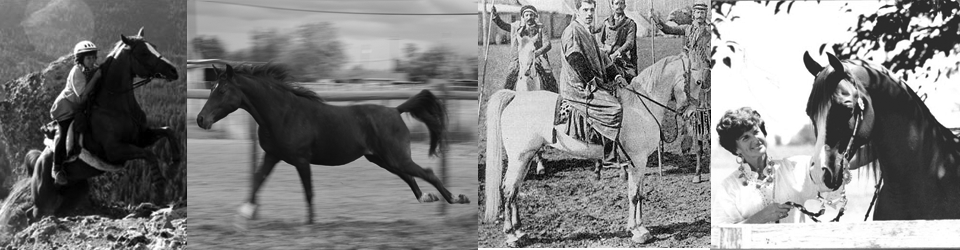
Monthly Archives: November 2008

Van Vleet’s Arabian Laboratory

by Bob O’Shaughnessy

(Western Horseman Mar/Apr’44)

High in the Rockies near Boulder, Colorado—8,600 feet up, to be exact—Lynn W. Van Vleet has established a Stock Horse “laboratory” that has drawn the interest and admiration of horse breeders everywhere.

Feeling the need for better Stock Horses—horses with the necessary stamina for working the range at high attitudes, Van Vleet turned to the horse whose courage and powers of endurance have been on record for more than four thousand years, the Arabian.

There are no pampered equine prima donnas in the Van Vleet Arabian stud at the Lazy VV Ranch. On the rough, rocky trails of this gigantic western “spread,” cowboys astride purebred, registered Arabians drive cattle to the highlands.

Transplanted from the hot and dry deserts of Arabia to the cool, glacier-scarred slopes of the Rockies, Van Vleet’s Arabians outshine the western horse of frontier fame, on his own roping grounds.

“And why not?” asks Van Vleet. “The Arabian horse is a tough, hardy, close-coupled horse who can adapt himself to any condition and any situation. It was the Arabian, you know, who was the ancestor of the western cow pony. America had no horses until the Spaniards and the Mexicans brought them here, and they were mostly of Arabian blood. Those horses which escaped from these early expeditions, into the wilderness of the great unexplored New World, founded the Indian pony herds. And those herds, in turn, produced some of our greatest cowponies.”

Van Vleet started in 1938 stocking his Hereford cattle ranch with a pool of some of the finest Arabian blood obtainable. He had studied the Arabian and was intrigued by its history. It was not long after the first of these horses arrived in their new mountain home that he decided there were to be no pampered darlings among them.

“Primarily, the Arab is valuable because of his blood,” says Van Vleet. “The reason this blood is so desirable is because it is hardy, rugged, courageous blood. It was prized in Arabia above gold and diamonds. A man’s true wealth was calculated on the basis of the number and quality of horses he owned.

“Bedouins fought for them—emperors and queens connived for them—and the world’s horsemen now are attempting to perpetuate them. All this is not only because the Arabian is a beautiful horse. Primarily, it is because the Arabian blood is the fountain from which the world’s great horses have come.”

So Van Vleet decided there would be no glass-barred stalls, no tasseled trainers, no formal riding rings, no jewel boxes on his ranch.

“Instead,” he said, “I wanted to bring out all the hardy, battle-born characteristics for which the Arab horse has been noted since the time of Christ. I wanted to transplant this horse into totally different surroundings and revive, even intensify, the traits of courage, intelligence, resourcefulness, and endurance which necessity and the experience of thousands of years of adversity in desert hardships bred into him.

“I wanted to bring the Arab into this mountain setting, which is as much the opposite of the desert as daylight is to dark, and substitute the rich diet of plentiful mountain meadows for the scarcity of desert lands; to substitute cooling, soothing mountain breezes for the hot winds of the desert.”

All this was done. Where the Arab had existed on a handful of dates, camel’s milk and a few drops of water, he now roams mountain meadows filled with wild flowers, and hay which is noted throughout the land for its nutritional values, and streams that trickle downward from the ancient glacier of nearby Arapahoe peak. In addition, these Arabs—whose ancestors the Bedouins considered privileged members of their families, and entitled to sleep in the tribal tents—were given human companionship. The cowboys, the farm hands, members of the Van Vleet family, and even visitors were encouraged to cultivate friendships with the horses.

Despite the human understanding that is extended to them—despite the plentifulness of their pastures—these Arabs still lead a life that is as rugged, in other ways, as the adversities of an Arabian desert.

In winter the stallions are kept at the Nederland ranch, where the barn is 8,600 feet in altitude. The mares and colts are taken to a pasture near Boulder, Colorado, about twenty miles away, where they are more accessible. Although they have shelter, the blizzards which sweep down the snow-capped Arapahoe Peak are bitter cold on the Arabs.

In summer the entire cavvy, which now numbers 69 purebreds, roams the ranch. It’s a many thousand acre spread. Cattle production is its primary business. There are more than 500 head of Whitefaces to be driven each spring from the winter pastures below Boulder to the branding pens on the Sulphide pasture.

That’s a cowpony’s paradise. For two days the herd is trailed up Boulder canyon. The overnight stop is midway up the canyon. The next day the herd is pushed again, upward, into the home ranch pastures. It’s a trip of about 25 miles, a long two-day trail drive in these days of fast cattle trucks and trains.

At the Sulphide, the Arab stallions—Kabar (grandson of fabled Skowronek, for whom Lady Wentworth of England declined $250,000 offered by the Russian government) and Zarife (the classic beauty)—vie with Red Wing and Little Red, two of the best western-bred cow-ponies for corral honors. Either stallion can cut a calf from the herd and its bawling mother, and into the branding pen, as precisely and as quickly as Red Wing or any of his cowpony ancestors.

The Arabian learns quickly,” says Bob Pack, foreman of the cattle crews. “They neckrein more gracefully than most western horses—they are as fast as a Quarter Horse. Kabar, for instance, whirls on his hind feet, raising his front ones. Not one horse in a thousand learns that trick, but it is an invaluable one in driving and cutting cattle. He’s as fast as a panther.”

Barek, another Arab stallion, foaled on the ranch in 1938, also is a favorite “cowpony.” He was ridden not only in the round-up last spring, but was used on cattle trails throughout most of the summer by Pack. The way Bob cocks his ten-gallon hat each time he sits astride Barek is a signal of the pleasure and pride he has in this young son of the desert. He, personally, trained Barek as a roping horse. And Bob(sic) also has the distinction of being the tallest Arabian ever recorded. Standing 16 hands, one quarter inch, he “shades” the previous record-holder, Nureddin, owned by Lady Wentworth of England.

In addition to their cowpony chores, the purebred Arabs are used as mountain trail horses by the Van Vleets. A westerner can appreciate the meaning of that phrase. In the West, only the hardiest of cowponies and rangebred animals are used for that purpose. Many mountain horses are awkward, heavy, plowhorse type animals, because the fancier breeds do not have the endurance, the legs, or the hoofs to survive mountain trails of the kind to be found on the Lazy V V.

One of these trails meanders through the hay meadows—up Boulder Creek, past the Bluebird tungsten mine, on past Arapahoe Falls where deer scamper away, and above the green-watered lakes of the Boulder water system. Then this trail leads straight upward 2,000 feet and more—across timberline and the tundra of Arapahoe Peak, 13,000 feet in the air.

It’s a full day’s ride to Arapahoe, and slightly beyond to Hell’s Hole—a favorite overnight camp ground that is little sheltered in the lee of nearby Sawtooth range. A cowpony, carrying rider and equipment, has to be conditioned to make that ride safely. It’s across jagged, hard-granite rocks that cut unprotected hoofs to shreds. It’s along trails that weave back and forth over the face of almost perpendicular mountainsides.

Rifage, small, but with the ruggedness and grace of tens of hundreds of generations of pure Arabian breeding behind him, picks his way along with the other larger Arabs over that trail each summer. Rifage weighs 850 pounds. Frequently, his rider and equipment will weigh 250 or 275 pounds, or one-third of gallant Rifage’s own poundage. He doesn’t falter—he doesn’t stumble on that trail. When the pack train stops to “blow” in the rare air, Rifage disdains the opportunity to catch his breath. He’s more interested in snorting and pawing the Alpine flowers to demonstrate his affection for his friends, the mares, who also of an occasion make the trip.

The close association with human beings likewise has sharpened the Arab’s natural affection. Guests who visit the huge mare pastures have but to whistle to bring the entire cavvy—twenty or thirty strong—meandering slowly toward them. Frequently, the mares are permitted to roam the lawns in front of the ranch houses and there, too, they come casually to greet both the friend and the stranger who appears on the lawn.

No special protective fences of wood enclose these mare pastures. Instead, the mares are confined by common wire that may, on occasion, cut a horse’s hoof as if it had been sliced away by a surgeon’s knife.

Does this sort of treatment of purebred Arabians sound fantastic?

Well,” says boss Van Vleet, “we don’t believe it is fantastic. Arabs love this sort of life. They thrive upon it. They are intelligent. They learn, more quickly than a cowpony, to stay away from barb wire fences. Seldom is one cut. A mountain lion killed one of our colts in the mare pasture on a summer’s night, but that is the only tragedy that has occurred. I believe that the natural way in which we have handled these horses has improved their stamina, their size, and their intelligence. That’s what we want.

Excerpted from THE ARAB HORSE, HIS COUNTRY AND PEOPLE

Excerpted from THE ARAB HORSE, HIS COUNTRY AND PEOPLE

Chapter II- FOREIGN ESTIMATES OF THE ARABIAN

Major General W. Tweedie, 1894 England

from the Khamsat Volume Seven Number Two Apr/June 199?

“up to this point we have been chiefly occupied with the Arabian Horse in countries where he is regarded as the work and gift of Allah, which neither needs nor admits of improvement. But the time has arrived to consider another series of facts. The same breed commands almost an equal degree of admiration wherever it is known. The horse of nations with whom the world, if ever it was young, still is so, and for whom the “long results of time” are traditional and unwritten, is sought out by the most civilized Government for the improvement of their studs and the expansion of their empire and resources. Several of the greatest generals of modern Europe have shown a strong preference for Arab horses as chargers. In the courtly circles of Persia and India, this is the horse which is prized above all others. The point is, what do these familiar facts imply? Is the Arabian abroad a genuine good thing or an illusion? Is it is merits that have thus distinguished him, or chiefly his oriental associations, and he the circumstance that no one knows exactly where he comes from? Such are the questions which next await us; but first, it may be well to notice what has been said by others, both in favour of the Arabian breed and in depreciation of it.

The praises of Arabians by their owners which occur in popular books require to be received with abatement. Not only does admiration come more naturally than fault-finding, but the authors of Such passages have frequently been literary persons, without any very wide experience of horses. This applies to one of the prettiest and most frequently quoted references of the class alluded to — that in which, in his Narrative of a Journey through the Upper Provinces of India in 1824-5, the amiable Bishop Heber commended his Arab riding-horse.

No ancient or modern Church can bear comparison with the Church of England in the power of producing excellent preachers and parsons, who are also horsemen; but the author of “From Greenland’s Icy Mountains” represented a different phase of clerical life. There can be no question that, for one whose seat is not well down into the saddle, the Arabian is the pleasantest and the safest of all the chevaux de luxe of the world. No one can be called a coachmen who has never handled rougher teams than gentlemen’s ones, — never worked a coach, stage after stage, and grappled with them as they came — bolters, bo-kickers, and all sorts of reprobates. And neither should one whose equestrian experiences have been confined to Arabs make too sure that he is a horseman. While noting this, we would not be thought to suggest that the clientéle of the Arabian is in any considerable degree, formed of men who are not exactly centaurs. A far larger class of his admirers, in which are many of the strongest riders in the world, consists of those who, when they are in the saddle, have other things to think of than horsebreaking. An adjutant-general or an aide de-camp, whose charger is given to “sticking up,” as it is called, under saddle cannot perform his duty. We know as well as any one that Arabs also are sometimes difficult to ride. Even the gentlest have their little ways, especially with the timid; and we have known a few which would give any man an uneasy half hour, when it was inconvenient to treat them to all that they required to sober them — a right good gallop. But, as a rule, horses of this breed, when asked to go in one direction, do not insist on going in another direction, or fix themselves on their forelegs and curl up like hedgehogs. Their worst tantrums, compared, for example, with the sullen humours of the Australian buckjumper, remind us of the “Amaryllidis Iras.” If one or two of the many splendid Arabs which the late Emperor of the French collected had been preserved for his ill-starred son, the Prince Imperial, the fateful moment in Zululand would not have found him struggling with his charger.

It should also be remembered that, ever since Great Britain took charge of India, the Arabian horse has enjoyed extraordinary opportunities of shining in the public service. India has been surveyed and settled, not by the Englishman alone, but by the Englishman and his horse. Important divisions of its cavalry armament — notably the Lancers of the Nizam’s country and the Central India Horse — obtain a large number of remounts from the Arab horse-marts of Bombay. In the brief but difficult campaign of 1856 in Persia, the straight swords and Arab horses of the Bombay Light Calvary demoralized the Shah’s forces. Chargers from the Euphrates have carried our soldiers to Candahar and Cabul, to Pekin and to Magdala. More recently, in Burma, where it is extremely difficult to keep foreign horses healthy, the cavalry of the Hyderabad Contingent added to the high reputation which it inherits.”

Web cmkarabians.com

Travels In Arabia the Desert by the Chevalier D’Arvieux (1718)

The Chevalier D’Arvieux’s Travels In Arabia the Desert

Originally published London, 1718

CHAPTER XI Of the Arab Horses

from the KHAMSAT Volume 2 Number 1 January 1985

The Khamsat introduction:

This is a most amusing reprint from a very long time ago (1718) in a form of English seldom seen or read in many years. We have reprinted it without modifying any of the phrases or spellings so it will read somewhat differently than we are used to but it provides some interesting insights into bedouin life with their horses as observed nearly 300 years ago. We thank Dr. Sherman Stinson for submitting it to us.

*****

There’s not the sorriest Arab but has his Horses. The Arabs had rather be without the most necessary Things in the World, than want a Nag to go about their Affairs, to seek their Fortunes upon the High-ways, and to make their Escape from their Enemies with.

They usually ride upon Mares, as properest for their Business; Experience has taught ’em that they bear Fatigue, Hunger and Thirst better than Horses; they are gentler, less vicious, and bring ’em every Year a Colt, which they presently sell, or keep it if it be a fine one and of a good Stock to make Money of it when ’tis fit for Backing: Their Mares never neigh; which is very convenient for ’em in their Ambuscades to surprise Passengers; and they accustom ’em so well to be together, that they will sometimes stand a whole Day, and in great Numbers, without incommoding one another.

The Turks on the contrary, don’t love Mares: The Arabs sell them their Horses which they won’t keep for Stallions, because of the Inconvenience to ’em in their Troops. They are never fix’d in any one Place’ they are all People that go and come just where their Service calls ’em: Their’s are Stone-horses, and it would be impossible to govern ’em if they smelt any mares amongst ’em. An Arab would not be reckon’d an honest Man if he had not a Mare to bestride. They call her Serras, which is a general Name for Horses; and they call a Horse Hhussan, which signifies only Curry’d or a Curriable Creature. The Turks, on the contrary, think it a Dishonour to mount a Mare, saying, that there is nothing so noble as a Horse; that a Cavalier, who is to make all the World his Country, ought not to embarrass himself with any sort of Female, nor any thing that may look like a kind of Family.

I told you, that the common Arabs ne’er mind their own Genealogy; if they do but know the fathers and Grandsires ’tis enough; They are usually unacquainted with the very Name of the Predecessors or their Families; but they are very curious about the Extraction of their Horses. There are some which they call Kehhilan, that are noble; others Aatiq, that are of ancient Race, but match’d below themselves; after those come the last Kind call’d Guidich, as much as to say, a Pack-horse, or by way of contempt, a Jade, these are very cheap’ the second are dearer, they are sold however at a venture, without proving their Descent. They that understand ’em well, find as beautiful and good one’s among them, as among the first sort, and set no less Value on ’em. They never let the Mares of the first Rank be Cover’d but by a Stallion of the same Quality. They know by long Custom the Race of all the Horses they or their Neighbours have; they knowe the Name, the Surname, the Coat, and Marks of every Horse and Mare in particular; and when they have no noble Horses of their own, they borrow some of their Neighbours, paying so much Money, to Cover their Mares, and that before Witness, who attest it under their Hand and Seal before the Emir’s Secretary, or some other public Person, where the whole Generation, together with the Names of the Creatures, is set down in Form. Witnesses are likewise call’d when the Mare has Foal’d; and another Certificate is made; where they put down the Sex, the Shape, the Coat, the Makes of the colt, and the time of its Birth, which they give to the Party that buys it. Those Tickets determine the Price of Horses; And they sell ’em dear the least are worth Five hundred Crowns in ready Money, or in Exchange against other Cattle, according as they bargain. The Emir Turabeye had a Mare that he would not part with for Five thousand Crowns, because she had travell’d three Days and three Nights without drawing Bit, and by that means got him clear off from those that pursued him. Nothing indeed was handsomer than that Mare, as well for her Size, her sharp, her Coat, and her Marks, as for her Gentleness, her Strength, and her Swiftness. They never tied her up when she was not bridled and saddled: She went into all the Tents with a little colt of her’s, and so visited every body that us’d to kiss her, make much of her, and give her anything. She would often go over a heap of Children that were lying at the Bottom of the Tents, and would be a long time looking where to step, as she came in or out, not to hurt ’em.

There are few of that Price, but abundance of a Thousand, Twelve hundred, Sixteen hundred, and Two thousand Crowns a-piece; and as there is a great deal of Profit to be made of their Colts, their Owners join with other Arabs, deducting their Share of the Sum she was agreed to be consider’d at, after the Rate of Three, Four, or Five hundred Crowns a Leg, (that’s their way of Bargaining.) Those who have none of the Value, join two, three, or four of ’em together, and buy one: He that keeps her and makes use of her, is oblig’d to maintain her; and when she has Foal’d, and the Colt is fit for Sale, they sell it, and part the Money amongst ’em.

A Marseilles Merchant that liv’d at Rama, was Part’ner so in a Mare with an Arab whose Name was Abrahim Abou Vouasses: This Mare, whose name was Touysse, besides her Beauty, her Youngness, and her Price of Twelve hundred Crowns, was of that first noble Race. That Merchant had her whole Genealogy, with her Descent both of the Sire’s and Mother’s side, up to Five hundred Years of antiquity, all from public Records, and in the Form I spoke of, Abrahim made frequent Journies to Rama to enquire News of that Mare which he lov’d extremely. I have many a time had the Pleasure to see him cry with Tenderness, whilst he was kissing and caressing her; he would embrace her, would wipe her Eyes with his Handkerchief, would rub her with his Shirt-Sleeves, would give her a thousand Blessings during whole Hours that he would be talking to her: My Eyes, would he say to her, my Soul, my Heart, must I be so Unfortunate as to have thee sold to so many Masters, and not keep thee my self: I am yours, my Antelope : You know well enough, my Honey, I have brought thee up like my Child’s; I never beat nor chid thee; I made as much of thee as ever I could for my Life: God preserve thee, my Dearest; thou art pretty, thou art sweet, thou are lovely; God defend thee from the Looks of the Envious; and thousand such Things as these. He then embrac’d her, kiss’d her Eyes, and went backward, bidding her the most tender Adieu’s.

This puts me in mind of an Arab of Tunis, whither I was sent to execute a Treaty of Peace, who would not deliverer us a Mare which we had bought for the King’s Stud. When he had put the Money in the Bag, he look’d wishfully upon his Mare and begun to weep; Shall it be possible, said he, that after having bred thee up in my House with so much Care, and had so much Service from thee, I should be delivering thee up in Slavery to the Franks for thy Reward? No, I will never do it, my-Dear; and with that he threw down the Money upon the Table, embraced and kissed his Mare, and took her Home with him again.

As the Arabs have only a Tent for their Horse, it serves ’em too for a Stable; the Mare, the Colt, the Man, the Wife, and the Children retire thither and all pig together. There you’ll see little Children asleep upon the Mare’s Belly, upon her’s and the Colt’s Neck, without the least harm from those Creatures. ‘Tis said they durst not stir for fear of hurting ’em. Those mares are so us’d to live in that familiarity, that they bear any kind of Toying with. The Arabs ne’er beat ’em, they make much of ’em, talk and reason with ’em; and take the greatest Care imaginable of ’em; they always let ’em pace, and never spur ’em without necessity; but as soon as ever they feel their Belly tickled with the Corner of the Stirrop, they fly with such Swiftness that the Rider had need have a good Head not to be stunn’d with it, as well as with the Wind they raise in his Ears by the violent Agitation of the Air. Those Mares leap Rivulets and Ditches as nimbly as Stags, and if the Rider happens to fall whilst they are leaping or upon full speed, they instantly stop and give him time to get up and mount.

All the Arabs Horses are Middle-siz’d, of a free, easy Shape, and rather Lean than Fat. They dress ’em very carefully Morning and Night; They have large Curry-combs, which they use with both Hands; they afterwards rub ’em with a Wisp of Straw and Woollen Brush as long as there’s the least Soil upon the Skin; they wash their Legs, Mane, and Tail, which they leave at its full length, and but seldom comb it, not to break the Hair. They eat nothing all the Day, in which time they give ’em Drink twice or thrice, and every Evening half a Bushel of very clean Barley in a Bag which they hang about their Head like a Halter: They feed in the Night, and keep the Bag ’till the Morrow Morning, when they eat up what is left. They litter ’em every Evening with their own Dung, when it has been dry’d in the Sun, and bruis’d between their Hands. They think that the Dung dries away the ill Humours, and preserves ’em from the Farcy; they heap it up in the Morning, and in the height of Summer sprinkle it with fresh Water, to keep it from overheating and breeding Corruption.

They turn their Horses out a grazing in March, when the Grass is pretty well grown: Then it is that they get their Mares Cover’d; and they eat neither Grass nor Hay anymore the whole Year. They never give ’em any Straw but to heat ’em when they have been some time without an Inclination to drink; Barley alone is all their Feeding.

They cut their Colts Manes as soon as ever they are a Year or Eighteen Months old, to make ’em grow handsomer; and they back ’em at two Years, or two Years and a half at most. They never tie ’em up ’till then; after which they stand bridled and saddled from Morning ’till Night at the Tent Door. They accustom ’em so much to see the Lance, that when once it is fix’d upon the Ground, and they are placed near it, they ne’er budge from it without any fast’ning; they walk quite round without losing sight of it.

These Horses are not often sick; The Arabs are all good Horsemen, and know their Distempers, and every thing that is necessary to cure and manage ’em; so that they have no manner of occasion for Farriers but only to make their Shoes; Those Shoes are of a soft flexible Iron, hammer’d cold, and always two Fingers shorter than the Horn of the Foot; They pare off before all that is over, that nothing may hinder their Running.

The Arabs and Turks have a great Faith in certain superstitious Writings and Pray’rs which preserve, according to them, from several Accidents. They fold these Talismans in a Paper made Triangular, put ’em in a leather Purse of the same Figure, and so hang ’em about their Horses Necks; It is, besides, to hinder the Effect of Envious Eyes. I express my self so, because I can meet with no Terms in our Language that render literally those of the Arabs: The Provence People’s Ceouclami is exactly what they mean. They hang likewise about their Necks a couple of Boar’s -Tusks, join’d by the root with a Silver Ring, that makes ’em a very agreeable Half-Moon; and this is to keep ’em from the Facy. The Turks keep too upon that account your young wild boars or He-goats in their Stables to attract, as they say, all the bad Air.

I have seen some Arab Horses so extremely fond of smelling the Smoak of Tobacco, that they would run after Folks they saw lighting their Pipes; They took so great a pleasure in having it puffed into their Noses, that they would rise up and End after it, and shew their Teeth, as they usually do when they have smelt the Stale of some Mare. One should see Water at the same time drop from their Eyes and Nostrils. I don’t know whether, considering the Instinct that leads ’em to seek that Smoak, one may believe it does ’em good. There are some Horses that are continually shaking their Heads when they are tied up in the Day-time; the Mahometans think that they are reading when they make that Motion; and that these Creatures being noble, generous, and proper for the Progress of their Religion, the Prophet Mahomet has obtain’d for ’em the Blessing of God, and an occult Capacity to read or repeat tacitly every Day some chapter of the Alcoran. These are the Whims of devout Persons in that Religion, who thus contrive Mysteries from every thing they see and don’t know how to assign a Reason for. As soon as ever the Horse has Cover’d the Mare, they immediately throw some cold Water upon her Buttocks; and at the same time a Fellow takes the Stallion by the Halter, and makes him frisk two or three Turns round the Mare, to fill her with the Image of the Horse at the Moment of Conception, having the same Notions as we have about the Causes of Likeness.

Their Saddles are of Wood, cover’d with Spanish Leather; they have no Panels as ours. Instead of that they make use of a stitch’d Felt that goes cleverly betwixt the Saddle and the Horses back, standing out about half a foot upon the Crupper. The Stirrops are very short, so that a man fits a Horseback as in a Chair, when he gallops he lifts himself above Saddle, and bears upon the Stirrops, to strike with the greater Vigor. The Bottom of those Stirrops is flat, large, and square; their Corners are pointed, and sharp: They use ’em instead of Spurs to prick their Horses with. This cuts their Skin, which makes the horses so tender, that if they are tickled ever so little in that Part, they manage ’em as they please.

  Web cmkarabians.com

I would have written sooner, but… Further in the Case of the Blunt-Davenport Correspondence

This entry is part 3 of 3 in the series Blunt-Davenport Correspondence

by R.J. Cadranell

Arabian Visions, July/August 1993

used by permission of R.J. Cadranell

In the August, 1991 edition of the “Baker Street” column, Debra and Jerald Dirks presented three letters from the correspondence between Homer Davenport and Lady Anne Blunt, both pioneer Arabian horse breeders. Together with her husband Wilfrid Blunt, Lady Anne had founded England’s Crabbet Arabian Stud in 1878. Crabbet’s earliest foundation stock, including the key mare Dajania, was acquired in and around Aleppo in what is today Syria. In 1906 Davenport, an American political cartoonist, had made his own Arabian horse buying expedition to that region and returned to the U.S. with 27 head. Davenport and Lady Anne made enormous contributions through the horses they imported and bred, but also through their influence on the way people in England and America think about Arabian horses. Their correspondence provides an intimate look at the dialogue between these two foundation breeders.

To Homer Davenport Sheykh Obeyd Garden

21 December 1907           Ain Shaems, Egypt

Dear Sir:

Thank you for your letter of Nov. 25 which followed me to Egypt, and for the previous one and the photographs. I would have written sooner to say this but could not find time before I left England.[1]

I am glad that Bushra and her Mahruss colt are in your hands and you were fortunate to get them.[2] And you see how right are the Arabs to attach a peculiar importance to particular strains. In the center and south of Arabia they have remained much more exclusive in that respect than in the North. Moreover they apply the term “Shemalieh” (Northerner) to the horses of the northern tribes as indicative of the suspicion with which they regard all such, excepting only those bred by certain known families amongst whom Ibn Sbeyni, Ibn ed Derri and others you will have heard of.

It is a pleasure to have good news of Markisa.[3] I trust she will do credit to her ancestry. She is, you know, like Bushra, a Seglawieh Jedranieh of  Ibn ed Derr’s strain.

I do not, at present, see my way to selling any of my few mares of the Hamdani Simri strain. I am afraid that these precious strains are becoming so very rare owing to the destruction of mares through the use of fire-arms in the war now raging in Nejd,[4] that very great caution will be more than ever necessary in parting with representatives of them. Apart from this new reason for caution, I want to guard against a recurrence of mistakes formerly made more than once at the Stud in not securing a sufficient number of representatives before parting with a mare or horse. Shahwan, whom you mention, is a case in point.[5] He was a Dahman Shahwan of the strain in the Abbas Pasha[6] collection, and is quite inadequately represented, as accidents happened unfortunately to almost all of his stock. N.B.—they were too few when the horse was gone.

Bushra’s dam, Bozra, was by imported Pharoah, a Seglawi Jedran of Ibn ed Derri’s strain and her sire imported Azrek being of the same strain, she is altogether of that blood. Mahruss was a descendant of Abbas Pasha collection—the strain, Dahman Nejib, existing with the Beni Hajar and Ajman tribes southeast of Nejd. Abbas Pasha got that and Dahman Shahwan and Kehilan Jellibi through Ibn Saoud, the powerful prince of Riad of those days. As an instance of the prices the Viceroy would pay, I may mention that I had it on high authority that he gave lbs 7000 for the original Kehileh Jellabieh brought to him!

I am delighted to hear of the excellent support your stud is having in the large order for half-Arab cavalry remounts. That is something like support—and your government is wise to give it.

I shall always be interested whenever you care to report further progress.

Believe me to be yours faithfully,

Anne N. Blunt

Thanks to the generosity of the Arabian Horse Trust in making its files available to members of the Arabian Horse Historians Association during the AHHA annual meeting.

  1. [1]Lady Anne wintered in Egypt at her home near Cairo, Sheykh Obeyd Garden. According to her published Journals and Correspondence in 1907 she left England on November 19 and arrived at Sheykh Obeyd by November 26.
  2. [2]*Bushra (Azrek X Bozra) was a bay mare bred at Crabbet and foaled in 1889. She was sold at the 1900 Crabbet sale and imported that year to the United States, carrying a colt by the Crabbet sire Mahruss. This colt was foaled in 1901 and eventually registered as *Ibn Mahruss. Davenport acquired *Bushra and *Ibn Mahruss several years after they arrived in America.
  3. [3]*Markisa (Narkise X Maisuna) was a 1905 bay filly bred at Crabbet. Davenport had purchased her from Crabbet and she had arrived in the United States in February of 1907.
  4. [4]Nejd is a region in the north central part of the Arabian peninsula.
  5. [5]*Shahwan was a grey stallion foaled in Egypt in 187. The Blunts had purchased him in January of 1892, used him at stud in Egypt briefly, and imported him to England that spring. The Blunts used him for breeding at Crabbet in 1892, 93, and 94, then sold him in September of 1895 to Mr. J.A.P. Ramsdell for export to America. By the time of this letter, apparently *Shahwan’s only representatives at the Crabbet Stud were Shibine (out of his daughter Shohba) and Ibn Yashmak. Ibn Yashmak’s dam, Yashmak (by *Shahwan), was still owned at Sheykh Obeyd in 1907.
  6. [6]Abbas Pasha was Viceroy of Egypt from 1848 to 1854. His collection of Arabian horses provided foundation stock for the stud of Ali Pasha Sherif, from whom Lady Anne began acquiring horses in 1889.

The Case of the Blunt-Davenport Correspondence Part II: A Shoddy Affair

This entry is part 2 of 3 in the series Blunt-Davenport Correspondence

Copyright 1991 by Charles Craver

published in the Sept 1991 Arabian Visions

Used by permission of Charles Craver

In the August issue, the “Baker Street” series contained an article by Debra and Jerald Dirks presenting an exchange of three letters dating from 1906 and 1907 between Lady Anne Blunt of England and Homer Davenport of the U.S. Commentary on these letters was reserved to the present writer for this issue of Arabian Visions.

In these letters, as in others, communications between Lady Anne Blunt and Homer Davenport were cordial and provided a reasoning exchange of thought. Lady Anne starts in an apologetic mode because the fact is that in prior correspondence with Spencer Borden, and before she knew anything on the subject other than gossip and hearsay, she had made some comments about the Davenport importation. These comments were not in themselves so bad, but they were used selectively by Borden to create a red hot controversy in the American Arabian horse community.

In a letter which we do not have, Davenport obviously had contacted her on the subject directly, and her reply to him begins this series of correspondence.

The differences between Lady Anne Blunt and Homer Davenport were really misunderstandings, and rather easily resolved. Beyond that there were considerable shared observations about the Arabian horse and experiences in Arabian travel. Lady Anne observed that Davenport’s travel experience confirmed her observation of the difficulty of travel in Arabia, and she commented on Davenport’s good fortune in having the sponsorship of the Turkish government, personal pluck, and a favorable season for desert travel, in that the Anazah were relatively accessible to contact by travelers in the heat of the summer. Lady Anne and Davenport discuss the role of a prominent sheikh, “Hashem Bey,” in Arabian desert politics. It is observed by Lady Anne that Davenport’s use of the word “chubby” corresponds to what she gives as the Arabic word “shabba,” meaning suitable to breed from.

Lady Anne points out that Davenport’s report that only 600 of the 6000 horses he was told of in the desert were in the “chubby” or “shabba” category confirms her observation of the need for caution in making purchased of horses in the desert. Lady Anne indicates her suspicion of Arabs as big as fifteen hands, and indicates that this height is an exception in the desert and in her own stud. Davenport confirms her observation, saying that among the Arabs, the best horses are from 14:2 to 14:3 hands high.

A number of other letters have been preserved from Lady Anne concerning Homer Davenport. Her tone is invariably polite and positive. The final item of action from her on the subject occurred when she translated and authenticated the pedigree of Davenport’s mare *Urfah 40, so that this mare and her son, *Euphrates 36, would be acceptable to the Jockey Club for registration in its stud book.

The letter in this series from Homer Davenport to Lady Anne Blunt is typical of his attitude towards her. In this letter and in other commentary of record, he obviously felt great respect for her as a person and as a breeder of Arabian horses. He quietly addresses several points upon which he feels there are misunderstandings, and makes a comment which can be used as explanation for much of the success of his trip to Arabia:

“I don’t believe that I was misled, or had misrepresentations made to me by any of the men around me, as owing to the Irade from the Sultan, and the three strong personal letters which I carried from President Roosevelt, they accorded me every honor…”

If these two people could have kept their exchanges of thought to each other they would have gotten along fine, and Arabian history of the era would have been more simple. Both of them from time to time said things to other people which would have been better unsaid. Lady Anne was jealous of her reputation as an unique expert on the Arabian horse, and she appeared to have had an underlying conviction later shared by her daughter, Judith, that no horses but her horses were real Arabians. Homer Davenport had foibles, too. He was an old-fashioned newspaperman who painted his thoughts with a broad brush, and there was decidedly a bit of P.T. Barnum in his soul. He was inclined to speak of his own horses in superlatives. Most of what he said was factual, but there was a measure of what we consider to be hype. All this came out in a series of interviews published in the New York Times about his importation of horses. Anne Noel Blunt’s lady-like teeth were obviously set on edge.

Several other pioneer American breeders of the time took the occasion to stake out their individual territory in the Arabian horse scene. They each had their own horses to promote: The Randolph Huntington group, who wanted to breed larger, Mu’niqi-type horses, felt that theirs were the only worthwhile kind of Arabians, and they had a further ax to grind with Davenport, probably based on personal conflict between him and Randolph Huntington. Davenport had adversely caricatured Huntington’s relative and benefactor, Collis P. Huntington, in public newspaper cartoons, and had published an article which was unfavorable towards the Huntington horses.

Another breeder, Spencer Borden, was a major customer of Lady Anne and Wilfrid Blunt, from whose Crabbet stud he had imported most of his horses. Borden was an “establishment” sort of person who appears to have felt that he had bought his Arabians from the best Arabian stud in the world, and he did not take kindly to the notion that some newspaperman could go to Arabia and come back with real Arabian horses that were competitive with what he had bought in England. Typically, Borden remained in the background of controversy, but he was a strong and persistent influence against the establishment of the Davenport bloodlines in America.

With this explosive combination of personalities, American Arabian breeding became complicated. There were newspaper exchanges, challenges for competition, horse-show disputes, bitter letters. The Jockey Club and even the USDA and Congress became involved.

Final resolution began with the establishment of the Arabian Horse Club of America, but the influence of the controversy between those early breeders has continued over time, although, of course, weakened, which is appropriate for something of no substance to begin with.

Some of the arguments from those early days still turn up now and then, usually as snide remarks from one side or another. Thus Raswan published an article called “Blunt vs. Davenport Arabians.” Lady Wentworth (Judith Blunt Lytton) makes disparaging remarks about the Davenport horses. Even now, one of Lady Anne Blunt’s current biographers cannot write about the Davenport importation without negative asides that are contrary to her own written remarks to Davenport and others. Some breeding programs are even influenced on the basis of the arguments that started in 1906 and followed the continuity from Spencer Borden through W.R. Brown, Judith Lytton, H.H. Reese, and Reese’s ideological heirs.

Too bad. Homer Davenport and Lady Anne Blunt got along fine, and they seemed to be in good agreement about horses. Without “friends” to stir up trouble between them and between them and and others, they each had a contribution to make a beautiful breed of horse. This occurred despite all the unnecessary help. Many feel that both the Blunt and Davenport Arabian bloodlines reach their peak expressions of Arabian beauty when combined with each other, and the fact is that much of the best of the Blunt heritage is found primarily in combination with the bloodlines that Homer Davenport brought from Arabia in 1906.

That Nura Style

by Rick Synowski © 1995

from The CMK Record Spring 1995 XI/2: page 15

used by permission of Rick Synowski

That air of distinction which characterizes the ‘Crabbet type’ cannot easily be explained. Lady Anne Blunt called it ‘that indefinable thing style’, and Wilfrid Blunt spoke of the ‘almost electric thrill’ he experienced when he saw a really first-class horse.“(1)

GHAZIEH (Ibn Nura x Bint Horra) (Note: an Ali Pasha Sherif mare, not the Abbas Pasha desert import who founded the family to which belonged Helwa and Yemameh.) Not a brilliant photo, still this exemplifies the remarkable style of this breeding (NBGS)

The influence of the Ali Pasha Sherif line of NURA(2) has been obscured, not only by the passage of time, but by the fact that her name appears only in the middle of pedigrees. Mares which did not leave enduring dam lines, at least from a historical perspective, are less easily celebrated. A horse’s genetic influence is not necessarily less, because its name does not appear in the direct sire or dam line. NURA was an important mare to the Blunts, though it is not clear whether they ever saw her; there was something in her descendants which caught their eye. Ali Pasha Sherif too recognized the special quality of these horses as attested by the “one hoof of the Bint Nura” quote at the head of the lead article. NURA’s early descendants were notable for their style, bearing and finish — traits which have bred down in the two lines carried on from this mare at Crabbet.

IBN NURA was an aged stallion when purchased by the Blunts. He was described as a “magnificent horse…and style perfection.” Although in his 20s, he was much used at Sheykh Obeyd, until his son FEYSUL replaced him as head sire. Of FEYSUL’s sons IBN YASHMAK notably displayed the regal elegance of the line, though as a sire he would be outdone by FEYSUL’s British son RASIM, sire of RASEEM, RAZINA, *RIFLA, *FARASIN, NASHISHA and FASILA — all of importance for breeding on the NURA attributes.

BINT BINT NURA ES SHAKRA [BINT NURA GSB] was the sole NURA daughter purchased by the Blunts. Existing photos of the mare show beauty and great bearing. BINT NURA bred two important sons: MAHRUSS GSB by MAHRUSS, bred by Ali Pasha Sherif; and DAOUD by MESAOUD, bred by the Blunts.

DAOUD’s value was a point of controversy between the Blunts; his contribution was to be through his daughters. Of these NASRA would be come a grande dame of Crabbet, perhaps rivaled only by RISSLA. NASRA exuded finish and elegance, in photos reminiscent of her granddam BINT NURA. Unquestionably NASRA passed on the NURA style to her later Crabbet stamp. By this time Crabbet horses carried multiple crosses to NURA; such as INDIAN GOLD and FARIS were double BINT NURA, the first combining DAOUD with RIJM and the second a double grandson of the latter.

MAHRUSS left only one breeding son at Crabbet, RIJM; he also sired the American en utero import *IBN MAHRUSS. Lady Anne Blunt in her Journals regretted the lack of opportunity given MAHRUSS. The same source records how Wilfrid Blunt “remarked over and over again of RIJM,’that is a real show horse’.” Years later Lady Wentworth described the RIJM son *NASIK as “a magnificent horse…having style and quality in a superlative degree.” H.H.Reese, after *NASIK’s importation, called him a “made-to-order show horse.” *NASIK was used sparingly in England, perhaps overshadowed by his full brother *Nureddin II. *NASIK did sire the notable RAFEEF, whom Lady Wentworth credited with “magnificent style. Neck arched, tail in the air. Everyone wanted this horse.”

The NURA style breeds on notably from *Nureddin II through his son FARIS, remembered as “very showy” by Cecil Covey. FARIS sired RISSALIX and this showy quality was evident in the great RISSALIX sons MIKENO, BLUE DOMINO and *COUNT DORSAZ. The latter was described by a British sporting journalist as “that prince of dandies.”

We have come most to identify the founder influences in Crabbet pedigrees with MESAOUD, RODANIA, NEFISA; to a lesser extent QUEEN OF SHEBA and later, Skowronek. Yet horses like Abu Farwa, *SERAFIX, INDIAN MAGIC and Aurab would not have been what they were had NURA not been a presence in the middle of their pedigrees. This reminds us to seek out the less immediately obvious.

References

(1) Archer, Pearson & Covey. The Crabbet Arabian Stud, its history and influence. p. 225.

(2) “Nura” is used to refer to the Ali Pasha Sherif mare BINT NURA, daughter of the original Abbas Pasha NURA. The Ali Pasha Sherif BINT NURA is the dam of IBN NURA and of BINT BINT [Es Shakra], registered as BINT NURA GSB.

See also: The Banat Nura of Ali Pasha Sherif

Post-Traumatic Stress Disorder in Arabian Horses

Post-Traumatic Stress Disorder in Arabian Horses

Used by permission of Rick Synowski

Copyright by Rick Synowski 1994

from ARABIAN VISIONS July/August ’94

Reprinted from The CMK Record

used by permission of Rick Synowski

The community of Arabian horse owners — “the Industry” as we have come to call ourselves collectively — has yet to face the far-reaching consequences in any genuine way of our treatment of the Arabian horse.

In the recent article “Observations” by David Murdoch, (Arabian Visions, January-Febuary 1994), the author makes the statement that

“Abuse messes up the mind. That is the reason that wonderful young horse you sent off to be trained — the one you foaled out in your arms and watched grow up — comes back to you like a maniac.”

Murdoch’s statement strikes a chord. As an Arabian horse breeder and as a professional in the mental health field who has treated many human victims of abuse, I have been disturbed in particular by the long-term, even permanent psychological damage suffered by horses which have been traumatized in the course of training, competing, and by general mismanagement.

My 20 years experience in the mental health field includes treatment of children and adults who suffer from Post-traumatic Stress disorder, the debilitating disruption of the emotions, mental functions, and behavior which is a delayed or residual reaction to some prior catastrophic event. My observation of behavior in horses which had undergone extreme trauma, whether of human or natural cause, and the observation of other horse owners relating their experiences, indicates that horses have responses to traumatic experiences parallel to responses of people.

The disorder was earlier identified as shell shock in returning combat veterans of the two World Wars and the Korean conflict. The term Post-traumatic Stress began to be widely used as it was applied to returning Vietnam veterans who were found to have serious problems readjusting to civilian life and who suffered emotional disturbances, mental problems, and problems with their behavior which continued for an indefinite period after their return. The disorder was also identified in both children and adults who had suffered prior physical and sexual abuse. These people were often misdiagnosed and sometimes locked up in back mental wards because they were thought to have major mental illnesses, their symptoms being so severe at times.

The Diagnostic and Statistical Manual of Mental Disorders (the DSM), published and revised periodically by the American Psychiatric Association, is the diagnostic bible for the mental health field. The DSM IV, the latest edition, gives the most complete and definitive description of posttraumatic stress disorder (PTSD) to date. The following is an excerpt:

The essential feature of Post-traumatic Stress Disorder is the development of characteristic symptoms following exposure to an extreme traumatic stressor involving direct personal experience of an event that involves actual or threatened death or serious injury, or other threat to one’s physical integrity; or witnessing an event that involves death, injury or threat to the physical integrity of another person. The person’s response to the event must involve intense fear, helplessness or horror. The characteristic symptoms resulting from the exposure to the extreme trauma include persistent reexperiencing of the traumatic event, persistent avoidance of stimuli associated with the trauma, and numbing of general responsiveness, and persistent symptoms of increased arousal. The full symptom picture must be present for more than one month and the disturbance must cause clinically significant distress or impairment to important areas of functioning. Intense psychological distress or physiological reactivity often occurs when the person is exposed to triggering events that resemble or symbolize an aspect of the traumatic event. In rare instances the person experiences dissociative states that last from a few seconds to several hours, or even days, during which the components of the event are relived, and the person behaves as though experiencing the event at that moment (page 424.)

The lastly described reliving of the traumatic event or “flashback” is often reported by patients to be more painful or otherwise distressing than the actual event had been for them.

A personal horse-related incident which comes to mind as illustrative of a simple example of PTSD involves a situation brought about by a rider’s misjudgment. My horse, as you will see, did not experience the trauma himself but merely witnessed the event.

During the 1970s when I was living in Marin County north of San Francisco, I spent many quiet relaxing hours riding my stallion on the miles of wooded, mountain trails and back roads. One particular Sunday afternoon we had passed two young women trail riding their horses. They left the main road to take a narrow side trail which circled around the other side of a nearby lake. It had not been long when I heard shouting from that general direction and turning found one of the riders galloping toward me. The other horse and rider had apparently slipped from a particularly treacherous part of the trail high above the lake. Luckily the rider had been able to jump free but the poor mare had slid further down the embankment and was caught under a downed log about fifty feet above the lake. We turned back to find the mare thrashing wildly to free herself. Just as we were about to reach her she struggled free only to go crashing end over end down into the deep water below. Once in the water the mare struggled for what seemed an eternity. At times she would appear to tire and then sink out of sight. Horrified, we stood helplessly on the bank: the two riders, myself, and my stallion. Eventually she was able to make her way close enough to the bank to touch bottom. At that point we were able to wade into the water and slip a rope over her head and pull her to the shore. She was able to get up on her own legs and staggered out of the water, the heavy, waterlogged stock saddle still on her back. Amazingly she had escaped serious physical injury. My stallion stood trembling, his attention riveted to the mare during the entire ordeal. When she emerged from the lake I had allowed him to sniff her, as a mare will do with a foal which has become upset or separated. On the ride home however, he seemed spooked and fretted all the way. After that day he would take to shying when I attempted to ride him near the edge of a lake, even on trails which were familiar to him and which had not posed a previous problem. His behavior did not generalize to fording streams or crossing bridges over streams, which he did with little fuss.

A horse’s response to real or perceived danger is either “fight or flight.” This is an instinctive survival response, as it is in people. Like people, horses will, when not physically able to fight or escape, attempt to leave the situation psychologically, and will dissociate. Horses dissociate in response to immediate trauma (this is sometimes associated with and symptom of shock), but I have seen them dissociate in response to a triggering stimulus associated with prior trauma. A horse in a dissociative state will seem to take leave of his senses. He may seem to be in another world and unaware of his immediate surroundings. If highly aroused he may be dangerous, to others or to himself. I had acquired another stallion who I had found in a starved, emaciated state. I was told he had been beaten. He was a gentle soul but when he became distressed he would weave with a vengeance and at times appear to go into a trance-like state, eyes glazed over. This behavior diminished in time but never disappeared.

Horses by nature are highly social, gregarious animals. The species evolved to live within a social group as its primary means of survival. Separation from the group often meant death from predators or from lack of experience in coping with other threats in its environment. The Bedouins bred horses these past thousands of years which were purposefully developed to generalize their social needs and responses to people. This resulted in the characteristic horse to human bond for which the Arabian would become a legend. Separation from horse or human companions can be stressful and traumatic. Separation and forced readjustment to unfamiliar, alien surroundings occurs as a matter of course to most horses, especially those shuffled from one owner to the next.

Such was the story of the great *Serafix, imported from the Crabbet Stud in England to California by John Rogers. The young *Serafix became so homesick after his arrival that he refused to eat. It was thought he would die, the situation was so serious. Finally, Rogers himself moved into *Serafix’s stall to provide round the clock companionship to bring the horse out of his nearly fatal slump. Happily most horses do not experience adjustment problems as severe, but it is not uncommon that horses are never able to completely adjust. Many develop abnormal behaviors such as stable vices or other irksome or even dangerous habits — coping mechanisms used to adapt to the fallout of traumas we owners seldom even notice, which includes isolation from familiar companions and adjustments to unfamiliar surroundings.

Human caused trauma seems far more debilitating to people than is trauma from natural events such as floods, fires and earthquakes (DSM IV, p. 424). Arabian horses, with their strong natural affinity for people, are especially vulnerable to the devastation of human-perpetrated abuses. Deliberately inflicted trauma, usually meted out as corporal punishment, is the most frequent cause of PTSD in horses — especially horses trained for competitive events. In Arabians, it is most commonly associated with halter training and showing, but it occurs on some level in all kinds of competition. We certainly are not talking about reasonable discipline or correction here — with alarming frequency we go over that line of discipline to outright abuse, and perhaps some of us do not even know when we have crossed that line. Where trauma does not involve punishment, it occurs in horses which are in physical pain and continue to be worked. Sometimes the horse does not even protest. Too often they are anesthetized and continue to reinjure themselves or worsen present injuries. Such practices result in suffering extending beyond the reach of painkillers and which often develops in chronic ailment. Working lame horses is cruel and inhumane, but far more insidious and even more common is the forced work of horses with musculoskeletal pain arising from trauma to the spine. These injuries result from the forced collection of young horses for prolonged periods and are aggravated by use of mechanical devices such as martingales, tie-downs, and draw reins. These appliances may actually be misused to correct horses which are already hurting from spinal problems, shown by resisting collection and going above the bit. We add more pain to an already hurting horse without a clue as to what we are doing. Little wonder these horses develop bad attitudes and other evasive or even violent behaviors which continue long after the pain itself may have subsided.

Whip abuse is the most often decried of the abuses to which the Arabian is almost universally subjected, owing to the high arousal state in which the Arabian is forced to be shown. People who believe the decline of whip abuse seen at the shows reflects that abuse is on the decline are gravely deceived and have little understanding of the use of the whip as a trigger to call up past abuse. One does not even have to use a whip as a trigger — the response may be elicited by a hand signal or gesture of the upright arm, or a verbal cue like the “shush” or clicking one hears in the ring. Just like the salivation of Pavlov’s dogs when the bell rang, halter horses are conditioned to become highly aroused and to exhibit the fight or flight behaviors given the threat of harm — or the memory of harm.

These responses include the tightening of muscles and exaggerated posturing and movement common to many other species when confronted with danger. Posttraumatic Stress Disorder is not merely an effect of halter training; it has become the method itself, employed deliberately to elicit the response we demand in the show ring. Since the abuse need not occur at the time the response is triggered, it need not be repeated in the ring or even at the show. It does not take a rocket scientist to realize that holding horses in paddocks at shows to be observed and inspected by stewards is little more than a charade.

The effects of conditioning by pain or fear of pain result in a variety of responses which may become long-term or permanent and usually generalize to other people, including their bewildered owners. I have heard more than one sad story from an injured owner who was attacked by their own horse they got back from the trainer — the horse they raised and thought they knew. One never knows what will trigger an aggressive reaction in what seem like otherwise gentle, sensible horses. And, one learns never to put one’s own guard down with them. These behaviors may subside in time but one cannot predict whether they will ever go away entirely.

Depression is another effect of abuse. These horses seem to suffer mental breakdowns. They become listless and withdrawn and non-responsive to their surroundings. We see this so often in show horses that I doubt we pay much attention to this kind of response. Once returned to hearth and home and to familiar companions these symptoms seem to subside in about six months to a year.

Of course, horses suffer a variety of physical ailments due to the effects of PTSD, just like humans do. Immune systems become depressed. These horses are much more prone to colic and other digestive upsets. This is not news to the insurance industry which has limited liability, raised premiums, or even refused to insure horses where abuse of one kind or another has become commonplace.

A bizarre and little understood response to abuse is the perverse kind of loyalty, and in extreme cases, affection the victim occasionally develops toward the perpetrator. This had been first observed in some victims who had been interned and tortured as POWs. I can remember my own bewilderment and frustration years ago working with a woman who had been repeatedly beaten by her husband, but who remained loyal to him, even to the point of raising his bail when he was jailed for sending her to the local emergency room with injuries.

Charles Craver brought to my attention his observations of horses which, having suffered abuse, seemed to develop the same kind of bond to their abuser. Craver’s observation brings to mind my visit to an Arabian breeding establishment some years ago and watching the trainer bring out one of the much publicized stallions. The horse was agitated and repeatedly lunged at the trainer, mouth open and ears flat back. It was obvious the stallion regarded the trainer with hatred and the trainer displayed no little skill to dodge the attacks while presenting the horse to guests. Imagine my shock when I learned years later of the special rapport these two were touted to have.

When a handler gives a horse a loving pat and the horse appears to respond, it is no guarantee that the handler hasn’t abused that horse to within an inch of its life back at the barn to earn that pat. I witnessed such an incident in the show ring one year. When it was announced that a particularly lovely young mare was chosen as the champion, her handler jubilantly threw his arms around her neck as though she were the love of his life. The mare was dazed, seemingly disoriented, and confused as she stood trembling to receive her accolades.

In his article, Murdoch cites owners as coresponsible with trainers for abuse, as we have the ultimate responsibility for the welfare of our own horses. Owners may plead ignorance and may well indeed be unaware of the abuses their horses suffer when under the care of someone else, or which they themselves inflict unwittingly. But the causes of ignorance are less the lack of accurate information than the lack of genuine concern which comes from the heart and conscience rather than that to which one pays lip service only. It really comes down to not putting the horses first.

GLOSSARY OF TERMINOLOGY

Dissociative States: Any mental state in which an individual seems to lose contact with his immediate surroundings. Day-dreaming is a common and normally harmless dissociative state most of us experience at one time or another. In more severe instances, an individual may suffer amnesia (blackouts), confusion, disorientation or even psychosis.

Generalized Response: Any response which is learned in one context or situation and is repeated in a similar context or in response to a similar stimulus.

Increased Arousal State: Psychologically any state of intensified emotion (anger, fear, anxiety, excitement) and awareness (hypervigilance). Physiologically, increased arousal states are characterized by rapid heart beat and respirations, increased adrenaline release, and other indicators of increased metabolism.

Trigger: An event, circumstance, or object which resembles, or is symbolic of a previous traumatic event and which causes the victim to respond as if he were reliving the event.

Some Thoughts on Training and Showing Your Own Halter Horses

Some Thoughts on Training and Showing Your Own Halter Horses

Copyright by Rick Synowski 1993

from ARABIAN VISIONS May/Jun ’93

used by permission of Rick Synowski

I am among the multitude longing to see the return of the days when the majority of handlers in halter classes were owners rather than trainers. That is the way it was when I first started showing halter in 1962. Trainers would not necessarily be out of a job, but rather their role would change. It has always seemed to me odd that trainers themselves compete in horse shows whereas in other competitive sports trainers coach the competitors. What we now have, at least in the world of Class “A” shows, is a trainers’ competition, not a horse competition, especially in halter classes. Horsemanship has been replaced by “De Sade” methods of tormenting horses in order to achieve the petrified look which wins in today’s American show ring. The horses themselves are prepared by grooming and other methods to appear bizarre, even macabre. Sadly, it is amateurs too who mimic these “it’s-how-it’s-done” practices where insensitivity, if not outright abuse, is inflicted by their own hand on their own horses.

One either marches to a different drummer and sometimes lets the chips fall where they may in terms of winning, or one conforms. It is my experience you can win without conforming provided 1) your horse is very good and is expertly fitted and presented, 2) you have consistently put in long hours and meticulous care over months and years in fitting and training, and 3) you have done your homework in selecting a judge who will rate your horse knowledgeably and without prejudice. One insults one’s own horse to show under a poor or corrupt judge.

As an amateur-owner halter competitor, I believe showing can still be fun for you and for the horse. And you can facilitate a thrilling performance by the horse for the audience, whether the judge appears to appreciate it or not.

In my experience, certain horses demonstrate a natural halter attitude. These are the born show-offs. They tend to be “hot” and display an extra style and brilliance. Such a horse was *Nasik, imported to the Kellogg Ranch from Crabbet Stud, whom H.H.Reese described as “a real peacock” and “a made-to-order show horse.” These horses love to perform in front of an audience and they tend to be extroverts. This natural attitude is to be built upon and rewarded in halter training. Then one appeals not to the horse’s fear but to his vanity. I tend to select these kinds of horses to show at halter. Probably my prettiest mare is the most annoyed by halter training and showing. It was a real burden for her and not fun. But from the day she was born she never cared a whit about impressing anyone.

I begin halter training with a young horse by working a more experienced horse in the aisle in front of his stall. Horses, especially youngsters, do learn a lot by imitation. I have been amazed at how much a horse picks up this way. Normally I work my horses in front of their comrades, appealing again to the horse’s desire to show off or be shown off. Praise for ever-so-small right responses is loud and exaggerated; one might say I use applause as a reward. Sessions are brief — less than five minutes. Remember horses, like kids, have a low tolerance for tedious tasks. Bad days are allowed for without penalty or chastisement. I do not use a halter chain during training. I think this tends to sour horses. I prefer a short riding whip as a cue and sometimes as a reminder to pay attention. Some horses sour quickly with a whip, even lightly applied, and do best without it. If you are using the whip to discipline your horse during each session you are doing something very wrong and the whip is only making it worse. Likewise with the incessant jerking I see too often.

I train with the horse on firm ground rather than using the soft arena footing so the horse is not working against an uneven surface while he is learning. Lesson number one must be “whoa.” You cannot proceed until your horse has learned this. I let my young horses free-exercise prior to a halter session. It is much easier for them to focus and pay attention then. Concentration is hard work for youngsters, horse or human. Another cardinal rule: never back your horse into position. You may back him and then have him step forward into position. Also, I tend to be a visual thinker and it is natural for me to visualize what I am asking the horse to do. I know there is something to this in training horses. As far as positioning your horse’s legs, neck, and head: have someone evaluating your horse’s most flattering position, standing alongside your horse while you are at the front. Learn this position and train your horse toward it.

Equally important to training is conditioning. I do not believe there are shortcuts to the months of consistent, regular exercise program and proper horse management such as feeding, foot care, worming, and grooming to achieve a properly fit halter horse. In showing a youngster, one must also evaluate that individual’s stage of growth. If a young horse is slow to mature, small, or at an awkward stage, it is best to wait until he can be shown without the temporary handicap which time will change. I believe it is better to scratch and forfeit the entry fees than show when a horse cannot be at his best.

Training with these tips in mind, your horse should display a natural brilliance and sparkle in his eyes in contrast to the zombie expressions and contrived posturing which has become the norm. You may or may not win but you will be proud of your horse’s “good show” and there will be people in the audience who appreciate what they see.

  Web cmkarabians.com

Delightful as Companion and to Ride

Delightful as Companion and to Ride

 Copyright by Rick Synowski 1995

from ARABIAN VISIONS Sept/Oct ’95

used by permission of Rick Synowski

“The perfect union between horse and rider” is a state of being for which the true horseperson strives, and achieves momentarily, perhaps. Exhilarating moments difficult to describe unless you have been there. In these moments, described by someone as like having a wire between your brain and that of your horse, you are aware of your mount’s keen ability to know and understand you. You are aware of his delight to function in harmony with your thoughts, your will, and your emotions.

Perhaps beyond his other attributes, this is the unique quality possessed by the Arabian horse which has been passed on in varying degrees as the progenitor of light horse breeds. This attribute was valued above all others by the Bedouins.

In his article: “The Arabian Horse as Your Friend and Companion” (Western Horseman, November-December 1942), Carl Raswan writes in his inimitable style, “The gift of an intelligent spirit was bestowed upon the mare of Ishmael and an intuitive soul to dwell within her beautiful, strong and symmetrical body. Psychic powers of her animal spirit were gifts of God, but her conscious mind developed through her intimate human association.” Though Raswan’s poetic description seems archaic to contemporary readers, he did faithfully reflect the Bedouin sentiment.

Do we believe this about the Arabian horse, or do we account it as another one of many myths which have come to us from the desert? Do we believe the “scientific articles” appearing in various horse magazines and recently in U.S. News and World Report which ascribe only rudimentary intelligence to horses beyond unconscious responses to basic, instinctive drives? What we believe is critical because it determines how we train, handle, and manage our horses, and what we experience of them. It even determines how our horses respond to us, or maybe more accurately how they do not respond.

It may be an inconvenience to perceive the Arabian horse as a complex thinking, feeling creature with a capacity to experience in some way similar to our own, because it begs the question how our horses experience the circumstances we force on them. One would define abuse in terms of how one understands this mental capacity as well.

Like other traits, the Arabian’s mental/emotional capacity exists in various degrees and with differences which are specific to families and to individuals, and this based largely on inheritance. Within the breed one finds a wide range of personalities and intelligence. One should expect that different horses respond differently to various kinds of handling, training, and management. Perhaps this is why certain bloodlines are more popular than others with professional trainers given the methods of training, managing, and showing horses which have become the norm. Horses which possess the greater mental/emotional capacities may adapt less satisfactorily to these methods.

“[D]elightful as companion and to ride” was penned in her journals by Lady Anne Blunt following a June 4, 1891 ride on Sobha. This was one of several references she made to the intelligence of the Sobha line. Riding and companionship of her horses was doubtless to provide respite for Lady Anne Blunt from her life made tumultuous by conflict with and eventual estrangement from her family. What she noted was the capacity of these horses to provide for her that which people no longer did.

It is difficult to imagine any quality more valuable than that which Lady Anne Blunt describes in the Arabian horse. In the Selby Stud Catalogue published 1937, Roger Selby quotes, “But it is his fine disposition coupled with his great intelligence that have made the Arabian ‘a horse you can chum with, a real trustworthy pal, one that adapts himself to the moods and whims of his riders.” Yet today one can thumb through any of the breed journals without finding a single reference to these qualities. You can be left only with the conclusion that at least in “the industry” these qualities are passe’.

The Davenport desert import *Wadduda, noted by Davenport as having been “the favorite war mare of Hashem Bey” (Sheik of the Bishr Anazah Bedouins) was extolled for her “almost human brains” and like Sobha she passed this trait to her descendants. Her grandson Antez was credited by W.K. Kellogg for saving his life by staying “cool in a crisis.” Kellogg later returned the favor by making sure Antez had a permanent home to live out his last years. Pep, a great-grandson of *Wadduda, was trained as a trick horse for the Kellogg Sunday Shows. Pep apparently got bored with the routine and discovered his calling as a stand-up comedian muffing his cues and exasperating his trainer, sending his audience into hysterics. It was reported that after the performances when he was taken ’round the barn to be corrected he did his routine without a hitch.

I remember the surprising cleverness of my own first Arabian, a double great-grandson of Antez, which he displayed from the first day we brought him home. He was six months old and just off his mother when my father and I brought him home in the back of our pick-up truck. About halfway home the canvas cover, which was lashed over the side-panels, tore loose and began flapping violently in the wind, collapsing over the colt. I don’t know how far we drove before we noticed, but the colt stood calmly while we stopped and pulled the canvas off him.

The next year there were more incidents. One day our hired man came to the house to tell us how the colt was helping him put up a new fence. He explained that the colt would carry nails in his mouth from a keg near the barn over to where the man was nailing up rails. That year we took him to his first show. We had arrived the evening before our class and left our now yearling colt in a stall in the race barns at the fairgrounds. It was his first night away from home since we got him. When we returned several hours later “Antez,” which we called him, was missing from his stall. Unable to find him we found friends who had been there the whole evening. They took us to where Antez was now stalled and recounted his evening of mischief and adventure. Apparently he unlocked his door and let himself out of his stall. He then proceeded to go down the barn aisle and free other horses. Surprised in the act by the night watchman, Antez ran into an empty stall, standing as if totally innocent, amidst the melee of loose horses.

Fortunately, Antez outgrew his mischievousness and matured to become a fine riding horse and wonderful companion for 28 years. Maintaining a mind of his own, he was never one to be forced to do anything. But working together as a team he was willing and eager to put himself into any task from trail horse to English pleasure, dressage, jumping, and even herding cattle. Each thing he did with eye-catching style.

One hopes we can get beyond our Arabian-as-living-art phase. His physical beauty is just one dimension to be understood and valued. It was this physical beauty which caught the eyes of Westerners perhaps, but it was the beauty beyond the physical for which he was valued by the Bedouin. His conversable personality and companionable nature may be the finest assets he brings to the horsepersons of this day and age.

  Web cmkarabians.com

The Changing Eye

The Changing Eye

copyright 1999 by Robert J. Cadranell

from Arabian Visions Spring 1999

used by permission of RJCadranell

After you’ve spent a few years with horses, you don’t look at them quite the same way as you did when you started. I’ll give as an example my experience at about age ten with horses — these were not Arabians — from two different farms in the state where I grew up.

One farm was located “on the other side of the mountains” in the eastern part of the state, and the other farm “on this side of the mountains,” in the western part of the state. Today I am sure enthusiasts of that breed count both farms as successful breeders of sound, typey, and useful horses. But when I was ten years old, it seemed to me there was no contest. I liked only the horses bred at the farm on this side of the mountains, and I was always looking for them at the shows. The horses bred on the other side of the mountains — which I knew mostly from published photographs — looked to me coarse, clunky, and ugly. Nonetheless they were popular pleasure and show horses, so I assumed disposition must have been their one good point.

When I recently looked again at pictures of those horses I used to think were clunks, I was amazed to find average to pretty horses of sound, balanced conformation. There wasn’t a clunk in the bunch. Some of them even had bone that looked a little too light for the pronounced musculature it supported. Not all of them were perfect, but it was clear their breeder was doing something right.

What had changed? Certainly not the pictures. Yes, a few of the owners needed to learn a little more about how to pose and photograph their horse to its advantage, but most of the photos were acceptable or better. I can conclude only that the change has been in my eye for a horse.

At an Arabian farm I visited in my early teen years, I left the place wondering how that band of plain, indifferent mares could have produced those dazzling young stallions. One fleabitten grey mare in particular I thought was much too large and coarse: definitely offtype. I wrote her off almost immediately — no point wasting time going in the stall and looking at that mare and foal.

Only a few years later, I met that grey mare again in my travels. She had been sold to another farm, and somehow in the process she had shrunk down to 14.1 hands — maybe less — and had developed a beautiful head with particularly enchanting eyes. More likely she had always looked like that, but I was not able to see it the first time.

On a later visit to the band of plain, indifferent mares, it became clear to me where those dazzling young stallions had come from: that was actually one fine band of broodmares. All I had to do was learn how to see them, and it took a few years. It’s easy to be impressed by a prancing, dancing stallion. Properly evaluating a broodmare often requires a more practiced eye.

Broodmares know their priorities: good hay or pasture, and lazing in the sunshine. Most of the time, they don’t try to impress anyone. It’s easy for a visitor to walk right past the broodmares in search of the more animated residents of the farm. And maybe that’s just as well. Until the eye is ready to appreciate them, they might be evaluated unfairly.