Monthly Archives: July 2006

The Arab Horse in Legend and History

This entry is part 2 of 3 in the series Amin Zaher

by Dr. Amin Zaher
Photos from the Zaher collection (Western Horseman Mar/Apr’48)

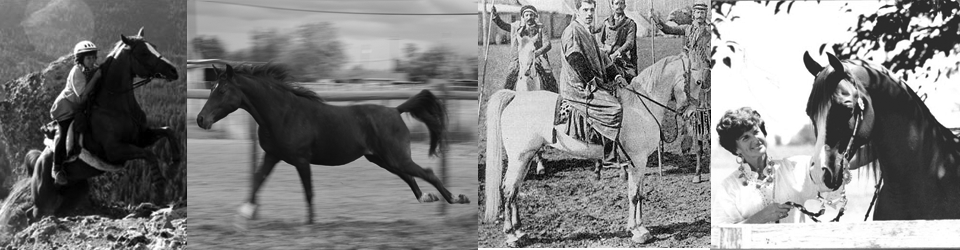
Nigma at 5 yrs. with her first colt in Egypt. Picture taken in front of Prince Mohammed Ali’s palace.

Amir Abdelkader Algazairy, a nineteenth century Morroccan nobleman, tells us that some Arabs of the Azed tribe went to Jerusalem to congratulate Solomon on his marriage to the Queen of Sheba. Having completed their mission, they asked him to give them food to take on their long journey. He gave them a stallion descended from the Ismail stock and said to them:

When you are hungry, place your best rider on this horse and arm him with a stout lance; by the time you have collected your wood and kindled a flame you will see him returning with the fruit of a successful chase.”

The Azed did this and never failed to obtain a gazelle or an ostrich. Therefore they called this horse “Zad Elrakeb,” meaning “provision for the rider.” Unfortunately Amir Abdelkader did not give any description of the stallion. Later when bred he produced some mighty sons and daughters.

The first Egyptian records of the horse are very ancient. A wall painting shows an Egyptian hunter, and it was drawn about 1400 B.C. The horse has a good many of the original, desirable characteristics of the Arabian such as the dished face, the large eye, the sensitive muzzle, the long swan neck, the well rounded rump, and the cocked tail, all of which are still highly esteemed in the Arabian horse. Whether this kind of horse existed in Egypt at that time, or whether the horse originated in the mind of the artist, nobody can tell, but the latter seems improbable.

Before the rise of Mohammedanism the famous Arabian poets, Imro-olkais, Amr Ibn Abi Rabeah, and Antara wrote their masterpieces of Arabic verse. In these they described many of the characteristics, colors, and habits of the Arabian horse. From their description one can tell that they were talking of the horse of the desert.

Shahloul by Ibn Rabdan, Royal Agriculture Society stallion, Egypt.

The Bedouins of Arabia had the Arabian horse, loved it, and in their life it played an extremely important role. The sayings of the prophet Mohammed reveal the significance of the Arabian to them. The following are good examples:

1. Bounty and happiness are ever on horseback; horses are gold that one may hold.

2. Every Moslem must have as many horses as he can afford.

3. The best of all is the bay, chestnut, or black with star and three stockings.

4. Abu Horairah recalled the prophet saying: “when a man races his mare with another horse unknown to him and the winner is a matter of chance, it is not gambling; but if he knows his mare will win, that is gambling.”

Gambling was forbidden. The prophet took gambling to be a form of cheating, such as betting on a sure thing.

5. The prophet said that nothing made a man happier than the following: (a) playing with his wife, (b) training his mare, (c) hunting with his bow and arrow.

6. When Arabian horses gather and run together, the chestnut will be the leader.

7. The best is the attentive, black, five-year-old; the next best is the five-year-old with three stockings and no white on the off forefoot. If it is not black, dark brown will do.

8. Every man who loves a horse is as good a man as he who is generous to the poor.

Nigma at 32 yrs. Much of the produce of this mare came to America.

The Arabian horse has been a source of pleasure to men not only during the time of the prophet but at all other times. Al Asmai, the great Arabian poet who lived about 750 A.D., tells how Haroun al Rasheed rode out to see a race. He says,

I was among those who came with the Califf Al Rasheed. The horses all belonged to Haroun Al Rasheed, his sons, and Soliman Ibn Gafar El Mansoor. A black mare named Zibd, which had been bred by Haroun Al Rasheed, won the race. The Califf was so delighted that he sent for me. He told me to write a poem about this mare Zibd, describing her from head to foot.”

The Bedouins certainly must have been masters in the science of breeding. In the development of their famous Arabian they used many modern breeding techniques. When they breed they never forgot the importance of color, endurance, thirst and hunger.

One trick they used was to measure their horses with a string, passing it just behind the animal’s ears and joining the two ends at the upper lip. The measurement thus gained served as a guide for the proper distance from hoof to withers. H. H. Mohammed Ali says “Find a well bred Arabian horse and it will surprise you to see what a true test this is.”

Color preference was, and still is, good material for argument among Arabian horse breeders, as it is with most other horsemen. Even the Arabs had a diversity of opinion with regard to color. In general they preferred the black first, then the dark bay with a star on the forehead, and then the dark chestnut. Dark colors were always favorites. The light chestnut and grey were last on the list.

Very light colors, such as palominos, were not popular. In fact, they used to call such a light colored animal “Ghagari,” which means “gypsy.” There was no reason for their disliking light colored horses; I believe it was just a matter of individual taste. Among the thousands of real Arabians that I have known and seen I have yet to find a single one that resembled the American Palomino. It is recorded, however, that such a color did exist among the Arabs, although it was very rare.

The Arabs were very superstitious about markings. White well up on the legs was considered unlucky. Two white socks on diagonal or lateral feet were also disliked. If the two fore or two hind feet were white, however, the horse was acceptable.

Modern scientific breeders question the belief that strains and families exist among the Arabian horses. An interesting story, however, is offered by Amir Abdelkader about the early foundation of the Arab.

At the beginning of the Christian era, about two thousand years ago, the Arem flood covered the Arabian lands, as is mentioned in the Koran, the holy book of Islam. All horses were turned loose for some little time and it became difficult to recapture them. After the flood subsided, five Bedouins were hunting in the desert. Here they saw five mares by a well. After several days they succeeded in capturing them. On their way back home they were unable to find anything to eat so they at last decided to kill one of the captured mares. Which one became a matter of heated discussion. It was finally decided to race them, the loser to be killed. This indicates that they had in mind the principle of selection. While the race was in progress, they killed a deer so that it was not necessary to kill one of the mares. These five mares were destined to become the ancestors of a new line of horses. They named one Saqlawieh, because she had glossy hair; another Om Arkoob, because she had a defective hock. Arkoob is the Arabian word for hock. Another they called Showaima, because she had many cow-licks; another Ibayyah, because the dress of her rider slipped down and she carried it all the way back on her tail; and lastly Kahilah, because she had dark eyes.

According to another story, which is believed by many authorities, the mares were originally named after their owners. When a man tied a mare in his stable, this was a sign that he owned it and the horse took his name. If the mare foaled, her offspring might be sold to another breeder, and then its name would be composed of two names, its dam’s name and the name of her dam’s owner, and so on.

The name, “Seglawi Jedran Ibn Sudan,” is found on some Arabian pedigrees. According to the above theory the female ancestors on the dam’s side were owned by three different men, Seglawi, Jedran, and Ibn Sudan. In a similar way, as time goes on, you may have separate families in this country. It has happened in every kind of livestock. Dickinson, Draper, Selby, Babson, Ben Hur, all may develop strains if they continue to breed Arabians, especially if they do not make many outcrosses. Then their names may have a meaning similar to Seglawi, Koheilan, Dahman, and so on.

The ability some claim to separate Arabians into certain types according to conformation, to relate those types to certain strains, and to know their family from their conformation is incredible to me. There is only one type that should be in the mind of Arabian horse breeders, “the typical Arabian,” even though individuals may vary.

An Introduction to the Author, Dr. Amin Zaher

This entry is part 1 of 3 in the series Amin Zaher

From “This Issue and Next” (Western Horseman Mar/Apr’48)

Dr. Amin Zaher, D.V.M., M.S., has recently come to the United States from Egypt to obtain a PhD. in genetics and animal breeding. His thesis title is “The Genetic History of the Arab in America.” Prior to his arrival in the states he occupied the position of Arabian horse breeder in the stud of the Royal Agricultural Society of Egypt for twelve years. The Egyptian ministry of agriculture has requested that he visit the various Arabian Stud farms while he is in America. Already he has visited many of the most prominent, such as Kellog, (sic) Dickinson, Babson, Van Vleet, Raswan, Tormohlen, Draper, Bazy Miller and many others. Just so that he would have plenty to occupy his time he has been judging Arabian horse shows and has kindly consented to write three articles for The Western Horseman. The first, which appears in this issue, is on the background. This will be followed by articles on the Arab in Egypt and America today.

My Visit with the American Arabs (Horses)

This entry is part 3 of 3 in the series Amin Zaher

by Dr. Amin Zaher Photos from the Zaher collection (Western Horseman Jul/Aug ’48)

The Van Vleet Arabs on their high altitude ranch, not far from Denver, Colorado.

While I was in Egypt, I read much about the American-bred Arabs. When I had the opportunity to come to this country to study, it was my honor to be asked by the Egyptian government to make a tour and to inspect these Arabians in America.

After making some preliminary inquiries, I learned that a great many of these Arabs were in California, so I planned to begin with the Western breeders. I wrote to them before leaving Lansing by train and reached San Francisco after about three days.

On a foggy day, I started out to see my first lot of American Arabs on the Jedel ranch of J. E. Draper. No, I was not dreaming; Arabs were before my eyes in the pasture. More than ten thousand miles from Egypt, and I was awakened by the smell of Arabs, after having missed them for months.

While in San Francisco I met another Arab breeder, a young man, “not rich enough to have Arabs,” as he said; yet right in the heart of San Francisco he had a few. He is not a rancher, but he likes Arabs. In the hotel we talked about them, and I was surprised at the excellent information he was able to give me about the Arabs of America. His wife was also very interested in them.

The next morning I saw his horses. I said, “Mr. Smith, which are your first purchases and which the last?” When he showed me it indicated what happens to almost all Arabian lovers in this country. Their first purchases are not the best type, and the last bought more closely resemble the ideal type. This is a good sign.

The day next took the train down the Pacific coast to Santa Barbara, to the home of “The Dean.” I call General J. M. Dickinson the dean of Arab breeders in this country because I knew even while I was still in Egypt, that he had spent most of his life taking care of Arabs. He has imported horses from almost every country to his large stud. The General is a man who has written about them in a fair and authoritative manner. I spent an enjoyable day at his ranch.

I then proceeded to Los Angeles to attend the meeting of the Arabian Breeders Association of California to which I had been invited. There I was suddenly asked to speak. Although it was the first time I had given a public address in a foreign language before a large group of people, I enjoyed a very pleasant evening. In Los Angeles I also saw the Kellogg Institute, and, under the guidance of Mrs. Phillips, the secretary of the society, I had the opportunity to inspect many fine Arabs and to talk to breeders about their horses.

Sartez and Dr. Zaher at the Raswan Ranch at Cedar Crest, New Mexico.


Cedar Crest, N.M., was my next stop, to see the enthusiastic Carl Raswan and his Maniquiat. He is happy on his 8000-foot mountain among his few, well-selected Arabs, and his many books. It was most pleasant to sit on Arabian carpets and “talk horse” until three o’clock in the morning!

Although I had been looking at horses for thirty days, when I returned to Lansing I was soon “horse sick” and started out to see more.

In Peru, Ill., a young lady, Mrs. Bazy Miller, has established her Arab stud. Mrs. Miller was busy with her horses when I saw her. That night we talked horses, and, although her husband pretended to know nothing about them, he joined the talk, and expressed ideas that many horsemen would do well to learn and follow.

My most thrilling visit was to Van Vleet in Colorado where Arabs are kept at a very high altitudes. Mr. Wayne was kind enough to tell me how the Arabs are trained here and how they react to the climate. I shall never forget the horror of going up the winding road through the mountains, where one can see the great city of Denver, so small, moving with every turn. This was my first acquaintance with high mountains.

Azkar. Ben Hur Farm, Portland, Indiana.


A drive to Portland, Ind., gave me the pleasure of meeting Mr. and Mrs. Tormohlen of the Ben Hur farm and seeing their horses. On their farm they live with their Arabs, feeding them, talking to them, and writing about their ancestors. I was impressed by their broad knowledge of the Arab.

My last trip before writing this was to see Arabs of my country, not in Egypt, but on the farm of Babson in Grand Detour, Illinois. They were the first Arabs I wanted to see when I came to America, but the last I got to visit. I saw them on a rainy, snowy day. What a difference between Egypt and America in almost everything — on weather, in pasture. But the horses have become quite adapted, as is the case with Arabs.

In September, 1947, I had the honor of being invited by the Arabian Breeders Association of California to judge their third annual show in Devonshire, Los Angeles. I drove to California with two of my Arab Lebanon friends who are very interested in Arabs. They were glad to see Arabs again after having missed them for so long. Through the generosity of Dr. and Mrs. Long of Tazana, I spent my happiest days in this country. The inspection of 250 pure-bred Arabs at the show, all in their best condition, was both thrilling and pleasant.

Shortly after my return to Lansing, I was invited to visit Mr. Kellogg in Battle Creek, Michigan. He was anxious to have me visit him, but so many people had told me that the old man could not stand long conferences that I expected to speak with him no more than five minutes. The greatest Arabian horse fancier in America, however, did almost all the talking about Arabs, and, to my surprise, for fifty-five minutes. The breakfast food king still maintains a great interest in the Arab horse.

In this my last article in this series, I want to try to answer some of the many questions I have been asked about American Arabs. Questions such as: What do you think of our Arabians, where do the best importations come from, and many other similar questions.

I know from experience that ideas about Arabs differ, and that looks, especially among horses, have a wide range. The importations to this country have also varied widely. There were several importations which were decidedly off-type. But what can the American breeder do when the importer says he is sending the best type of Arab? He has to take it for granted.

Importations were made from almost every country in the world that had Arabians — from Arabia, Egypt, Syria, Spain, France, Germany, England, South America, and other countries, average ones, and off-type animals. Every importer claimed his were best, no doubt.

The Arabian Horse Club of America had no classification requirement for registration, and it may have been logical not to make any requirements so that importations would not be discouraged.

In many instances I have been asked to judge horses, and for my opinion of horses that were off-type. They may have been pure Arabs, but certainly Arabs that good Arabian breeders do not like. The owner, (not being thoroughly acquainted with the type) believed that he had the best, and spread the blood that he had to others who knew no more than himself. On the other hand there are cases where some breeders have typical horses, but neglect them. Occasionally some breeder who knows Arabs will get ahold of them and use them as the principal stallion in their stud. Some of those so secured have been twenty years old, and never used for breeding purposes before.

I was not well acquainted with the pedigree of the Arab of this country when I judged the Los Angeles show and heard the announcer say that Ramah and Skolma, (whom I had judged to be the champions of the show) were related. This indicates that importations do have something to do with the type of animals we see.

I then examined the pedigrees of most of the registered Arab horses in this country, paying greater attention to those I liked best and comparing them with the pedigrees of the animals I saw on my trip. It interested me very much to find out that the majority were closely related to Raseyn or Skowronek; some were related to such outstanding sires as Mirage, and a few other studs, who, I found out afterwards, are great favorites with the American breeders. Almost all stallions or mares that had the blood of the famous Ali Pasha Sherif of Egypt were also outstanding animals.

Some California breeders are making a mistake, I believe, in trying to increase the height and weight of the Arab. All of us know that the Arab is not a big horse. If you see a horse that is sixteen hands high, you should hesitate to classify him as an Arab. There may be Arabs which are comparatively tall, but they still maintain the majority of the typical Arab characteristics. If you have a sixteen- hand Arab which has a big head, drooping hind quarters, and long legs, would you like him? This kind of animal is surely an off-type and should not be used for breeding.

What do you want a big Arab for? Some people say for a Stock Horse. I know stock men. They have found from experience that tall, big horses tire easily, and smaller horses get the job done better. A Stock Horse does not need to be over 15 hands.

The Arab is still a foreigner in this country. Because he is a warm-blooded horse, I have heard that cowboys do not like him. Either he has been misrepresented to them, or their experience has been with a few exceptional horses. They have not tried him enough to know what abilities he has. The Arab has worked with stock since the dawn of history.

Which is the best Arab horse in America? This is always a very hard question to answer. It is a well-known fact that no animal on earth is perfect. At the same time, there are some better than others. To my mind, the best stallion for you is the one that adds desirable points to your mares.

Your stallion may have only one defect, but if the mares may have it too, you are going to fix this defect in all your animals for ages. I have seen this in some studs in America.

The United States is a big country and breeders do not usually have the opportunity to choose stallions that fit their individual mares. They cannot afford either to keep many stallions in one stud, or to send their mares a long way for a stallion in another state. This problem can be solved in one of two ways: either through exchange of stallions, or through averaging the defects of the mares and securing a stallion that can correct most of them. The smart choice of Gharris for Draper’s mares and Azkar for Ben Hur mares are examples. It is a sound principle to pay great attention to the pedigree (italics) and the progeny (end) of the stallion to be used.

Mares on the Kellogg Army Remount Station of Pomona, California.

When I tell the breeders these things, they still are not satisfied. They still want to know my opinion of the stallions I have seen. They want names. To answer this I can say: Gharris at Jedel, Ferseyn at Reese, Ramah at Scheele, Roayas at Phillips, one or two imported Polish Arabs at Pomona (Kellogg’s), Zarif [*Zarife] at Van Vleet, Sartez at Raswan, Azkar at Ben Hur, Fa-Eldin [Fay-el-Dine] at Babson, and Indraff at Bazy Miller. These are good stallions. Although each lacks a little that another may have, they are all good specimens of Arabs. Again I repeat, although they are good stallions, watch your step. Choose the stallion that can correct your mare’s defects.

I can see now that American breeders are the people who can and will gain new knowledge about the Arab. Very little scientific work has been done with the Arab. The American breeders, by keeping photographs, and filing full descriptions of their animals, can provide the colleges with rich material that can form the basis of future work on the Arab.

The horse of the desert is now running loose on your rich pastures in almost all your states. He will give you greater service than you expect, but do not go too far in trying for big animals. If you do you will not have Arabs, or service.

THE END.

Excerpted from: Gleanings from the Desert of Arabia: Chapter IV – Visit to the Sabaah

Articles of History:

excerpted from: GLEANINGS FROM THE DESERT OF ARABIA Chapter IV – Visit to the Sabaah Major R.D.Upton, 1881 from The Khamsat Volume Eleven Number Three Aug. ’94


            Towards the close of a long and trying day, we made repeated offers for a bay mare, five years old and unblemished; she was a beautiful creature, just under fifteen hands in height, very bloodlike, but wildly excitable, glared at us like a tigress, and resented our approach even. Crowds gathered round as we frequently repeated our offer. The Shaykh indicated she was not to be taken away, and we thought we were on the eve of obtaining her, but suddenly, among the sound of many voices and loud talking, the mare was taken off by her owner.

            This was just at sundown. I turned over in my mind what was best to be done, for I seemed to be losing time, which, under pressing circumstances, was of great consequence to me, and when dinner was announced, I ordered my tent to be struck, and preparations to be made for our departure that night.

            The Arabs who were about the Shaykh’s tent were much astonished at this movement. While we were quietly eating our dinner, Suleyman ibn Mershid, accompanied by Jadaan ibn Mahaid,c came in to us in haste, and after saluting us, and having been requested to sit and partake of our repast, asked, What meant the preparations they saw around them, and hwy were our tents struck? what had they done.? what had happened? I explained to Suleyman ibn Mirshid that I had come from a very great distance to visit him and his people; that he had expressed his willingness to receive us; that he said we could obtain some mares and horses from his people; but as I found, when I offered to buy, I could not obtain; I could not afford to delay longer, and although I regretted the object of my visit had failed as far as business was concerned, I was still glad to have seen him and his people. Both Suleyman ibn Mirshid and Jadaan ibn Mahaid begged and implored me to remain; they called upon our Effendi to intercede. I replied that I did not complain of the people not parting with their horses or mares if they did not want to part with them, but being told I could buy, and then to find no one would sell,w sa rather like being mocked. I had no desire to beat down his people; I was prepared to give and had offered a fair price; if he thought it was not sufficient, he could let me know.

            Suleyman ibn Mirshid and Jadaan ibn Mahaid, taking my hands in theirs, implored me to stay in a manner so demonstrative, in spite of my endeavors to restrain them, that I felt quite ashamed; and they promised faithfully that the next morning the bay mare should be mine.

            The next morning, things in and around the Sheykh’s tent appeared to us more quiet than usual. The usual scenes at the well near our tent had been performed. Notwithstanding we were anxiously expecting the mare, we kept a calm exterior; but although we looked about us as we strolled in the neighborhood, we could not see the mare, nor indeed any other. At last there was a slight stir in the tent of Suleyman ibn Mirshid; he came up to us, leading the mare, accompanied by Jadaan ibn Mahaid, and followed by the owner of the mare, who appeared rather dejected and reluctant to part with his mare. It was Sulyman ibn Mirshid who put the halter rope in my hands; her price was told out on the table, exactly that which I had offered, and handed over to her former owner, and the mare was picketed at our tent. A very simple certificate of the mare’s breeding and family was written out at my request, in the presence of the two Shaykhs, to which they placed their seals, one as a guarantee, the other as a witness.

            After this we were enabled to get on better, and eventually obtained both horses and manes. There were several for which I made offers. Generally, after an offer was made and we had some talk with the Shaykh on the subject, the animal was tied to his tent, the owner or owners an and many others resorted to the Shaykh’s tent, and after a long consultation, sometimes in tones loudly raised, the Shaykh appeared with the owner and his horse, or the animal was led away. The Badaween who looked on seemed to regard the proceedings with much interest. Talkat, the owner of a fine bay horse I selected, walked behind his horse, which was led by the Shaykh to our tent, looking as if he wee going to be hanged, and just as Suleyman bin Mirshid was handing me the halter, Talkat rushed forward to seize it; but the Shaykh turned upon him, rebuked him, and even threatened him with the end of the halter rope. These consultations sometimes lasted several hours. Another man brought up his mare with a colt at her foot, with a kind of savage determination on his face, as if he had made up his mind to a very disagreeable thing, after a long and apparently rather stormy debate in the Shaykh’s tent, in the presence of a large assembly, she became mine, but he led away the little foal in sullen silence. I could not get the little colt; but the mare was in foal, and dropped in the following spring a bay filly, own sister to the colt.

            Sometimes, when we thought we had almost concluded a bargain, at the last moment the owner could not make up his mind to part with his horse or mare, and disappeared suddenly; at other times, Arabs had to consult with their joint owners, and did not return. There were several animals we might have secured, but until I had obtained what I had specially gone for, I would not buy others. To be successful you must have the money with you, and be ready to pay it down, either in Turkish gold or silver, at the right moment, or the opportunity will very likely be lost. English and French gold the Anazeh would not look at, I think for this reason: in buying grain and other commodities from them the merchants in the towns to which they send, or to intermediate dealers who may visit them, the value of Turkish gold is known, but the Arabs probably think they might not be able to do so well with the other gold, of the value of which there might be some difference of opinion, and they might lose in the exchange. It appeared to us that whenever the Shaykh had made the bargain for us, there was no going back.

            On one occasion we had a large gathering of Badaween Shaykhs in our tent, Anazah as well as some from other tribes, to discuss some points of importance to themselves. It was an interesting spectacle.

            Had not Suleyman ibn Mirshid, Mamoud Bey, Shaykh of the Mowali, who was also there, and others, told us that there was a project on foot among the Anazah to thwart some measures on the part of the Turkish authorities, several incidents which occurred during our stay with the Sabaah would have indicated that some movement was intended, and as we had finished our business, so far at least as circumstances had permitted, we announced our intention to depart. Suleyman ibn Mirshid and others, who but a short time before had been so anxious to prolong our stay, did not now offer any opposition, nor press us to delay our departure. Jadaan ibn Mahaid, Mamoud Bey, the Mowali Shaykh, and several others had departed previously; others had arrived. Several councils had been held in the Shaykh’s tent, at which the leading men had attended, and on these occasions they wore their swords with silver hilts. Messengers ride up, and, after a few words with the Shaykh, disappeared. Mounted men were despatched, and I have reason to believe that a body of some fifty horsemen were sent off on a flying expedition. Suleyman ibn Mirshid’s countenance was graver than usual, and it was evident to us that when he conducted us out of camp and had set us fairly on our way one night, our departure was a relief to him. Events had become ripe. That night the camp was broken up; a fight ensued, and the tribes dispersed.

Working Arabs in the Northwest

by Ralph H. Smith (Western Horseman Apr ’51)

We fellows up here in Montana and Wyoming have a yen for good horse flesh, the same as they do in Texas or California, especially after the jeep can’t cross a washout or take up through the timber on a mountainside. Most Northwestern ranchers run cattle, sheep or horses on summer range in the Forest Reserve high in them mountain ranges, adjacent to our valleys and flat lands. Cattle and horses especially are left to rustle for themselves in the lush high mountain meadows and seek shelter in the canyons or timber. Seldom are they seen during the grazing period. Sheep, of course, have a year round herder. When these stock are gathered in the fall, believe me, it’s a job for a horse with plenty of lung capacity. Working from daylight till dark in timber, over rock, fallen trees, up cut banks, down steep canyons and sometimes at high speed up mountain sides, this takes a top horse. Here is where we find some of the outstanding Arabs at work. They are noted for their hard feet, endurance, will to do and adjustability. Just any ordinary ranch horses have been worn out at noon, their feet broken up and sore. Arabian blood, call it “hot” if you want to, has what it takes when endurance is desired, they go places the jeep bogs down, and much smoother.

This natural group of events and terrain has brought a good many Arabians into use here in the Great Northwest, (the mountain states) Montana and Wyoming. Arabs have been brought in to use as well as to breed up our ranch horse. It has been found, on many large ranches, that our horses were going soft. The Arab has proven his worth by putting tougher half-Arabs on the range (thanks to the U.S. Remount stations who placed some of the top Arabian studs in these states years ago, back in the 30’s).

No. 1. Gamhuri AHC 1776, sire of many good range Stock Horses. Owned by Cross-U-Bar ranch, Big Horn, Wyoming.

Gamhuri AHC 1776 (see illustration No. 1) was one of these Remount Arabs that left many good half-Arab ranch horses in the wide-open spaces around Lavina and Roundup, Montana. The late L.G.Mason, of Lavina, was a rancher who knew good horse flesh and always had the best for his boys to work several hundred whiteface, winter and summer, in the river bottom, foothill and plains country. L.G. told me that when Gamhuri was first used to bring in cattle, he soon caught on to their tricks. One day he was running some steers to head them into a north pasture; L.G. and Gamhuri came to a wide wash, and much to L.G.’s surprise, Gamhuri went sailing across the cut, landing at top speed on the other side. He was smart enough and game enough to risk his front quarters and neck as well as L.G.’s to out smart and out distance the steers. I later acquired Gamhuri and experienced this same thrill, but it took me 10 minutes one day to get him to walk through six inches of water, 7 or 8 feet wide; he didn’t want to spoil the water for drinking (an inherent characteristic of Arabians). He’d jump it and never touch a drop, if allowed to. His offspring are on the range, in the city, and many can be found in the stock yards working cattle and doing someone a service. Gamhuri now stands at the Cross-U-Bar ranch, Big Horn, Wyoming.

No. 2, Borkaan AHC 1383. Owner Jack Hammans, Shoshoni, Wyo., up.

Borkaan AHC 1383 (see illustration No. 2) is another little dandy, belonging to Jack and Alice Hammans. Here’s a stylish Arabian that can look like a million bucks after a week’s work in the hills, carrying either Jack or Alice, through brush, up mountain sides, into timber, through the Yellowstone river or any place they say to route out a cow to get her into the bunch; he’ll bring in a bum calf on the saddle along with his rider, if necessary. Borkaan has sired hundreds of fine Stock Horses for the ranchers on the Yellowstone near Livingston and Pray, Montana. He’s 14 years old and is still doing the job for Jack on his big cattle spread in Wyoming, near Shoshoni. Incidently, Jack and Borkaan are always a threat in the little home town fair contests for horses. Anything Jack decides he’s going to do with Borkaan, it’s generally done well, such as a quarter or mile race, hazing, calf roping, bulldogging or steer busting, for Jack has used Borkaan for a general purpose ranch horse.

Olnatar AHC 2628, another Western bred purebred Arabian, is developing into a using horse at the Smith Arab ranch on the Yellowstone. He was foaled at Ft. Robinson, Nebraska, Remount, served the Cross-U-Bar at Big Horn, Wyo., for a few years, where he left and scattered many pure and half-bred Arabs for using stock around some of the large northern Wyoming ranches. He has good prospects of becoming one of the top Stock Horse studs in Montana. Bookings for 1951 season show his general acceptance among using horse and pleasure horse breeders alike.

Ahanab AHC 1099 of the O.T.O. ranch, Livingston, sired many good range horses, even though he was small. He seemed to put the right stuff in the right place if the mare had anything. His colts were nearly always larger than he was. The same is true of Ptolemy AHC 2012, who stood at Springdale, Mont., for Hershey Roberts for years. Both these little fellows sired Stock Horses, trail horses, and many pleasure horses for the Yellowstone country. Chan Libbey, former owner of the O.T.O. ranch, has retired Ahanab, and Hershey Roberts takes Ptolemy along just like a member of the family. The last we knew they were in Bozeman, Montana.

Barab AHC 2512, up at Bigfork, Mont., on the Walter Robbin Hereford ranch, earns his keep three ways every season. He works cows and calves for Walter the year round, and on Sunday, Neta, Walt’s wife, takes her pleasure ride around the pastures and hills with him. Here’s a horse that puts the best to shame when it comes to working mountains. His feet are black and like flint. He can carry 250 pounds all day in the mountains and come in like a colt. I know, for it was after one of these days’ work that I first met Walt and Barab. He has the respect of the ranchers in his area.

Rifzadin AHC 1953, in the Lambert, Mont., area, left a good many fine half-Arab Stock Horses. His fine colts were ideal for the small wheat and cattle ranchers because of their easy keeping ways, gentleness and willingness ot work at any and many jobs on small acreages. He was a Remount horse with good breeding that passed on to his foal.

No. 3. Kodama AHC 1070. Owned by Quirk Ranch, Billings, Montana.

Kodama AHC 1070 (see illustration No. 3), tall and lanky, stood on the Wilbur Quirk ranch near Billings, Mont., for two seasons and left some very desirable results in cow horses from some of the top grade mares in this area. All are busy helping the drylanders tend a bunch of cows and horses. He’s another Remount horse from Ft. Robinson, standing 15-3. His foals are very attractive and will be fast using horses.

Khaldi AHC 3137, at Missoula, Mont., owned by H.O.Bell, is being trained for stock and ranch work because H.O. has a large cattle spread up near Ronan. He is young and will be very useful in the area because most of the horses are not too good quality (mostly Indian ponies in bred, out bred, off bred and cross bred.).

Ras-El-Fedawi AHC 1129 stood in Montana for years to improve the Stock Horse in many parts of the state, before he sold to a Wisconsin farmer and later died. I watched this fellow work in the sale ring. He responded to the slightest signal, turned on a dime, had a sliding stop second to none and could swap ends faster than the cook could flip a flap-jack. We got a bet on as to what he would sell for. My friend, Ed Wakely, said he wouldn’t go over $750. I bet him he’d go close to $1000. Sure enough, Ed paid off, he sold for $960 at age 10. We watched stockmen pay $250 to $500 for his colts during the morning sale. His Montana reputation will never be forgotten. Arthur E. Boswell, Vermillion ranch, Billings, Mont., who owned him, will never forget him either.

Wartez AHC 1953 and Azloumah AHC 3562 have just recently been brought into the upper Missouri river basin to help build up our range horses. Wartez is at home on the Crouch ranch out of Great Falls, Mont., while Azloumah stands at Big Sandy on one of the largest cattle spreads between the Missouri and Milk rivers. Both these studs are using horses on big spreads where even the men are not spared. The prairies are extended as far as the eye can see and the days are long, so the job for a horse requires endurance and stability.

No. 4. Dakar AHC 2132. Owned by Mackay and Mackay.

Dakar AHC 2132 (see illustration No. 4) came to our country last year from Reno, Nev., off the Hadley Beedle outfit. He sure got put to work on the Mackay and Mackay ranch near Ismay, Montana. Bill and Eva Bradshaw run this spread for the Mackays, and it consists of about 27,000 acres in the breaks and hills off the Yellowstone out of Miles City. They have 10 or 15 individual pastures for well bred Hereford cows, and it requires lots of riding. Here’s what Eva says about Dakar:

Although we have not had Dakar very long, we feel that we could not have found a better Arab for improving ranch stock. He is a wonderfully rugged Arabian, very well quartered and muscled, travels straight and can get out and get over the country. He is taking considerable interest in the stock work, and I can take him out and cover 20 to 30 miles in a day at an easy gait. You see, the ranch takes in about 27,000 acres and runs about 1,000 head of cattle, so we have to have horses that can get out and cover plenty of ground in a day and work on the way. Dakar can hit a walk close to five miles an hour, or he can hit a wonderful elongated trot which really eats up the ground. He has a nice canter in which he bounces along so easily that one hardly feels him touch the ground. He knows what to do with a cow or calf on a rope or otherwise, too.

No. 5. Bad Boy, half-Arab by Babyat AHC 460. Owned by Cross-U-Bar ranch, Big Horn, Wyo., S. Watts Smyth up.

Down Wyoming way at Big Horn, S. Watts Smyth uses a half-Arab for his ranch work in the shadow and on top of the rugged Big Horn range. It’s a sight to see this guy Watts come down down out of the mountains with a band of horses; sometimes there are about as many buck deer as mares, all coming at top speed with Bad Boy and Watts close on their heels (see illustration No. 5). Here’s what he says about Arab blood.

This horse is by Babyat AHC 460 (Ybabi’s sire) and out of an imported Irish Hunter mare. He stands 16-1 and weighs about 1250, and certainly fills the bill from a using standpoint. I formerly had two half bred Arab geldings as my personal mounts (now retired on account of age), but since breaking this horse have found that he takes the place of both my older horses. Bad Boy has been trained exclusively in the handling of other horses, wrangling broodmare and foals, moving horses to and from mountain pastures, along highways, as well as cutting them in corrals. He does not get ‘hot’ when running large numbers of loose horses in large pastures and has the speed and endurance to turn them in the roughest kind of country. A horse that will do this and still remain calm is to my mind harder to find than a typical cow horse. As you know, we don’t run many cows, but when he is called upon to handle them it seems child’s play to him after his usual horse work.

No. 6. Faram AHC 1043. Owner Jerry Angell, Cheyenne, Wyo., up.

Faram AHC 1043 (see illustration No. 6) is an oldtimer in the Cheyenne country and has plenty of land marks still running the long plains range in the form of top Stock Horses. He works for his keep on the Angell ranch out of Cheyenne where cows and Arabs make the life worth living for Gerald and Vera Angell. Incidentally, Vea Ward Angell used to entertain the rodeo crowds years ago with her stunt riding, so she picks the horses, uses them, and Gerald brings up the rear on a top Arab, too. Read what they say about Arab Stock Horses:

Faram is short coupled, well muscled, with excellent body conformation, having long, sloping shoulders, deep through the heart, powerful quarters and well formed withers. He is larger than some, standing 15-1, but size and height do not detract from his beauty, brilliant action and regal carriage. He has won several high honors and many grand champion trophies. He works stock with speed and knowhow. Endurance and level-headedness are two of his many attributes.

We understand young Joder at the Joder ranch near Cheyenne is training Rafflind AHC 4319 for stock work so he can help Doc with the roundup and branding.

Someone says: “How do the Arabs stand the severe northwest winters?” The answer: They do just as well as other breeds and on less feed. We only figure to feed half the normal amount of hay and grain or allow half the winter pasture per head of Arab as we customarily used to figure per head on other horses and some cattle. Dr. Crouch says:

We purchased Wartez in San Antonio, Tex., a southern horse, shipped him to Great Falls in the winter, unloaded in zero weather, and he never batted an eye. He took it in his stride with no trouble in adjustment, grew a coat of Montana winter hair and went about life without even so much as a sniffle.

None of the Arab people have much in the way of box stalls, barns or the shelter afforded the high pedigreed horses of the show ring. We look at it this way: “If they can’t take it, we want to know it now.” This is no country for a sissy!

Old Santa Fe AHC 882 was reared in the south and came north at the age of 21 and has foaled two fillies, one in February 1949 and another in April 1950, nine below zero for the first one and a late blizzard for the second. She’s coming 24 this spring and is in foal to Ybabi 2580, to drop her foal early in May this year. We’ll probably have a cold, wet rain with wind then, but she can take it. We don’t pamper them, and think they are rugged individuals, adaptable to any job, any climate, any person and any feed or pasture situation. In fact, they are the purebred horse from the deserts of Arabia and are the foundation of most of our good horses here in America. They really are the all around “doing” horses.

There are a great many more purebred Arabs, with good reputations that are outstanding, to help build good using horses in this great Northwest. It is regrettable that their history isn’t better known by the writer, because a good many deserve mention here. My apologies to those fine Arabians that have done so much to improve Stock Horse blood, which we have been unable to mention for lack of detailed information and pictures.

Maidan

From The Khamsat Vol 9, Num 4, Nov/Dec ’92
excerpted from The Arab Horse
Spencer Borden, New York, 1906

Maidan at 23
from The Arab Horse


Maidan is the last of the great horses that came to England from Arabia through India, whose name can have our especial attention. Many who knew him, including Lady Anne Blunt and the Hon. Miss Dillon, place him even above Kismet, and the opinion is concurred in by others who knew him only by his offspring. Maidan was foaled in 1869 in Nejd, a chestnut (as was Kismet), said by some to have been a Manakhi Hedruj, though this was doubted by others because of his great beauty, the Manakhi being a family of rather plain appearance, though great race horses He was brought to Bombay by Abdur Rhaman in 1871, and sold to Captain Johnstone, who immediately commenced racing him, though the colt was but two years old. Captain Fisher and Major Brough were also interested in Maidan; and as these English officers had tested him they were free in taking the long odds which were laid against him by the Australian sports who came to the races and were ready to lay against an untried colt. It is said that after Maidan won the Punjab Cup, the Australians had hardly money enough left to pay their passage home. For three years, from 1871 to 1874, Maidan continued his winning career, until no further matches could be made for him. Then, at 5 years of age, he was sold to Lieut. Col. Brownlow of the 72d Highlanders, as a charger. Brownlow was a heavyweight of nineteen stone (266 lbs.) with his equipment, yet Maidan carried him for twelve years in campaigns through the mountainous regions of India and Afghanistan, until the soldier was killed in the fight at Kandahar, at the end of the famous forced march of Lord Roberts’s Army from Cabul, three hundred miles distant. After carrying Brownlow for ten years Maidan won the Ganges Hog Hunt Cup, and also a four mile steeplechase across difficult country. At seventeen years of age, on the death of Brownlow, Maidan was bought by Lord Airlie who again put him to racing where he won a number of races both on the flat and steeplechases. He was then sold to Captain the Hon. Eustace Versey, who bought him to take to England. Leaving India on the troopship Jumna Maidan got as far as Suez, where the ship met the expedition going to the relief of Suakim, where Osman Digna was harassing the garrison, and was pressed into service as a transport for troops to Massowah, near the lower end of the Red Sea.

            So it happened that the old race horse and charger had his journey lengthened, to the degree that he stood on his feet one hundred days without once lying down, before he reached Marseilles. Yet Capt. Vesey raced him successfully at Pau, and afterward in England. He won a steeplechase when twenty-two years of age. When he had to be destroyed, because of a broken leg, at twenty-three, he was absolutely sound. In 1890 he was described in the London Live Stock Journal, as “fresh and well, with immense bone below the knee (he measured eight inches) and as clean in the legs as a four year old, notwithstanding the fact that he was hunted in Suffolk last year.”

[ED NOTE: Maidan is an Al Khamsa Foundation horse. He is the sire of the imported mare *Nazli (x *Naomi) who was imported by Randolph Huntington in 1893. That same year Mr. Huntington also imported *Nimr, a son of *Nazli sired by the Al Khamsa Foundation horse, *Kismet. Mr. Huntington proceeded to line breed to *Nazli and her blood forms a strong basis for the Drissula family in Al Khamsa breeding (See Khamsat Anthology, page 28). The foundation horse information on Maidan in Al Khamsa Arabians (1983) is as follows:

MAIDAN cb

1869 chestnut stallion, imported in 1871 to India by the agheyl, Abd Ar-Rahman. Imported in 1885 to England by the Hon. Eustace Vezey. Sire: db, Dam: a Mu’niqiyah-Hadrujiyah. Strain: Mu’niqi- Hadruj. Maidan is the sire of *Nazli.

According to the registration application for *Nazli at the Arabian Horse Registry, Maidan was said to be a “Managhi-Hedruj.” This agrees with Randolph Huntington, who imported *Nazli, and Carl Raswan. No strain is given for Maidan in the General Stud Book, which does give the following transfers of ownership: purchased “of Abd er Rahman, of Bombay, by Colonel Brownlow in 1871 … He was then sold to Major Brough, who sold him to Captain Fisher. He won the Kadir Cup (the blue ribbon of Pigsticking in India), and was then purchased by Lord Airlie. He was three years in Afghanistan, and was imported into England by the Hon. Eustace Vezey.” HUNTINGTON ancestral element.]

Arabia, and some of the Bedouins from The Arab Horse Chapter II

Articles of History: Voices from the Past

See Also:                                   Maidan                                  CHAPTER VI – SOME LAST WORDS   From: The Arab Horse Chapter II Arabia, And Some of the Bedouins by Spencer BordenNew York, 1906 from the Khamsat VolumeFoun Number Three August 1987           At the northeastern courner of the Mediterranean Sea, just below the point where the southern coast of Asia minor joins the western coast of Syria, lies the town of Scanderoon, the ancient city of Alexandretta. This is the seaport for Aleppo, ancient Haleb, about one hundred miles to the east and a little south, for centuries a trading centre whence go caravans of merchandise to the towns far down the Euphrates, and where are brought the grains and wool that come in return. Almost due east of Scanderoon, about five hundred miles distant, is Mosul, on the River Tigris, which from this point flows south and a little easterly about four hundred miles till it joins the Euphrates near Bussorah, the two rivers thus joined flowing into the Persian Gulf. About two hundred miles below Mosul is Bagdad, also on theit gris River. The Euphrates and Tigris nearly unite at this point, but again separate to join farther down, as already noted. Still farther east, nearly parallel with the tigris is the western frontier of Persia.

The line from Scanderoon to Mosul may be taken as the northern boundary of Arabia. The western frontier of Persia, then the Persian Gulf and the Gulf of Oman, mark its eastern boundary. On the south lies the Indian Ocean. On the west are the red Sea, Palestine, and Syria. From this rapid sketch one can get an idea of the great areas of the country. Coming in at the northwestern corner from the mountains of Asia Minor, the Euphrates River crosses the upper end of Arabia at a slant from northwest to southeast, and the valley of the euphrates ha for thousands of years been a most important route of Communication between the Orient and western nations. Indeed, until the discovery of the way around the Cap of Good Hope, and later the construction of the Suez Canal, it was the only route and its cities were the great centres of commerce for the world.

When we speak of Arabia we are apt to forget what the country once stood for. Between the Tigris and Euphrates is the land of Mesopotamia. Here was believed to have been the Garden of Eden – whatever that may mean – the place whence the human race spread abroad to populate the earth. Mosul, already mentioned, is the site of Nineveh, capital of the great Assyrian Empire. Fifty miles south of Bagdad are the ruins of Babylon, where the children of Israel were in captivity, and within ten miles of Babylon are still to be seen the remains of the Tower of Babel. El Uz, below Bagdad, on the Euphrates, was the home of Job; and from Chaldea, east of the Euphrates, came Abraham, father of the Hebrew race.

Through this land Alexander the Great marched to the conquest of India, after having overthrown the Babylonian Empire. In a straight line west of Deyr on the Euphrates, and half way between that point and Damascus, is Tadmur, the ancient Palmyra, capital city of Zenobia, that Queen who was conquered by Aurelian, and carried away to Rome to grace his triumphal entry.

Later in the Christian Era Mohammed established his religion at Mecca and Medina, far down in the Arabian peninsula. The Mohammedan chaliphs afterward made Bagdad their capital, and held a court there that was glittering in riches, the home of art, science, poetry; the scene of the Arabian Nights Entertainments until Timour the Tartar with his hordes of barbarians poured down from the North and drowned the country in blood. In ancient days this country was the home of science. Some of the earliest astronomers were Arabs of Chaldea, and our present system of numerals, which makes modern mathematical calculations possible, the decimal system, was an Arabian invention of Palestine, upper Africa, and Europe, which was an Arabian overrunning.

What is most germane to our present investigation, however, is the fact that this country is the place where the horse has attained his highest perfection; where he has been bred pure by a careful system of selection and adhered to for hundreds of years, a system, not departed from in the slightest degree. It has come to be acknowledged by the most intelligent breeders that thorough breeding in horses is chiefly a calculation of the amount of Arab blood they posses, just as gold stands as a measure of value in the currency of a country the value of a coin consisting of the amount of gold it contains.

The oldest and most exclusive registry in the world – the one at the foundation of all more recent works of the kind is “Weatherby’s General Stud Book of Thoroughbred Horses,” the only recognized organ of the English Jockey Club. The makers of that Stud Book recognized in the beginning, and today make the specific statement in writing that “Native Arabs, with the Barbs, are the source from whence the race horse springs.”

The history of the Arab horse is not merely the romantic tale of imaginative writers, though poets have sung his praises, artists have painted his graceful form on canvas, and sculptors have made use of him as their model. Job describes him in words that could apply to no other horse and the horses from the frieze of the Parthenon at Athens, the Elgin marbles now in the British Museum, could have been modelled from none but Arabians.

It is fortunate, however, that before it was too late, careful travellers, scholars and horsemen, such as Major Roger Upton and the Blunts, have visited the land of the Arab horse and written in books what they learned from original sources of this interesting subject.

Upton and the Blunts both made two journeys to Arabia in the years between 1870 and 1880. In both of Upton’s journeys he had the company and assistance of H.M.Consul General at Aleppo, Mr. Skene. His wanderings were extended both in distance and in time. Hon. Henry Chaplin, former Minister of Agriculture in Great Britain, breeder and owner of the famous Derby winner Hermit, tells us that Upton went a thousand miles into the desert south of Tadmur to get the horses procured for him, and he was gone two years. Both Chaplin and the Weatherbys are sponsors for the truth of every statement made by Upton.

After Upton went Mr. Wilfred Scawen Blunt and his wife, Lady Anne Blunt, a granddaughter of Lord Byron. Their first journey was in the winter of 1877-78, three years after Upton, and they covered much of the same ground as he, meeting many of the same people, thought they went also further east than Upton. Leaving Aleppo in January, 1878, they reached the valley of the Euphrates as soon as possible, then followed the river as far as Bagdad. From Aleppo to Deyr they had the company of Mr. Skene, who went with Upton. Then he turned back to Aleppo as his consular prerogatives went no further in that direction, the Blunts proceeding to Bagdad alone. From that point, after crossing the Tigris River they went north and east to Shergat, nearly up to Mosul, traversing a quite new country for Western voyagers. At Shergat they turned west to again come to Deyr, where Mr. Skene had agreed to meet them on a fixed day. This he was unable to do. He was old, infirm, and, while waiting, his successor came from England, so he was detained. The Blunts were most anxious to go among the Anazah Bedouins, with whom Upton spent the greater part of his time, and to meet such of his friends as they might, being especially anxious to see Jedaan, their War Sheik – known as the “Rob Roy of the Desert”. After great difficulties they got away from Deyr, and in due time reached Tadmur, about half way in the direct line between Deyr and Damascus. Near this point Mr. Skene overtook them, went with them among the Anazah, helped them to buy horses and continued with them to Damascus. From that point the Blunts returned to England via Beirut, Mr. Skene went back to Aleppo. The next winter found the Blunts again at Damascus, from which point they made a journey across the southern desert to Nejd, a part of the world not reached by Upton; in fact a place that no more than half a dozen Europeans are known to have ever seen.

The results of Upton’s visit were written in two books, “Newmarket and Arabia,” a sketchy statement of early impressions, and a more serious work, “Gleanings from the Desert of Arabia,” published after his death; now, unfortunately, out of print, and copies extremely difficult to obtain.

Lady Anne Blunt, also wrote two books of absorbing interest, “The Bedouin Tribes of the Euphrates,” a journal of her first journey, and the “Pilgrimage to Nejd,” the story of the second. No one can read these books without being impressed with the veracity and intelligence of the writers. Weatherbey & Sons, publishers of the “General Stud Book,” say that they consider Mr. Wilfrid S. Blunt and Lady Anne Blunt the foremost living authorities on Arab horses. On these sources of information the present writing in large measure depends, wherever they touch the matter in hand.

Some of the individuals met by Upton and the Blunts were most interesting personages. Their introduction to the reader will help him to appreciate the sources of information, and the surroundings whence came many very great mares and stallions.

The Anazah Bedouins have always been the greatest horse breeders. Each tribe of the Anazah has its individual leader or Sheik, and at the time of Upton’s visit all the tribes of Anazah were united under one very remarkable man named Suleiman ibn Mirshid, who was called the Sheik of Sheiks. He was not only a great warrior, but also a wise administrator of te the internal affairs of the tribes.

Some years before the time of Upton’s visit the Shammar tribes had been united also under a great leader named Abd-ul-Kerim. The Shammar were Bedouins who came originally from Nejd, one thousand or fifteen hundred miles lower down in the Arabian peninsula. Something more than two hundred years ago, under the guidance of a Sheik named Faris, they had come north with their flocks and camels, invading the pasture lands always occupied by the Anazeh. These latter did not hesitate to wage war on the Shammar, and drove them across the Euphrates into Mesopotamia, to a point near Mosul. Abd-ul-Kerim was the descendant of that Faris in the sixth generation, and inherited the feud that always existed between the Shammar and the Anazah, periodical raids across the river being the consequence, in both directions; the land between the Tigris and Euphrates being considered the home of the Shammar, that between the Euphrates and Damascus, and reaching from the neighborhood of Aleppo far south toward Jebel Shammar, being the pasture lands conceded to the Anazah. The vital importance of protecting these pastures and the necessity for extensive ranges will be understood as we read from Lady Anne Blunt’s first book, that she saw together in one place a hundred and fifty thousand camels, besides thousands of sheep and many horses, all the property of a single tribe of Anazeh, the Roala, whose tents covered an area of 12 square miles. These great encampments had to be moved every few days because the pasturage was eaten down to the bare ground in very short order by the thousands of animals feeding thereon.

Yet Abd-ul-Kerim, though bound by hereditary obligation to fight the Anazah whenever and wherever they met, regarded the amenities of life, and his honour became a proverb throughout the length and breadth of the desert. It happened that at one period in his life, in his boyhood, he lived among the Anazah in the tents of Jedaan’s father. So, though when they had grown to manhood these two were bound to be always at war, Abd-ul-Kerin never forgot his affection for his boyhood friend. It happened then that Abd-ul-Kerim, in the course of the civil war, caught Jedaan’s forces in such a position that they were at his mercy. The trap was to be sprung on the morrow and Abd-ul-Kerim meant to push his advantage to the utmost. Yet he wanted to spare Jedaan individually. Therefore, the night preceding the day of the climax, he sent one of his men to Jedaan’s camp with his own white mare, bearing a message to Jedaan that the morrow meant certain defeat for Anazah, and begging him to accept Abd-ul-Kerim’s mare, and to ride her in the battle, as she was swifter than any animal belonging to the Shammar forces and could take him safely away. This Jedaan did and saved himself. Upton saw Abd-ul-Kerim’s mare in his possession when he visited the Anazah in 1875, and describes her.

Shortly afterward Abd-ul-Kerim, who had been successful in defeating the Turks who sought to subdue the Shammar, was betrayed into their hands by his secretary, an Armenian. They hung him from a bridge at Mosul.

His brother Farhan, a reprobate, submitted to the Turks, accepted from them the title of Pasha, and at the time of the visit of the Blunts to Mesopotamia was in receipt from them of a salary of Lb3,000 per annun.

The more noble of the Shammar, however, joined themselves to a younger brother named Faris, who declared unending war on the Turks and all who held to Turks. He was visited by the Blunts, adopted Mr. Blunt as his brother, by solemn rites, and is described by Lady Anne Blunt as a most brave, courteous and intelligent gentleman of distinguished appearance and manners.

It is this policy of “divide and conquer” that has marked the entire intercourse of the Turks and the Bedouins. So long as Suleiman ibn Mirshid lived he kept the Anazah tribes solidly combined. Shortly after Upton’s visit, however, and a little time before that of the Blunts, he allowed himself to accept an invitation from the Turkish Governor at Deyr, to visit the town and make a treaty of commerce between his tribes and the Turks, for exchange of products. At a banquet which was served to mark the close of the agreement, poison was put in the cup of coffee which was handed Suleiman, and he fell back dead as soon as he had drunk it. Confusion followed among his tribesmen.

Then the seeds of discord were sown among the individual tribes of the Anazah. Their herds of camels, their sheep, their horses were so numerous that it required a wise hand to guide them safely, assigning pasturage to each tribe according to its requirements. The Sebaa and Gomussa tribes had always made use of the district between Homs and Hamah, above Damascus, on the western side of the desert. The next year when they came to their usual district they found their brethren, the Roala, there before them. These had been told by the wily Turk that their fellow tribesmen of the Sebaa and Gomussa were not treating them justly. They were advised to take their great flock and herds, whose numbers have been mentioned, to the good pastures before the others could reach them, and were assured that the Turks would help them hold what they seized. In an evil hour they accepted the advice; Suleiman ibn Mirshid having been murdered was not at hand to arrange the difficulty, so when the Blunts were among the Anazah they found a factional war being waged. Sotaam ibn Shallin was leader of the Roala against the combined Sebaa and Gomussa. Suleiman had been succeeded by his two cousins, Beteyan ibn Mirshid and his brother, neither of whom had a tithe of his administrative ability, and as neither was able to wage the war against the Roala, they had made Jedaan their Akil, or War Sheik, to manage that end of the tribal business.

From what has been said it is easy to understand the wretched condition of affairs among the Bedouins for the ten years between 1874 and 1884. Let us remember, also, that during that period the Russo-Turkish war was carried on, so that relief from the usual aggression of the Turks, left the Bedouins free to fight among themselves. It was during the raids and counter-raids of this time that many priceless animals changed hands, to be run hot haste by their captors into the towns bordering the desert for sale to save them from recapture. It is certain that in the decade mentioned more high-caste Arab horses came out of the desert than ever before or since.

_______________

ABOUT THE AUTHOR – SPENCER BORDEN: An early American breeder of Arabians, Spencer Borden was at one time the owner of the famed Blunt mare *Rose of Sharon and the noted Ali Pasha Sherif mare *Gazala. Some well known Al Khamsa horses bred by Spencer Borden include the stallion Segario and the mares Ophir, Guemera and Gulnare.

The Arabian Horse in Motion… An Anthology of Glimpses

221 Baker Street: “The Arabian Horse In Motion… An Anthology Of Glimpses”   Compiled by Robert J. Cadranell from ARABIAN VISIONS Jan ’91 used by permission of RJ Cadranell  

        Below are some descriptions of the Arab horse in motion written by people who knew the breed well and who also happened to publish books about it. These statements were made prior to 1945. The advantage to the early dates, is that all of the writers were familiar with foundation stock of Arabian breeding in the English speaking world and can tell us about those horses. The disadvantage is that some of the statements are likely to be out of date and might not apply to our modern Arabians. Additionally, the writers were more or less limited to those Arabians of which they have personal knowledge, what they say might not reflect the breed as a whole. Nonetheless, a reader gets the impression of graceful, agile horses, which one hopes Arabians will always be.

        ”The Arabian in his purity is a horse… with elastic and graceful movement.” (1) [page 446]

        ”No other breed has such harmony of motion, giving the rider a delightful sense of riding over the ground on wings and springs.” (11) [page 27]

        ”The natural Kehilan gallops easily and trots with the freest shoulder and hock action. Knee action, however, is not a characteristic of the breed nor should it be sought for.” (8) (W.S.Blunt quoted, page 225)

        ”In action, the Arabian gives the impression of daintiness in the handling of his feet, — a certain dwelling of the feet just before being placed on the ground, with a light and airy tread,” (7) (page 59).

        ”At the walk, the powerful hindquarters come prominently into play, sending this small horse along at a great pace, far beyond expectation, the hind foot often overstepping the fore foot from two to three feet, and giving him a speed of close to five miles an hour. It is considered a point of breeding among the Arabs that a horse should look about him to right and left as he walks… ” (7) (page 78).           ”…Queen of Shea made a sudden rush, tail curved over back and neck arched, snorting proudly.” (9) (page 203)

        ”The shoulder… should have… the freest possible action, and there is no better test of quality than to turn a colt loose in a paddock and take note of how he moves his shoulders and forearms. There should be little high knee-action, but the whole limb should be thrown forward and the hoof ‘dwell’ a second in the air before it is put down. This, with corresponding action behind, like that of a deer trotting through fern, is most important in a sire and a great test of quality.” (5) (W.S.Blunt quoted, page 221).

        ”…her action was beautiful in the extreme; she had a long sweeping stride, and great reach; her movements were most springy and elastic, and full of force, power, and energy.” (4) (page 346)

        ”His action should be from the shoulder and not from the knee, and he should bend his hocks like a deer.” (5) (WSBlunt quoted, page 226).

        ”Generally the men rode up four or five at a time in line, and it was a pleasant sight to watch their mares coming towards us, with their long striding walk and the slightly swinging motion of their hindquarters and tails, their graceful necks bent as they turned their heads to look from side to side, their riders sitting easily on them, swinging in their hand the end of the halter rope, until, as not infrequently happened, one mare would make a snatch at her neighbour’s neck or shoulder, causing the other to spring to one side from the aggressor, when the men would rate them with a peculiar sound, which ‘Yach–k!’ might express to some extent, but indifferently; and we were constantly reminded of the Arab description, that mares resemble well-formed and beautiful women, distinguished by their swinging walk, and looking from side to side at objects as they pass.” (4) (page 260)

        ”Myself [mounted] on Siwa who goes up and down hill with catlike agility.” (9) (page 282)

        ”The Barb is held to have more knee action than the pure Arabian, who has shoulder action. The Arabian gait is pendulous, forward and ahead, and he dwells without much bending or lifting of the knee.” (7) (page 121).           ”Trotting is discouraged by the Bedouin colt-breakers, who, riding on an almost impossible pad, and without stirrups, find that pace inconvenient; but with a little patience the deficiency can be remedied, and good shoulder action given. No purebred Arabian, however, is a high stepper.” (5) (page 422).

        ”Trotting action should be smart and free and darting from the shoulders, the forefeet dwelling a moment before touching the ground with a semi-floating dancing movement, which suggests treading on air and springs and recalls a deer trotting in fern. The hock action powerful, and the hocks well lifted and brought forwards with a swinging stride… The knee action is rather higher perhaps than that of the Thoroughbred, but it is the shoulder action which matters.” (2) (page 227).

        ”…Mutlak[rode] the strange mare that we might be able to see her properly. One glance was enough, her going was heavy, as Mutlak said adding ‘but galloping is of the Arab horses,’ as saying she was not of them.” (9) (page 216)

        ”The Arab… is an easy horse to sit on. His gaits are so smooth and elastic one does not grow fatigued. This, no doubt, is accounted for by the fact that he does not lift his feet high or pound the ground. He is a good walking horse and has a nice trot, at which he merely lifts his feet high enough to clear the ground, and his canter, or gallop, is low, but smooth and graceful.

        ”…His trot is smooth and easy to sit, as are all his gaits, but he is not a fast trotting horse, nor a high stepper” (6)

        ”As to the action of the Arabian, it is very well described by the writer of an able article who signed himself ‘Picador.’ ‘Sit easily and flexibly on him, put your hands down, and set him going, and then you will experience a sensation delightful to the man who really can ride; he will bound along with you with a stride and movement that gives you the idea of riding over India-rubber.” (10) (page 151).


Abbreviations refer to the following works:

1) Arab Horse, by Homer Davenport. (Article appeared in the Cyclopedia of American Agriculture).

2) The Authentic Arabian Horse, by Lady Wentworth.

3) The Bedouin Tribes of the Euphrates, by the Blunts.

4) Gleanings from the Desert of Arabia, by R.D.Upton.

5) Greely, Arabian Exodus, 2nd ed.

6) The Arabian Horse, by Albert Harris. (Reprinted in volume V of The Arabian Stud Book).

7) The Horse of the Desert, by W.R.Brown, 2nd ed.

8) The Crabbet Arabian Stud, Its History and Influence, by Archer, Pearson, and Covey

9) Lady Anne Blunt, Journals and Correspondence, edited by Archer and Fleming.

10) Newmarket & Arabia, by R.D.Upton.

11) Arabian Type and Standard, by Lady Wentworth.

The Case of the Missing Rustem

Copyright 1997 by R.J. CADRANELL
from Arabian Visions Sept/Oct 1997
Used by permission of RJ Cadranell

221b Baker Street: “We met next day and inspected the rooms at 221b Baker Street and at once entered into possession.” — Sir Arthur Conan Doyle, A Study in Scarlet

Fifteen or more years ago I acquired a reprint of the 1917 catalog of England’s Crabbet Arabian Stud. The catalog for the 1917 season gives details of the Crabbet Stud as it was at the end of 1916. It lists all of the broodmares, stallions, and young stock — 81 horses in all.

Back in 1906, the Crabbet Stud’s founders, Wilfrid and Lady Anne Blunt, had separated. They divided the stud, after which Wilfrid Blunt managed his “Newbuildings Half” apart from Lady Anne’s “Crabbet Half.”

The 1917 catalog seemed to list both halves of the stud. But I noticed a glaring omission: where was Rustem? Lady Anne Lytton remembered Rustem as “a very favorite stallion”[1] of her grandfather Wilfrid Blunt, and Rustem had been one of the Crabbet Arabian Stud’s chief sires from the time he was three.

Then I noticed another gap: where was Abla? Rosemary Archer had written in The Crabbet Arabian Stud, Its History and Influence: “Abla became Wilfrid Blunt’s favorite riding mare.” The catalog included Abla’s 1915 filly Arusa, but Abla herself was absent.

A pattern was emerging: both missing animals were favorites of Wilfrid Blunt’s. But all the rest of the Newbuildings horses–among them Ibn Yashmak and *Nureddin II–seemed to be included.

Years later I had a chance to study additional Crabbet Stud catalogs from the Partition years. The available catalogs–for 1907, 1908, 1909, 1911, 1912, 1914, 1915, and 1916–list just the horses in Lady Anne’s Crabbet Half. There is also a 1913 catalog, with a slightly modified format, listing just the Newbuildings Half. Comparing these to the 1917 catalog indicates that the two halves were united during 1916, with Wilfrid Blunt retaining his two favorites, Rustem and Abla.

But a reunited Crabbet Stud ran counter to what I had always understood of its history. Hadn’t Wilfrid and Lady Anne failed to reach an agreement on the future of the stud when they met in 1915? Didn’t Blunt manage his portion separately right until Lady Anne died at the end of 1917? Didn’t the existence of two halves at the time of Lady Anne’s death fuel the lawsuit fought between Blunt and his daughter Judith (Lady Wentworth) over the ownership of the horses? I decided to scan Rosemary Archer’s book again, looking for clues, and found the following passage:

On October 13th [1915], Lady Anne signed the “new stud agreement which makes me sole owner” of the Crabbet Arabian Stud. Blunt, however, refused to sign it, alleging that it contained a “dangerous” clause… He nevertheless appears to have acquiesced in the new arrangement; five months later, in March, 1916, he and Caffin [agent for both the Crabbet and Newbuildings estates] were planning the removal to Crookhorn [a farm Blunt owned near Newbuildings] of what remained of the Newbuildings section of the Stud, on the following Saturday “which is Lady Day when my separate ownership of it comes to a final end” (p. 150).

Later in 1916 when Lady Anne prepared the Crabbet Stud catalog for the 1917 season, she added 23 Newbuildings horses (see sidebar) to what she had owned the year before. This bolsters Lady Wentworth’s claim in her Authentic Arabian Horse that “in 1915 the whole remaining stock was repurchased by, or made over to, Crabbet Park.”

These horses afford a look at a decade of selection by Wilfrid Blunt, apart from Lady Anne. Even though each party had the right to use the other’s stallions without fee, these horses show a high concentration of the Newbuildings sires: Rijm and *Astraled from the years immediately after the Partition; Ibn Yashmak and Rustem later on. The stallions Lady Anne used during the Partition — in particular Daoud and *Berk — are scarcely represented at all.

Many bloodlines were duplicated, of course: Newbuildings had *Nureddin II and Nessima, while the Crabbet Half had their full brother *Nasik. Crabbet had Feysul, and Newbuildings had his son Ibn Yashmak. Crabbet had Rustem’s full sisters Rim and Riyala. Newbuildings had Selima, while Crabbet had her full brother Sotamm.

Other bloodlines were unique to one half or the other. Lady Anne had lost the Queen of Sheba family in tail-female, for example. Newbuildings also had the stud’s only remaining descendants of the imported mares Ferida and Meshura. And Lady Anne had bloodlines Wilfrid lacked, for example the lines from Basilisk, Bint Helwa, and Rosemary.

Anyone could be proud of the record of several of the Newbuildings-bred horses Wilfrid Blunt turned over to Lady Anne in 1916. *Nureddin II became an influential sire under Lady Wentworth’s ownership of the stud. *Ferda left a daughter in England, then was sold to California’s Kellogg Ranch in 1926, where she was arguably that program’s single most important foundation mare. *Nafia and *Felestin were imported to the U.S. in 1918, where they left descent. Fejr, Nessima, and Selima became broodmares for Lady Wentworth. Fejr’s sons became important in England, but she also had a daughter sent to Poland, where she produced *Sulejman. Selima had foals exported to Russia (Star of the Hills), Poland (Sardhana), and the U.S. (*Selmian) — all became influential.

The Newbuildings Half

Horses from Wilfrid Blunt appearing in the 1917 Crabbet catalog
stallions & colts
Ibn Yashmak 1902 Feysul/Yashmak
*Nureddin II 1911 Mesaoud/Kasida
Kamar 1913 Rustem/Kartara
Najib 1914 Rustem/Narghileh
Fauzan 1914 Rustem/Feluka
Fantass 1915 Rustem/Feluka
Karun 1915 Rustem/Kantara
mares & fillies
Feluka 1899 Mesaoud/Ferida
Kantara 1901 Mesaoud/Kasida
Ajramieh 1901 Mesaoud/Asfura
Selima 1908 *Astraled/Selma
Nessima 1909 Rijm/Narghileh
*Ramla 1909 *Astraled/Ridaa
Fejr 1911 Rijm/Feluka
*Kerbela 1911 Ibn Yashmak/Kantara
Marhaba 1911 Daoud/Feluka
*Ferda 1913 Rustem/Feluka
Ajjam 1915 Ibn Yashmak/Ajramieh
Arusa 1915 Rustem/Abla
foals of 1916
Fursan colt Rustem/Feluka
*Nafia colt Ibn Yashmak/Nessima
Mabruk colt Ibn Yashmak/Marhaba
*Felestin filly Ibn Yashmak/Fejr
  1. [1]Lady Anne Lytton quoted in Mary Jane Parkingon’s The Kellogg Arabian Ranch, the First Fifty Years, p. 67.

Lady Wentworth in the London Times

221b Baker Street: Lady Wentworth in the London Times

Copyright 1993 by R.J.CADRANELL from Arabian Visions Mar/Apr 1993 Used by permission of RJ Cadranell

Founded in 1878 by Wilfrid and Lady Anne Blunt, from 1920 to 1957 the Crabbet Arabian Stud was under the firm hand of their daughter Judith Blunt-Lytton, also known as Lady Wentworth. Lady Wentworth added the stallion Skowronek to the stud, picked and chose from among the “Blunt mares,” bought back horses her parents had sold, sold some they had kept, and set about breeding Arabian horses to suit her own ideals and tastes. The Depression and Second World War put a crimp on her breeding activities, but after 1945 she expanded her program and Crabbet was going full blast when Lady Wentworth died in August of 1957. She left behind a herd of about 75 head.

Lady Wentworth continued her parents’ practice of selling horses all over the world. All of today’s major breed subdivisions benefited from Crabbet breeding. In 1936 Lady Wentworth sold a large draft to Russia’s Tersk Stud, including the key animals Naseem, Rissalma, and Rixalina. Her sale to Egypt in 1920 included the stallions Kasmeyn, Sotamm, and Hamran as well as the mares Bint Riyala and Bint Rissala. Five Skowronek daughters were among the horses she sold to Spain’s Duke of Veragua, and of these Reyna founded a particularly strong dam line. To Poland she sold the stallion Rasim and the mare Sardhana; in more recent decades horses from Tersk have brought additional Crabbet lines to the Polish state studs. To America she sent such key breeding animals as *Serafix, *Raffles, *Raseyn, *Rissletta, *Nasik, and *Ferda.

Lady Wentworth’s obituary in the London Times ran on August 10, 1957. The headline read “Lady Wentworth, Breeder of Arab Horses” and a surprising amount of the text was devoted to the Crabbet Arabians:

Baroness Wentworth died in hospital at Crawley, Sussex, on Thursday night at the age of 84.

As a leading breeder of Arab horses and as a writer of books on breeding, Lady Wentworth carried on the tradition of the Crabbet stud which had been built up by her father and mother. In her independence of mind, her eccentricities, her artistic pursuits, and her stormy domestic relations she reflected her ancestry — both her father, Wilfrid Scawen Blunt, the traveler and poet, and her maternal great-grandfather, Lord Byron.

Judith Anne Dorothea Blunt-Lytton, Baroness Wentworth, as sixteenth holder of the peerage, was the only daughter of Wilfrid Scawen Blunt and Lady Anne King-Noel, who as a child of the Earl of Lovelace was a granddaughter of Lord Byron, the poet. In youth she was a society beauty and her appearance made a strong impression on Burne-Jones, for some of whose last studies she sat. “She gives me the impression,” he said, “of perfect beauty combined with the speed and lightness of foot of some wild creature.” The second part of this tribute was not merely fanciful, for Lady Wentworth was a fine athlete. She became a champion royal tennis player, a game that is not generally regarded as suitable for women, and she built her own court at Crabbet. She was also a good squash player and went on playing the game until late in life.

In 1899 she married Neville Stephen Lytton, son of the second [actually first] Earl of Lytton. The marriage took place in Cairo. The bride was given away by Lord Cromer, the Resident, who to the Queen’s inquiry about the ceremony sent the laconic reply, “Marriage duly performed.” She later became estranged first from her father with whom she had differences of opinion about the management of the Crabbet estates, and afterwards from her husband, from whom she was divorced in 1923. Her mother succeeded to the Barony of Wentworth a few months before her death in 1917, when it devolved by special remainder on Judith Blunt-Lytton. The new Lady Wentworth lived for the rest of her life at Crabbet Park in the grounds of which her father was buried.[1]

She inherited from her parents the love of the desert and of the horse of the desert, the Arabian, and the “feeling for the desert” never left her. After her mother’s death she took over the Crabbet stud which the unfortunate quarrels of her parents had allowed to reach a very low level, and gradually built it up to the dominating position which undoubtedly it holds to-day. There is hardly a stud in this country or abroad which does not owe its existence to one or other of the Crabbet stock. As a breeder she probably had few equals; she combined a voluminous knowledge of pedigree with a keen eye for a horse and with the means to breed on a big scale, and she had a certain flair or instinct which transcends scientific calculations. She was also a competent horse trainer and brought the business of preparing horses for the show ring to a fine art. The foundation of the modern Crabbet stud was undoubtedly the almost legendary Skowronek, a pure bred Arab foaled in Poland, whose sire was hanged in the market place[2] by the revolutionaries of 1917; he was saved from a like fate by being bought for Mr. Walter Winans just before the First World War, after which Lady Wentworth acquired him. From this foundation has flowed the long line of champion Arab sires and mares which have dominated the show ring for many years in almost every country of the world.

A character as strong as Lady Wentworth’s could hardly keep out of controversy; indeed, like the Biblical warhorse which she loved so much, she probably “smelled the battle from afar” and she was a doughty opponent. Just after the war she became involved in a violent controversy within the Arab Horse Society over the height and size of Arab horses in England. After much acrimony she won her point that there should be no limiting the size of the Arab horses in English shows.

At Crabbet she used also to breed dogs and her toy spaniels won innumerable championships. In later years she gave an increasing share of her time to her painting and her poetry. Among her books are two major works: Thoroughbred Racing Stock and its Ancestors (1938), and The Authentic Arabian Horse and His Descendants (1945).

She is survived by her son, the fourth Earl of Lytton, to whom the [Wentworth] title descends, and by her two daughters.

A Requiem Mass was celebrated on August 14 at the Franciscan Friary in Crawley. The burial took place afterwards. According to the London Times of August 15, among those present were:

The Earl and Countess of Lytton (son and daughter-in-law), Lady Anne Lytton and Lady Winifrid Tryon (daughters), Viscount Knebworth, the Hon. Roland Lytton and Lady Caroline Lytton (grandchildren).

The Hon. Mrs. R.E.L. Vaughan-Williams, Colonel Sir Henry Abel Smith, Mr. Gordon Blunt, Mr. Ronald Armstrong-Jones, Q.C., Mr. K.W. Cumming (president) and Colonel D.R. Hewitt (representing Arab Horse Society), Mr. Geoffrey Cross (representing Royal Windsor Horse Show Club), Miss C. Draper (librarian St. Anne’s College, Oxford), Mrs. H.V. Musgrave Clark, Mr. Nigel Napier, Mr. R.W.F. Staveacre, Mrs M. Odell, Mr. R.S. Summerhays (representing National Pony Society), Dr. R.A. Matthews, Mr. and Mrs Cecil Covey, Mr. Gladstone Moore.

Lady May Abel Smith and Sir John and Lady Blunt were among those unable to attend.

  1. [1]Wilfrid Blunt was buried in the woods behind his house Newbuildings Place, about sixteen miles away from Crabbet.
  2. [2]In a February, 1958 Arabian Horse News article, Count Joseph Potocki presented a different account of Skowronek’s sire Ibrahim: “Some communist soldiers led him out of his box stall during the Revolution as other horses were being taken. Whereupon, that generally quiet and kindly horse began to react violently and would not be taken away. The troopers, in their irritation, killed him on the spot with their swords. The incident is described in a well known book ‘Pozoga’ by Zofia Kossak Szcyucka, who was there at the time.”